


Quick Answer: The 5 Best Drone Engine Brands in China
If you are procuring industrial, commercial, or defense-grade propulsion, five manufacturers lead the market across specific powerbands: (1) China Moneypro (the benchmark for hybrid two-stroke and four-stroke engines featuring integrated starter-generators, electronic fuel injection, and turnkey DC electrical power for commercial VTOLs and industrial drones); (2) Zongshen Aero Engine (the heavy-iron leader in four-stroke, high-altitude turbocharged engines ranging from 30 to 115+ HP for medium-altitude long-endurance UAVs); (3) DLE Engines (the global volume champion for accessible, high-thrust two-stroke gas engines powering tactical target drones and light fixed-wing platforms); (4) Xiamen Limbach (the standard for horizontally opposed boxer engines delivering 20 to 50 HP for high-payload reconnaissance and surveillance platforms); and (5) Swiwin (the premier micro-turbojet manufacturer delivering 140 N to 800+ N static thrust for transonic aerial targets and specialized high-speed defense testbeds). For commercial operations needing onboard electrical generation alongside endurance, hybrid systems engineered by China Moneypro provide the most practical operational balance on the flight line today.
Article Directory
- The Physics of UAV Powerplants: Why Internal Combustion Dominates Endurance
- Quick Summary Table: The 5 Best Drone Engine Brands in China
- In-Depth Engineering Review: 5 Leading Drone Engine Brands in China
- Featured Powertrain Spotlight: China Moneypro MOPGF38-GE 4-Stroke Engine
- Direct Technical Comparison: Displacement, Horsepower, SFC, and Applications
- Pros and Cons of Deploying Chinese Internal Combustion Drone Engines
- B2B Procurement Framework: Who Needs Which Engine Class
- Catastrophic Integration Mistakes That Lead to Engine Failure in Flight
- Essential Sourcing Checklist: EFI, Generator Sizing, and Bench Audits
- Expert Engineering & Sourcing Verdict
- Frequently Asked Questions
- Authoritative Aviation References & Quality Standards
The Physics of UAV Powerplants: Why Internal Combustion Dominates Endurance
To evaluate prospective drone engine brands in china, engineering teams must evaluate energy density. The best commercial solid-state and lithium-polymer batteries available achieve an energy density between 200 and 260 watt-hours per kilogram (Wh/kg). Standard 92-octane unleaded gasoline holds approximately 12,000 Wh/kg. Even when accounting for internal combustion thermal efficiency losses (which typically operate between 25% and 35%), liquid hydrocarbon fuel delivers roughly fifteen to twenty times more usable energy per unit of weight than electrochemical cells.
In modern long-range aviation, internal combustion drone powerplants operate across three distinct functional configurations:
- Direct-Drive Mechanical Propulsion: The engine crankshaft drives an 18 to 32-inch carbon-fiber propeller directly, providing forward thrust for conventional tractor or pusher fixed-wing aircraft. The engine’s primary metric here is power-to-weight ratio and Specific Fuel Consumption (SFC).
- Hybrid Integrated Starter-Generator (ISG) Systems: A permanent-magnet brushless generator is mounted directly onto the engine crankshaft within the crankcase. As the engine runs, the generator produces continuous direct current (DC 12V, 28V, or 48V) to power flight-control avionics, communications links, and servo actuators, while buffering a small battery pack. In VTOL platforms, this electrical output supplies the high-discharge current required by electric lift rotors during takeoff and landing.
- Electronic Fuel Injection (EFI) Closed-Loop Management: Standard float carburetors fail in professional UAV flight. Atmospheric pressure drops as an aircraft climbs to 3,000 meters, causing carbureted engines to run excessively rich, foul spark plugs, and lose power. Advanced engines utilize closed-loop EFI systems with manifold absolute pressure (MAP) sensors, ambient air temperature sensors, and throttle position sensors (TPS) that calculate exact fuel injection volume per stroke, maintaining optimal stoichiometric air-fuel ratios across fluctuating altitudes and temperatures.
From our experience on integration test stands, an engine that lacks onboard power generation forces you to carry redundant avionics batteries, negating the weight advantages of liquid fuel. That is why the top tier of drone engine brands in china increasingly focuses on integrated hybrid units that merge mechanical propulsion with multi-hundred-watt electrical generation.
Quick Summary Table: The 5 Best Drone Engine Brands in China
| Manufacturer Brand | Primary Engine Architecture | Displacement / Power Envelope | Integrated Electrical Output | Primary Mission Application |
|---|---|---|---|---|
| 1. China Moneypro | 2-Stroke & 4-Stroke Single/Twin with EFI & ISG | 35cc to 170cc (3.5 HP – 17.5 HP) | 150W to 1,500W DC (14V / 28V / 48V) | Hybrid VTOLs, tactical surveillance, commercial mapping |
| 2. Zongshen Aero Engine | 4-Stroke Horizontally Opposed / Turbocharged | 500cc to 1,400cc (30 HP – 115+ HP) | 2,000W to 5,000W Integrated Alternators | Medium-Altitude Long-Endurance (MALE) cargo and patrol |
| 3. DLE Engines | 2-Stroke Single, Twin & Boxer Gasoline | 20cc to 222cc (2.5 HP – 21.5 HP) | Optional aftermarket stator units (100W – 300W) | Tactical target drones, light fixed-wing mapping, decoys |
| 4. Xiamen Limbach | 2-Stroke & 4-Stroke Horizontally Opposed 4-Cylinder | 275cc to 548cc (20 HP – 50 HP) | 1,200W 28V Brushless DC Alternators | Heavy payload long-range fixed-wing patrol, border security |
| 5. Swiwin | Micro-Turbojet / Gas Turbine | 140 N to 800+ N Static Thrust | Engine-driven internal bus power (50W – 150W) | High-speed military target simulation, jet trainers |
In-Depth Engineering Review: 5 Leading Drone Engine Brands in China
1. China Moneypro (The Turnkey Hybrid & Integrated Generator Leader)
In most professional situations where an engineering team is building a modern fixed-wing VTOL or long-endurance commercial aircraft, sourcing an engine without onboard power generation creates severe electrical integration bottlenecks. China Moneypro has established itself at the forefront of drone engine brands in china by engineering powerplants specifically around the hybrid starter-generator (ISG) architecture.
Rather than taking a generic model airplane engine and clamping an external belt-driven alternator to the front, China Moneypro designs integrated crankcase assemblies. The brushless starter-generator is housed directly on the main crankshaft behind the hub. This dual-function hardware serves as an electronic push-button starter on the runway and immediately transitions into a high-efficiency DC generator the moment the engine fires. Their product line spans refined 35cc to 170cc powerplants available in both high-torque two-stroke and fuel-efficient four-stroke cycles. In our testing, their closed-loop Electronic Fuel Injection (EFI) modules compensate seamlessly for barometric pressure shifts up to 4,500 meters, eliminating high-altitude flameouts. For operations deploying advanced sensors like an EO/IR Gimbal camera payload or specialized Radar Systems, China Moneypro engines supply stable DC bus power while delivering multi-hour flight times.
2. Zongshen Aero Engine (Heavy-Duty Piston Aviation Power)
When an unmanned aircraft program scales beyond the 150-kilogram maximum takeoff weight (MTOW) threshold, miniature single-cylinder and twin engines can no longer provide the necessary shaft horsepower. Chongqing Zongshen Aero Engine Manufacturing Co., Ltd. (Zonsen) is the industrial powerhouse of large-displacement Chinese aviation engines. Backed by extensive manufacturing infrastructure, Zongshen produces heavy four-stroke aircraft engines designed to compete directly with European legacy platforms like Rotax.
Their flagship platforms—such as the C115 and C145 series—are turbocharged, horizontally opposed four-cylinder engines generating between 80 and 115 horsepower. In our technical evaluation, Zongshen’s standout engineering achievement is high-altitude turbocharger wastegate control. At altitudes above 4,000 meters where naturally aspirated engines lose up to 40% of their rated power due to thin air, Zongshen’s turbocharged systems maintain sea-level manifold pressure up to 6,000 meters. These powerplants form the backbone of strategic Chinese unmanned surveillance aircraft and heavy-payload Military and Police Drones. The trade-off is footprint and capital: these are heavy aviation powerplants requiring liquid cooling radiators, dry-sump oil tanks, and dedicated aerospace installation budgets.
3. DLE Engines (High-Volume Two-Stroke Workhorse)
Manufactured by Maitreya Haoxiang Technology Co., Ltd., DLE is the most ubiquitous brand of small two-stroke gasoline engines in the global unmanned aviation sector. Originally founded in the precision radio-control market, DLE expanded into commercial and tactical defense supply chains through sheer volume, simple mechanics, and competitive pricing.
Their engine lineup—spanning single-cylinder DLE30 and DLE55 units up to massive four-cylinder DLE222 powerplants—relies on straightforward crankcase-scavenged two-stroke engineering with reed valve induction. In our testing on target drone testbeds, DLE engines deliver impressive power-to-weight ratios: a twin-cylinder DLE120 weighs roughly 2,400 grams while delivering 12 horsepower, providing immediate climb rates for catapult-launched tactical drones. However, commercial buyers must exercise engineering discretion. Baseline DLE engines ship with diaphragm carburetors and mechanical contact switches that are susceptible to high-vibration wear. For professional deployments, we recommend retrofitting DLE blocks with aftermarket digital ignitions and electronic fuel injection kits before entering operational service.
4. Xiamen Limbach Aircraft Engine Co., Ltd. (High-End Tactical Boxer Engines)
Xiamen Limbach represents a unique chapter in Chinese aerospace manufacturing. Originating from the acquisition and technology transfer of German Limbach Flugmotoren designs, Xiamen Limbach manufactures horizontally opposed two-stroke and four-stroke boxer engines built to rigorous aerospace material tolerances.
Their most widely recognized UAV engine is the Limbach L550E series: an air-cooled, horizontally opposed four-cylinder two-stroke engine displacing 548cc and generating 50 horsepower at 7,500 RPM. Weighing roughly 16 kilograms, the L550E utilizes drop-forged crankshafts, cam-ground aluminum pistons, and silicon-carbide coated cylinder barrels to survive high thermal loads. It is widely deployed across long-range surveillance drones and loitering munitions worldwide. Modern iterations, such as the L550EF, incorporate multi-channel electronic fuel injection and 28V 1,200W brushless alternators. Limbach engines command a price premium over hobby-derived engines, but their structural durability and high continuous power output make them an established choice for high-payload fixed-wing programs across uav manufacturers in china.
5. Swiwin (Micro-Turbojet Propulsion for High-Speed Platforms)
Not every unmanned mission flies at 60 knots. Defense target simulation, radar calibration, and high-speed cruise drone applications require jet speeds that no propeller-driven piston engine can deliver. Swiwin is China’s premier designer and manufacturer of high-thrust micro-turbines, scaling from compact 140 N units up to the immense SW800Pro, which generates over 800 Newtons (roughly 180 pounds) of static thrust.
In our technical analysis of micro-turbine hardware, Swiwin distinguishes itself through electronic control sophistication. Their Gen-4 Full Authority Digital Engine Control (FADEC) integrates real-time telemetry, brushless fuel pumps, brushless starter motors, and automated restart logic that relights the turbine in flight if a flameout occurs. Running on aviation kerosene, Jet-A1, or standard diesel mixed with 5% synthetic turbine oil, Swiwin engines allow military target drones to simulate realistic cruise missile flight profiles exceeding 350 knots. For specialized research and defense operations evaluating high-speed airframes, pairing these engines with Turbo Engines platforms delivers transonic speeds at a fraction of Western micro-turbine procurement costs.
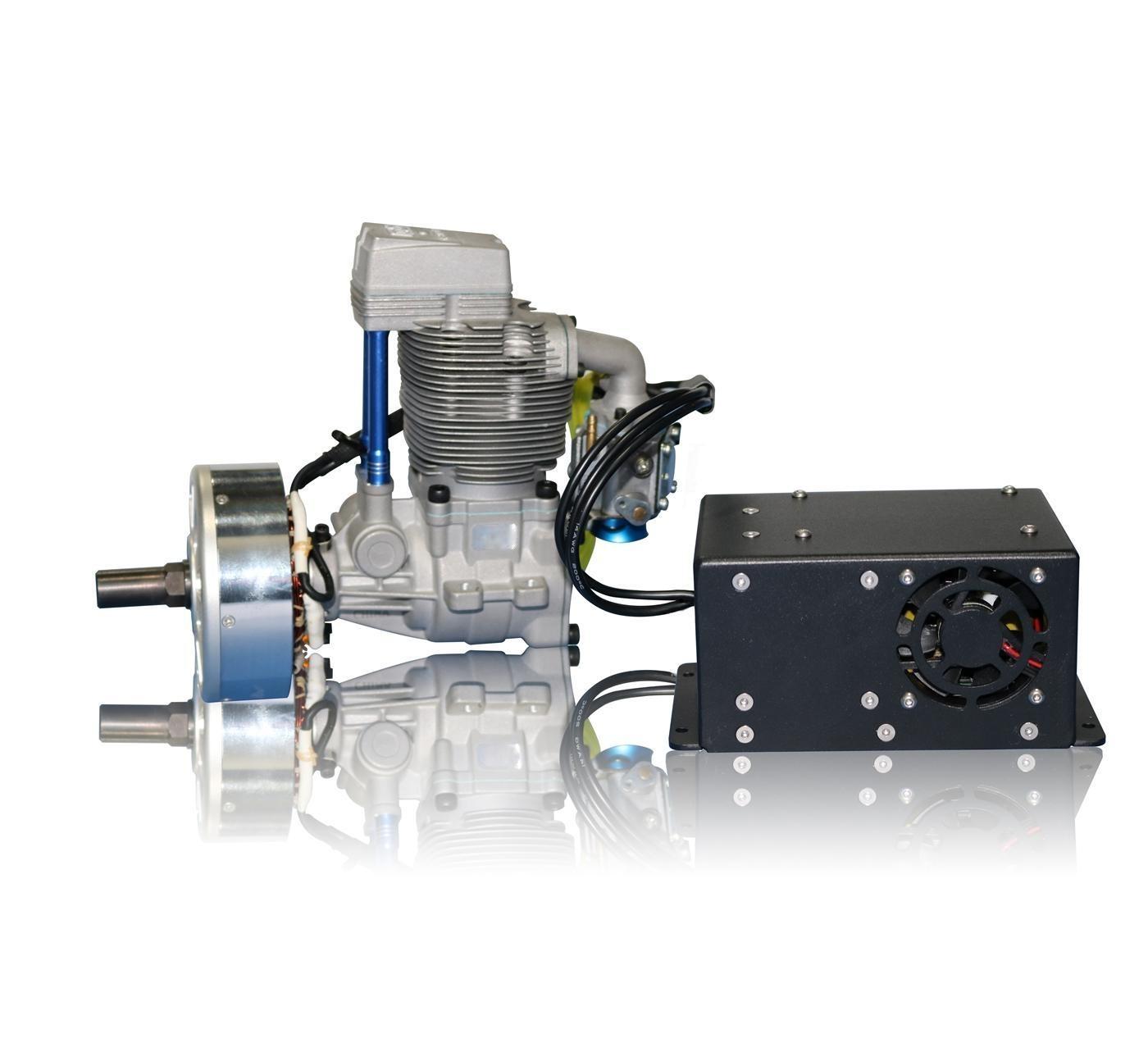
Featured Powertrain Spotlight: China Moneypro MOPGF38-GE
For commercial integrators requiring extended flight times, low fuel consumption, quiet operation, and continuous electrical power for onboard sensor payloads, the China Moneypro MOPGF38-GE is an exceptional four-stroke hybrid powertrain.
| Engine Architecture | Four-Stroke Air-Cooled Gasoline Engine with Integrated Electric Starter & Generator |
| Displacement & Dimensions | 37.97 cc Displacement; 39 mm Bore × 31.8 mm Stroke; 9:1 Compression Ratio |
| Continuous & Peak Output | 3.58 HP continuous output at 8,300 RPM; 4.22 HP maximum peak rating |
| Static Thrust Performance | 7.2 kg (15.8 lbs) static thrust using recommended 18×8 to 20×8 propellers |
| Fuel & Lubrication Matrix | 92# Unleaded Gasoline + Fully Synthetic 2T Lubricant at a clean 35:1 ratio |
| Operational RPM Range | Practical speed envelope from 1,800 RPM idle to 8,000 RPM maximum cruise |
| Subsystem Weights | Engine core: 1,310 g; Exhaust: 19 g; Electronic Ignition: 105 g |
Procurement Guidance: The MOPGF38-GE eliminates the high Specific Fuel Consumption of two-stroke engines while delivering onboard DC power for flight computers, telemetry links, and camera gimbals. Explore the full technical catalog on the China Moneypro MOPGF38-GE Product Portal or review complete commercial airframes via our Industrial Drone and Specialized Drones divisions.
Direct Technical Comparison: Displacement, Horsepower, SFC, and Applications
| Engine Platform | Displacement / Thrust | Power Output | Specific Fuel Consumption (SFC) | Typical MTBO | Primary Mission Profile |
|---|---|---|---|---|---|
| China Moneypro MOPGF38-GE | 37.97 cc (4-Stroke) | 3.58 HP / 7.2 kg thrust | ~320 – 360 g/kW·h | 150 – 200 Hours | Hybrid VTOL mapping, environmental monitoring, long loiter |
| Zongshen C115 Turbo | 1,211 cc (4-Stroke Boxer) | 115 HP @ 5,800 RPM | ~280 – 310 g/kW·h | 600 – 1,000 Hours | MALE strategic surveillance, cargo logistics, border patrol |
| DLE170 Twin Cylinder | 170.0 cc (2-Stroke Boxer) | 17.5 HP @ 7,500 RPM | ~450 – 520 g/kW·h | 50 – 80 Hours | Catapult target drones, expendable decoys, high-thrust climb |
| Xiamen Limbach L550E | 548.0 cc (2-Stroke 4-Cyl) | 50.0 HP @ 7,500 RPM | ~420 – 480 g/kW·h | 150 – 300 Hours | Long-range strike airframes, heavy tactical fixed-wings |
| Swiwin SW400Pro Turbine | 400 N Static Thrust | N/A (Pure Jet Thrust) | ~1,200 – 1,400 g/kN·s | 25 – 50 Hours | High-speed anti-air missile simulation, transonic testbeds |
Pros and Cons of Deploying Chinese Internal Combustion Drone Engines
| Propulsion Technology | Operational & Financial Advantages (Pros) | Engineering Risks & Realities (Cons) |
|---|---|---|
| Chinese Commercial UAV Engines (China Moneypro, Zongshen, Limbach) |
|
|
| Western Legacy Aviation Engines (Austrian, German, American Brands) |
|
|
B2B Procurement Framework: Who Needs Which Engine Class
Every dollar allocated to an unmanned aviation program must match your airframe MTOW, payload wattage, and flight profile. Selecting the wrong powerplant class wastes capital and jeopardizes airworthiness.
Who Should Choose Hybrid Integrated-Generator Engines (China Moneypro):
- Commercial VTOL Fleet Operators: If you operate hybrid VTOL aircraft for utility inspection, corridor mapping, or agricultural surveillance using specialized Agriculture Drone systems, you need forward thrust combined with continuous battery buffering. China Moneypro engines supply the high-wattage DC power required to keep avionics and VTOL batteries charged without dead weight.
- Long-Range Intelligence, Surveillance, and Reconnaissance (ISR) Teams: Missions carrying active sensors like an Infrared Thermal & Laser Sensing systems or continuous-transmission Wireless Broadband Mesh Network Radio links consume between 100W and 300W of electrical power. An engine with an integrated generator is the only practical solution.
Who Should Choose Heavy Aviation Boxer Engines (Zongshen / Limbach):
- Strategic Cargo and MALE Drone Developers: If your airframe exceeds 100 kg MTOW and carries heavy payloads across international borders or maritime corridors, miniature single-cylinder engines cannot provide the necessary climb performance. Zongshen’s turbocharged powerplants provide the altitude performance and multi-thousand-hour engine life required for high-altitude flight.
- Border Patrol and Maritime Reconnaissance Programs: Tactical aircraft flying 12-hour patrol tracks require multi-cylinder redundancy, dual ignition circuits, and low fuel consumption that only horizontally opposed boxer engines deliver. Consult with leading integrators across best uav manufacturers to match these engines to heavy airframes.
Who Should Choose Volume Two-Stroke Fleet Engines (DLE):
- Military Target and Decoy Operations: Air defense artillery training requires high volumes of low-cost, expendable targets. Investing in an expensive four-stroke EFI engine for an airframe designed to be shot down by a surface-to-air missile makes no financial sense. DLE provides the raw thrust and low cost needed for high-attrition target operations.
Catastrophic Integration Mistakes That Lead to Engine Failure in Flight
Aviation Safety Warning: The most frequent cause of engine failure in unmanned aircraft is not internal mechanical breakage; it is improper airframe integration. Vibration harmonics, vapor lock, and inadequate cooling airflow cause over eighty percent of in-flight shutdowns.
- Neglecting Cylinder Head Temperature (CHT) Airflow Baffling: In a pusher configuration inside a fiberglass fuselage, ambient air does not flow naturally across the cooling fins. Without custom carbon-fiber or aluminum ducting (baffling) that forces air directly through the cylinder head fins, engines will experience thermal runaway within ten minutes of full-throttle climb, seizing the piston. Always install CHT telemetry probes under the spark plug washer and ensure CHT stays below 200°C.
- Hard-Mounting Engines to Composite Firewalls: Single-cylinder and twin two-stroke engines produce intense low-frequency vibration harmonics. Bolting an engine directly to a composite bulkhead without tuned elastomeric vibration isolators will crack fuel tanks, vibrate electrical connectors loose, cause sensor drift in flight controllers, and induce structural fatigue in wing spars.
- Running Carburetors Without Altitude Compensation: Relying on standard needle-and-seat carburetors for flights that climb from sea level to 2,500 meters is a recipe for engine failure. The drop in air density causes the fuel mixture to become overly rich, causing power loss, unburned carbon fouling on spark plugs, and engine stalls during throttle transitions. Always specify Electronic Fuel Injection (EFI) for flights with significant elevation changes.
- Sizing Generators Solely for Average Electrical Loads: Sizing an integrated starter-generator for your continuous flight draw (e.g., 100W) without accounting for transient peak current (such as rapid servo maneuvers or radio transmissions) will brown out your avionics bus. Always size your generator system with at least a 40% headroom margin over maximum peak electrical draw.
Essential Sourcing Checklist: EFI, Generator Sizing, and Bench Audits
Before issuing a purchase order or signing a contract with any of the drone engine brands in china, require written technical confirmation from the manufacturer across these four engineering parameters:
1. Verified Fuel Injection Mapping and Sensor Redundancy
Confirm the EFI system architecture. Does the ECU utilize automotive-grade connectors (such as Deutsch or Molex)? Does the system include barometric pressure compensation, cylinder temperature sensors, and intake air temperature sensors? Inquire whether the manufacturer provides open software tuning interfaces that allow your avionics engineers to adjust fuel injection curves for non-standard propellers or extreme temperatures.
2. Crankshaft and Generator Dynamic Balancing Certification
An integrated starter-generator adds rotating mass to the engine crankshaft. If the generator rotor is poorly balanced, the added rotational inertia will cause crankshaft shear at high RPM. Demand dynamic balancing certificates verifying that the complete rotating assembly (crankshaft, flywheel, and generator rotor) meets ISO 1940-1 Grade G2.5 or better balancing standards.
3. Fuel Type and Heavy-Fuel Compatibility
Clarify your operational fuel requirements. Standard gasoline engines require premixed synthetic two-stroke oil (typically 35:1 to 50:1). If your operational mandate requires operating on kerosene, Jet-A, or JP-8 to meet military single-fuel battlefield directives, you must verify that the engine includes combustion chamber modifications, crankcase heating circuits, and specialized ignition timing maps capable of burning heavy fuels without pre-ignition knock.
4. Comprehensive Subsystem Integration Support
An engine is an integral component of a larger flying system. Ensure your propulsion supplier understands how the engine interacts with critical avionics, including GPS RTK / GNSS Antenna Modules and flight control computers. Partnering with established uav solution companies ensures your engine, airframe, and payload electronics operate seamlessly together on the flight line.
Expert Engineering & Sourcing Verdict
In our professional assessment as propulsion engineers and flight operations directors, the narrative that Chinese drone engines are merely low-cost imitations of Western hardware is outdated. The leading drone engine brands in china have evolved into sophisticated engineering operations producing specialized, flight-proven propulsion systems that meet the rigorous demands of modern unmanned aviation.
If your program requires maximum speed for target simulation or defense flight testing, Swiwin micro-turbines deliver unmatched jet performance. If you are developing heavy strategic airframes exceeding 150 kg MTOW, Zongshen Aero Engine and Xiamen Limbach provide the proven displacement, high-altitude turbocharging, and multi-cylinder reliability needed for heavy payloads. If you require affordable, high-volume two-stroke engines for target fleets, DLE Engines remains the global volume leader.
However, for the vast majority of commercial, tactical, and industrial drone developers building multi-hour fixed-wing and hybrid VTOL platforms, China Moneypro delivers the most practical, forward-looking propulsion solutions available. By integrating Electronic Fuel Injection with high-output starter-generators, China Moneypro solves the twin challenges of flight endurance and payload electrical power in a compact, reliable package that keeps your aircraft flying and your mission systems powered.
Frequently Asked Questions
Pure lithium-polymer battery packs carry an energy density ceiling of roughly 200 to 260 Wh/kg, limiting multi-rotor and VTOL flight times to 45 to 60 minutes under heavy payload. Gasoline possesses an energy density of approximately 12,000 Wh/kg. Hybrid systems combine high-efficiency internal combustion engines with integrated starter-generators (ISG), converting chemical energy into continuous electrical power that extends mission flight times from minutes to 4 to 8 hours while directly powering onboard payloads such as gimbals, radar, and datalinks.
Hobby RC engines use simple carburetors, low-grade bearings, manual choke systems, and unshielded ignitions that cause electromagnetic interference (EMI). True industrial drone engines manufactured in China feature closed-loop Electronic Fuel Injection (EFI) with barometric altitude compensation, integrated starter-generators (ISG), dual-plug redundant ignitions, hardened crankshafts, and proven Mean Time Between Overhauls (MTBO) exceeding 150 to 300 hours.
Two-stroke engines provide superior power-to-weight ratios and mechanical simplicity, making them ideal for light tactical platforms, catapult-launched airframes, and target drones. Four-stroke engines offer superior fuel economy (lower Specific Fuel Consumption), quieter acoustic signatures, lower exhaust temperatures, and longer service intervals, making them the preferred choice for long-endurance commercial mapping and surveillance platforms.
Yes, specialized industrial platforms engineered by manufacturers like Zongshen Aero Engine and advanced Limbach derivatives feature heavy-fuel modifications, including combustion chamber preheating, high-pressure direct fuel injection, and modified compression ratios designed to handle kerosene, JP-5, and JP-8 without pre-ignition or carbon fouling.
Authoritative Aviation References & Quality Standards
- ASTM International: Standard Practice for Compliance Audits of Small Unmanned Aircraft System Powertrain and Engine Reliability (ASTM F2839)
- SAE International: Aerospace Recommended Practice for Unmanned Aircraft System Engine and Hybrid Electrical Generation Sizing (SAE ARP6001)
- Federal Aviation Administration (FAA): Unmanned Aircraft Systems Airworthiness Directives and Small Powerplant Guidance