


For commercial drone operators, the biggest challenge is not always flight performance. It is finding a suitable place to launch and recover the aircraft while carrying the sensors, cameras, or cargo needed to complete the mission. Runway requirements can make conventional fixed-wing UAVs impractical in remote survey areas, confined industrial sites, and locations where prepared launch infrastructure is unavailable.
Vertical takeoff and landing (VTOL) aircraft address this problem by combining vertical flight with the ability to transition to efficient forward flight on designs that support both modes. The result can be a useful balance between operational flexibility and fixed-wing endurance, although actual performance depends heavily on aircraft architecture, payload, weather, and mission profile.

The main advantages of VTOL aircraft are runway-independent launch and recovery, access to confined locations, efficient forward flight on hybrid designs, flexible mission planning, reduced ground infrastructure requirements, and the ability to carry specialized payloads across a broad range of commercial applications. These advantages make VTOL UAVs worth considering when a mission needs both vertical operations and sustained forward flight. They are not automatically the best choice for every drone application.
Quick Answer: What are the advantages of VTOL aircraft?
VTOL aircraft can take off and land vertically without a conventional runway, operate from constrained sites, and—when designed with fixed-wing cruise capability—cover larger areas efficiently after takeoff. They can support surveying, mapping, inspection, environmental monitoring, and selected cargo missions. Their main trade-offs are greater system complexity on many hybrid designs, transition and control requirements, payload-dependent endurance, and potentially higher maintenance costs than simpler aircraft.
Quick Summary Table
| Advantage | Operational Value | Best-Fit Scenario |
|---|---|---|
| 1. Runway-independent operations | Launch and recover from suitable compact sites | Remote surveys and field operations |
| 2. Access to constrained locations | Reduces dependence on long, clear launch areas | Industrial inspection and geographically restricted sites |
| 3. Efficient forward flight on hybrid designs | Can combine vertical operations with wing-borne cruise | Large-area mapping and extended inspection routes |
| 4. Flexible mission planning | Supports different routes and deployment locations | Multi-site surveys and infrastructure monitoring |
| 5. Reduced ground infrastructure needs | Can lower the need for prepared runways and launch equipment | Field teams and temporary work sites |
| 6. Adaptable payload configurations | Supports cameras, mapping sensors, and selected cargo systems | Surveying, inspection, monitoring, and delivery |
What Is a VTOL Aircraft?
A VTOL aircraft is designed to take off and land vertically, rather than requiring a conventional runway for those phases of flight. The term covers several aircraft architectures, including multirotor aircraft, tiltrotor designs, tilt-wing aircraft, and hybrid fixed-wing UAVs that use separate vertical-lift motors alongside a wing and forward-flight propulsion system.
These designs should not be treated as interchangeable. A conventional multirotor can hover and maneuver precisely, but it relies on powered rotors for lift throughout most or all of its flight. A hybrid fixed-wing VTOL UAV can use vertical-lift motors for takeoff and landing, then transition to wing-borne cruise. That transition can improve energy efficiency over suitable long-distance missions, but it introduces additional mechanical, electrical, and control-system requirements.
How Does a Hybrid VTOL UAV Work?
On a typical lift-and-cruise design, vertical motors lift the aircraft from the ground. Once it reaches a suitable altitude and speed, the flight-control system transitions to forward flight. The wing then generates most of the lift, while the cruise propulsion system provides thrust. During recovery, the aircraft slows, transitions back to vertical flight, and descends to the landing area.
Other architectures achieve the same broad objective through tilting rotors or wings. The exact transition sequence, redundancy, and operating limits depend on the design.
For buyers, the important question is not merely whether an aircraft is labeled VTOL. It is whether its takeoff method, cruise efficiency, payload capacity, landing requirements, and operational limits match the intended mission.
6 Advantages of VTOL Aircraft
1. Takeoff and Landing Without a Conventional Runway
The clearest advantage of VTOL aircraft is the ability to take off and land vertically from an appropriate location. Conventional fixed-wing UAVs generally need a suitable launch and recovery method, such as a runway, launcher, net, or other approved arrangement. A VTOL design can remove the need for a long, prepared strip when its site requirements are met.
This matters when crews operate in remote valleys, open fields, temporary project sites, or areas where constructing a runway would be impractical. Survey teams can transport the aircraft to the work area, establish a suitable operating zone, and launch without preparing a conventional runway.
However, vertical operation does not mean that a VTOL aircraft can safely launch from anywhere. Operators still need adequate clearance, a suitable surface, acceptable wind conditions, safe separation from people and obstacles, and compliance with local aviation rules. Tall vegetation, overhead wires, dust, loose debris, and nearby structures can make a location unsuitable.
Practical recommendation: Choose VTOL when the lack of a runway is a recurring operational constraint. If the mission always starts from a prepared airfield, a conventional fixed-wing aircraft may deliver better value with less system complexity.
2. Better Access to Confined or Remote Operating Locations
Many commercial missions take place where infrastructure is limited. Utility corridors, agricultural properties, construction zones, mines, forests, and remote infrastructure sites may not have a convenient runway close to the target area.
A VTOL UAV can often deploy from a smaller suitable operating zone, allowing the team to begin closer to the mission area. This may reduce the need to transport and assemble additional launch equipment or travel to a separate launch location.
That flexibility is particularly useful when field teams must relocate repeatedly. For example, an inspection crew may need to assess several separate structures during a single workday. A vertical takeoff capability can simplify operations at each site, provided there is a safe landing area and the aircraft can complete the route within its endurance and legal operating limits.
Vertical capability does not eliminate all site-access problems. Trees, buildings, high-voltage infrastructure, rotor wash, and turbulent wind around structures can still limit operations. Before choosing a VTOL UAV, map the launch and recovery areas and identify hazards that may affect the transition or landing phase.
For missions where forward-flight range matters, compare VTOL options with long-range fixed wing drones and conventional platforms. The right decision depends on whether site flexibility is worth any endurance, payload, or cost trade-off.
3. Efficient Forward Flight on Hybrid Fixed-Wing Designs
One of the most commercially important advantages of hybrid VTOL aircraft is their ability to combine vertical takeoff with wing-borne forward flight. Once airborne and properly transitioned, the wing generates lift without requiring the vertical-lift motors to support the aircraft continuously in the same way a multirotor does.
For suitable mission profiles, this can provide more efficient cruise than a comparable multirotor platform. The benefit is especially relevant to large-area mapping, long infrastructure corridors, agricultural surveys, and extended inspection routes where hovering for most of the mission is unnecessary.
Nevertheless, buyers should distinguish between a manufacturer’s best-case endurance figure and the performance of the complete mission. Vertical takeoff, transition, climb, wind, turns, payload drag, reserve requirements, and landing all consume energy or time. A heavy camera or mapping sensor can reduce the practical flight duration compared with an unloaded demonstration configuration.
For example, a mapping contractor comparing two aircraft should request endurance data at the actual payload weight and operating configuration. A model advertised with several hours of endurance may still have substantially less useful mission time when carrying a sensor, operating in wind, and retaining a prudent reserve.
For projects that prioritize mapping output, evaluate the aircraft together with the sensor and processing workflow. This guide to a fixed wing drone for photogrammetry provides another comparison point for survey-focused buyers.
4. More Flexible Mission Planning
VTOL capability can expand the locations and routes that an operator can consider. The aircraft can launch vertically from a suitable site, transition to cruise, follow a planned route, and return to a designated recovery area that meets its operating requirements.
This is valuable for projects involving separated work areas, remote assets, or routes that do not begin and end near an airstrip. It can also help field teams avoid repeatedly transporting fixed-wing launch equipment between locations.
The practical benefit depends on mission planning. Operators still need to account for battery or fuel reserves, return distance, weather, terrain, communication links, navigation reliability, and emergency procedures. A vertical recovery capability does not guarantee that the aircraft can reach any chosen landing point under all conditions.
For commercial users, evaluate the complete operational cycle rather than flight range alone. Consider the time required to assemble the aircraft, check systems, establish the launch zone, conduct the mission, recover the UAV, change payloads, and prepare for the next flight.
Where operations involve beyond visual line of sight (BVLOS), the ability to launch vertically does not itself authorize the flight. The operator must meet the applicable regulatory requirements, airspace conditions, risk assessments, and approvals. A useful starting point is this overview of BVLOS fixed wing UAVs, while verifying the rules applicable to the intended country and operation.
5. Reduced Dependence on Ground Infrastructure
Conventional fixed-wing operations may require a prepared runway, launch equipment, a recovery system, or a larger clear area. A suitable VTOL aircraft can reduce dependence on some of that infrastructure, especially on temporary field projects.
This can improve deployment flexibility for teams working on remote assets or moving between sites. It may also reduce the logistical burden associated with transporting specialized launch and recovery equipment.
But infrastructure costs should be evaluated realistically. VTOL systems still require transport cases, batteries or other power sources, charging arrangements, maintenance tools, trained operators, and a safe operating area. Some designs are large enough that vehicle access and setup space remain significant considerations.
Before purchasing, estimate the cost of operating the whole system. Include training, spare parts, battery replacement, software, payload integration, transport, insurance, and the staff time required for launch and recovery. If a conventional fixed-wing UAV can use an existing airfield or launcher, its total operating cost may be lower.
6. Adaptable Payload Configurations for Different Missions
Many commercial VTOL platforms can be configured for different payloads, including RGB cameras, thermal cameras, mapping sensors, LiDAR, multispectral systems, and specialized monitoring equipment. Some platforms also support cargo modules for suitable delivery tasks.
This flexibility can make a single airframe useful across more than one project type. A survey operator might use a mapping sensor for one contract and an inspection camera for another, provided the aircraft supports the payload’s weight, dimensions, power needs, data interfaces, and center-of-gravity requirements.
Payload flexibility should not be confused with universal compatibility. A sensor may physically fit but exceed the maximum payload, change the center of gravity, introduce excessive drag, or require a data interface that the aircraft does not support. Payload changes can also affect endurance and flight performance.
For commercial buyers, confirm the maximum payload and the payload capacity available at the required endurance. Ask whether the quoted specification includes the battery, mounting hardware, and other equipment needed for the mission. The relevant number is the capacity of the complete flight configuration—not an isolated maximum payload figure.
How VTOL Aircraft Work in Real Operations
A successful VTOL mission depends on the entire operating sequence, not just the vertical takeoff. The following stages are useful when evaluating an aircraft for professional deployment.
- Site assessment: Check obstacles, surface conditions, wind, nearby people, airspace, and the planned recovery zone.
- Preflight inspection: Verify batteries or fuel, propellers, motors, control surfaces, navigation, communications, payload mounting, and mission settings according to the manufacturer’s checklist.
- Vertical takeoff: Confirm that the operating area is clear and that the aircraft has adequate power and control margin.
- Transition to cruise: On a hybrid design, the aircraft moves from vertical lift to wing-borne forward flight according to its approved operating procedure.
- Mission execution: The UAV follows its route while monitoring energy reserves, weather, payload performance, navigation, and communication status.
- Recovery: The aircraft returns to a suitable location, transitions to vertical flight when required, and lands according to the manufacturer’s procedure.
- Post-flight review: Inspect the airframe, propulsion components, batteries, payload, and flight logs before preparing for the next operation.
This workflow is especially important for hybrid VTOL platforms because transition and recovery introduce operating considerations that do not apply in the same way to a conventional multirotor. Training, documented procedures, and regular maintenance are essential parts of the purchase decision.
VTOL vs. Fixed-Wing vs. Multirotor Drones
VTOL is not automatically superior to every alternative. It is a design choice that solves a particular combination of launch, recovery, and cruise requirements.
| Factor | Hybrid Fixed-Wing VTOL | Conventional Fixed-Wing UAV | Multirotor UAV |
|---|---|---|---|
| Takeoff and landing | Vertical, subject to site and design limits | Typically requires a runway, launcher, or suitable recovery method | Vertical |
| Long-route efficiency | Often favorable in wing-borne cruise | Often very good for suitable fixed-wing missions | Usually less efficient for sustained forward travel |
| Hovering | Possible on suitable VTOL designs during vertical flight | Generally not possible | Generally excellent for close-range observation |
| Mission coverage | Suitable for broad-area routes with flexible launch sites | Strong where launch and recovery infrastructure is available | Best for many local inspection and hover-oriented tasks |
| System complexity | Often higher due to vertical lift and cruise systems | Can be simpler, depending on the platform | Varies by size and equipment |
| Payload and endurance | Depends on architecture, payload, and energy budget | Depends on wing design, propulsion, and payload | Depends on rotor system, battery, and payload |
| Best use case | Longer missions from sites without runways | Large-area missions with suitable launch and recovery methods | Hovering, close inspection, and short-range operations |
If a mission requires close inspection of a facade, slow hovering, or frequent changes in viewing angle, a multirotor may be the more practical choice. If it involves covering a large area from an established launch site, conventional fixed-wing aircraft can be highly effective. A hybrid VTOL UAV earns its additional complexity when the combination of vertical access and efficient cruise creates a meaningful operational advantage.
For buyers comparing conventional platforms, review the available commercial fixed-wing UAV options as well as VTOL models. Compare actual mission output and total ownership cost, not just the headline endurance specification.
Pros and Cons of VTOL Aircraft
| Advantages | Limitations |
|---|---|
| Can take off and land vertically without a conventional runway | Still needs a suitable launch and recovery area |
| Can access remote or constrained operating locations | Obstacles, turbulence, and nearby structures can restrict operations |
| Hybrid designs can use wing-borne cruise for longer routes | Real endurance depends on payload, weather, transitions, and reserves |
| Supports flexible deployment and mission planning | Requires detailed planning, training, and emergency procedures |
| Can reduce dependence on launch and recovery infrastructure | Still requires transport, maintenance, power, and trained personnel |
| Can support different sensor and payload configurations | Payload changes may affect endurance, balance, and compatibility |
| May serve multiple commercial mission types | Higher purchase and maintenance costs may not be justified for simple missions |
Best Use Cases for VTOL UAVs
Surveying, Mapping, and Photogrammetry
Large-area mapping is a strong use case for hybrid VTOL aircraft when teams need efficient forward flight but cannot rely on a runway near the survey area. The aircraft can carry a compatible mapping camera and follow a planned flight path across fields, development sites, or remote terrain.
Buyers should evaluate ground sampling distance, camera integration, flight-line planning, georeferencing workflow, wind tolerance, and usable coverage per sortie. Endurance is only one part of survey productivity: data quality and processing requirements matter just as much.
Infrastructure and Industrial Inspection
VTOL aircraft can help inspect linear infrastructure and dispersed assets where field teams must launch from different locations. Depending on the platform and sensor, applications may include powerline corridors, pipelines, roads, industrial facilities, and remote installations.
Choose the payload based on the inspection objective. A high-resolution visual camera may be sufficient for some structural observations, while thermal or specialized sensors may be necessary for other tasks. Confirm that the aircraft can safely operate around the relevant infrastructure and that the planned flight complies with local rules.
Agriculture and Environmental Monitoring
Hybrid VTOL UAVs can be useful for crop surveys, vegetation analysis, terrain mapping, and environmental monitoring across large or dispersed areas. Multispectral sensors and other specialized payloads can collect data for later analysis when integrated into a suitable workflow.
For agricultural missions, assess the required resolution, sensor calibration, seasonal flight schedule, wind limits, and data-processing process. A platform with greater endurance is not necessarily the best choice if the sensor, flight plan, or data output does not meet the project’s needs.
Cargo and Logistics
VTOL capability can simplify delivery operations in locations where runway access is limited. Some cargo UAV designs are intended to carry supplies to remote facilities or between designated operating points.
Delivery suitability depends on payload capacity, route length, landing-site conditions, cargo security, weather limits, and regulatory approval. Buyers should also calculate the economics per completed delivery, including staffing, maintenance, batteries, failed missions, and ground handling.
Explore the differences between mission-specific VTOL cargo drones and other cargo drone solutions before selecting an airframe. A cargo platform should be chosen around the payload and route requirements rather than assuming a survey UAV can be adapted for delivery without substantial changes.
Limitations and Common Misconceptions About VTOL Aircraft
Myth 1: Every VTOL Aircraft Has Longer Endurance Than a Multirotor
Hybrid fixed-wing VTOL designs can offer an endurance advantage on suitable forward-flight missions, but VTOL describes takeoff and landing capability, not a guaranteed flight duration. Some VTOL aircraft are multirotors and do not gain the same wing-borne cruise efficiency. Even hybrid aircraft can lose endurance when carrying heavier payloads or operating in unfavorable conditions.
Myth 2: VTOL Means the Aircraft Can Land Anywhere
Vertical landing removes the need for a conventional runway, not the need for a safe landing site. Obstacles, ground conditions, wind, rotor wash, and surrounding people still affect whether a site is suitable. The aircraft’s actual footprint and landing procedure must be considered before deployment.
Myth 3: A Higher Payload Rating Always Means Better Commercial Value
Maximum payload is only one specification. The aircraft must carry the required payload while meeting the mission’s endurance, range, and performance requirements. A model that can lift a heavier sensor for a short flight may be less useful than one that carries a lighter sensor over the complete route.
Myth 4: VTOL Automatically Reduces Operating Costs
Removing runway or launcher requirements can save time and logistics in some environments. However, the additional lift motors, transition systems, batteries, maintenance requirements, and training may increase cost. Evaluate the entire operating cycle before deciding that a VTOL aircraft is cheaper.
Myth 5: Vertical Takeoff Removes Aviation Restrictions
It does not. Flight authorization, airspace access, visual-line-of-sight rules, BVLOS permissions, remote identification requirements, and other obligations depend on the jurisdiction and operation. Buyers should confirm the current regulatory requirements for the exact mission and aircraft category.
How to Choose a VTOL Aircraft for Commercial Work
1. Start With the Mission, Not the Aircraft Type
Define the area to be covered, route length, payload, required data quality, launch locations, weather conditions, and turnaround time. This establishes whether VTOL capability provides a genuine advantage over a multirotor or conventional fixed-wing UAV.
2. Compare Endurance at the Required Payload
Ask the manufacturer for endurance or mission-performance data under a configuration comparable to yours. Confirm the payload weight, battery or energy configuration, operating conditions, and whether the figure represents total flight time or usable mission time.
For example, if a project requires a mapping sensor and a long route, a quoted endurance figure without the sensor installed is not sufficient. Request a realistic flight plan with reserve requirements and the intended recovery procedure.
3. Confirm Payload Compatibility
Check payload mass, dimensions, mounting points, power consumption, data interfaces, vibration isolation, and center-of-gravity limits. Ask whether the payload is supported by the manufacturer’s integration documentation or requires custom engineering.
4. Evaluate Transition and Recovery Procedures
Hybrid VTOL aircraft introduce transition behavior that should be understood before purchase. Review operating limits, training requirements, automatic flight-control features, emergency handling, and the procedures for aborting or recovering from an unsuccessful transition.
5. Compare Support and Total Cost of Ownership
Look beyond the airframe price. Include batteries, chargers, spare propulsion components, payloads, software, training, maintenance, shipping, insurance, and any required operating approvals. A cheaper aircraft can become expensive if spares are difficult to obtain or technical support is slow.
When comparing suppliers, assess engineering documentation, production consistency, warranty terms, repair options, and the availability of replacement parts. A shortlist of UAV manufacturers in China or leading UAV manufacturers can be a starting point for research, but verify capabilities, specifications, and support directly with each manufacturer.
Moneypro UAV VTOL Example: M400 Long-Flight-Time Platform
For buyers evaluating long-endurance VTOL aircraft, the Moneypro M400 provides a useful example of how to review a platform against a specific mission profile. The listed configuration specifies an endurance of up to four hours at a 5 kg payload, a 6.5 kg payload capacity, and a maximum takeoff weight of 31 kg. These are manufacturer-provided product specifications and should be verified for the intended operating configuration.
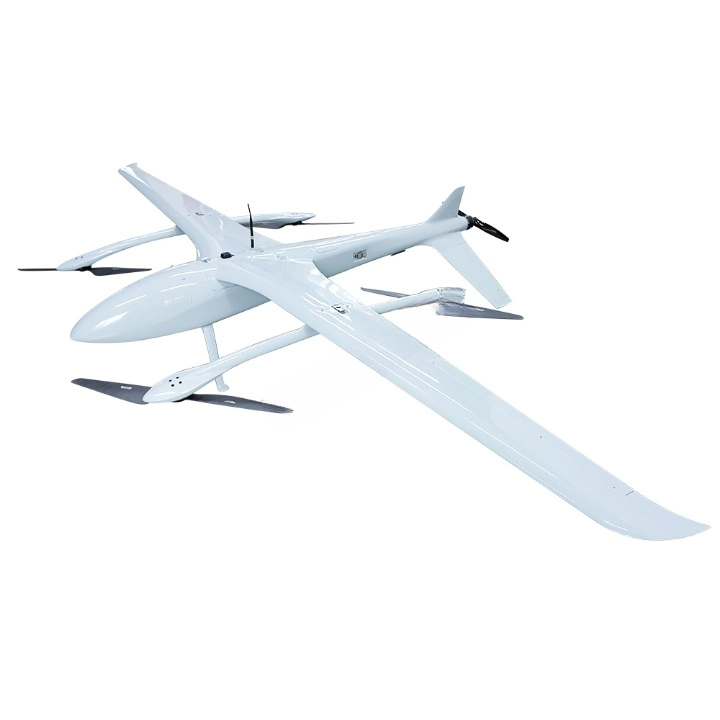
Moneypro M400 Long-Flight-Time Electric VTOL
Listed endurance: 4 hours at a 5 kg payload
Listed payload capacity: 6.5 kg
Maximum takeoff weight: 31 kg
Airframe weight: 17.5 kg
Listed cruise speed: 23 m/s (approximately 83 km/h)
Airframe material: Carbon-fiber composite
The platform is presented with a modular payload bay intended to support compatible imaging, survey, delivery, and specialized monitoring equipment.
What Should Buyers Verify Before Selecting the M400?
The listed endurance at a specified payload is a useful starting point, but it should not be treated as a guarantee of four hours of productive mission time in every situation. Ask for the test conditions, battery configuration, weather assumptions, and the definition of endurance used in the specification.
For mapping or inspection, confirm compatibility with the required camera or sensor, the complete installed payload weight, mounting arrangement, data connections, and any power requirements. For delivery work, verify cargo-box dimensions, load distribution, security, and the aircraft’s performance with the intended cargo.
The manufacturer lists a payload bay measuring 550 × 260 × 270 mm and hot-swappable payload arrangements. Buyers should confirm the supported interfaces, changeover procedure, and whether the claimed configuration is included in the quoted package.
The M400 is worth evaluating when a project needs a long-endurance electric VTOL platform with modular payload options. It should not be selected on endurance alone. A successful purchase depends on validated mission performance, support, operating limits, payload integration, and the total cost of running the aircraft.
Cost-Benefit Analysis: Is a VTOL Aircraft Worth Buying?
A VTOL aircraft is worth the additional investment when vertical launch and recovery solve a real operational problem or make a demanding mission feasible. If a conventional fixed-wing UAV already operates efficiently from an available runway or launch system, the extra VTOL capability may not justify its cost.
Compare the options using total mission cost rather than aircraft price alone.
Total operating cost per mission = allocated aircraft and payload cost + labor + energy + transport and setup + maintenance allowance + data processing + other mission-specific costs.
Mission productivity = useful completed mission output ÷ total operating time.
For a surveying contractor, useful output may be the number of hectares mapped to the required quality per day. For an infrastructure operator, it may be the number of assets inspected and documented. For a delivery service, it may be the cost per successful delivery.
VTOL can improve these measures when it reduces deployment time, removes the need for separate launch equipment, or allows access to work areas that are otherwise difficult to serve. It may deliver little benefit when the operation already has suitable launch infrastructure and the VTOL system’s added maintenance or setup time outweighs the savings.
When Is an Upgrade to VTOL Worthwhile?
- Upgrade when launch access is the bottleneck: repeated travel to a runway or difficult recovery logistics are reducing productive time.
- Upgrade when a multirotor lacks route efficiency: the project needs longer forward-flight coverage and the hybrid aircraft meets the payload requirement.
- Upgrade when payload flexibility supports more contracts: compatible sensors or cargo modules can be used across several profitable mission types.
- Do not upgrade just to gain a larger endurance number: validate usable mission time, reserve requirements, and the actual output needed.
- Do not upgrade if the team cannot support the system: training, maintenance, integration, and operating procedures must be ready before deployment.
Expert Recommendation
The advantages of VTOL aircraft are most compelling when an operator needs vertical takeoff and landing but also wants the route coverage and cruise efficiency associated with a fixed-wing platform. For remote mapping, infrastructure surveys, environmental monitoring, and selected cargo missions, that combination can remove real operational constraints.
Our recommendation is to evaluate VTOL as a mission solution, not as a universal upgrade. Start by documenting the operating locations, payload, required flight time, route length, weather conditions, and recovery options. Then compare a hybrid VTOL aircraft with a conventional fixed-wing UAV and a multirotor using the same mission requirements.
For beginners, prioritize safe operating procedures, training, and a manageable payload configuration. For commercial users, compare productivity and total ownership cost rather than relying on brochure specifications. For long-range missions, request performance data at the intended payload and confirm realistic reserve margins. For heavy or specialized payloads, verify compatibility and flight performance with the complete installed system.
A well-selected VTOL UAV can make field deployment easier and expand the missions a team can perform. The best investment is the aircraft that reliably completes the required work, within applicable regulations and operating limits, at a cost the business can justify.
Frequently Asked Questions
1. What are the main advantages of VTOL aircraft?
The main advantages are vertical takeoff and landing without a conventional runway, access to constrained sites, flexible deployment, reduced dependence on some ground infrastructure, and—in hybrid fixed-wing designs—efficient forward flight. Payload flexibility can also support multiple commercial applications when the aircraft is designed for the required equipment.
2. Are VTOL aircraft better than fixed-wing drones?
Not in every situation. VTOL aircraft are useful when a mission requires vertical launch and recovery, while conventional fixed-wing UAVs may be more efficient or less complex when suitable launch and recovery infrastructure is available. Compare the complete mission requirements before choosing.
3. Do VTOL aircraft have longer flight times than multirotors?
Hybrid fixed-wing VTOL aircraft can achieve longer endurance on suitable forward-flight missions because their wings generate lift during cruise. However, performance varies by architecture, payload, weather, propulsion, and energy configuration. Not every VTOL aircraft has fixed-wing cruise capability.
4. Can VTOL aircraft operate without a runway?
Many VTOL aircraft can take off and land vertically without a conventional runway. They still require a suitable operating area with sufficient clearance, acceptable conditions, and compliance with applicable aviation rules.
5. What industries use VTOL UAVs?
Common applications include surveying, photogrammetry, infrastructure inspection, agriculture, environmental monitoring, and selected cargo operations. The right aircraft depends on the required payload, flight duration, data quality, route, and operating environment.
6. What is the biggest disadvantage of a hybrid VTOL aircraft?
A common trade-off is greater system complexity compared with a conventional fixed-wing aircraft. Additional vertical-lift components and transition requirements can affect purchase cost, maintenance, training, and operating procedures. The actual trade-off depends on the design.
7. How should I compare VTOL endurance specifications?
Compare figures using the same payload weight, battery or energy configuration, weather assumptions, and operating profile. Ask whether the figure includes takeoff, transition, return, landing, and reserve requirements. A maximum endurance claim is not necessarily the same as useful mission time.
8. Can VTOL aircraft carry LiDAR or other specialized sensors?
Some platforms can carry LiDAR, mapping cameras, thermal sensors, and other specialized payloads. Confirm payload weight, dimensions, mounting, power, data interfaces, center of gravity, and performance at the complete installed weight before purchasing.
9. Does VTOL capability allow BVLOS flights without additional approval?
No. VTOL capability does not itself authorize beyond visual line of sight operations. Requirements depend on the jurisdiction, aircraft, airspace, operation, and applicable permissions.
10. When is a VTOL aircraft worth the additional cost?
It is worth considering when runway independence, field access, or the combination of vertical recovery and efficient forward flight materially improves mission completion or productivity. If those benefits do not solve a real operational problem, a conventional fixed-wing or multirotor platform may offer better value.
References
- Federal Aviation Administration (FAA) — Unmanned Aircraft Systems. Official U.S. guidance on drone operations, safety, and regulatory requirements. Operators must confirm the rules that apply to their specific aircraft and mission.
- European Union Aviation Safety Agency (EASA) — Civil Drones and Remotely Piloted Aircraft Systems. Regulatory and operational information relevant to civil drone operations in Europe.
- NASA — Aeronautics Research. Research resources covering aircraft aerodynamics, flight, and aviation technology relevant to understanding aircraft performance and design trade-offs.