


VTOL aircraft are changing how commercial operators approach missions that combine difficult launch conditions with long-distance coverage. By taking off and landing vertically, then transitioning to efficient forward flight, a fixed-wing VTOL UAV can operate from locations where a runway is unavailable while covering substantially more ground than many conventional multirotor platforms.
That combination is useful, but it does not make every VTOL aircraft suitable for every mission. Payload capacity, endurance, sensor integration, transition reliability, communications, weather tolerance, and local flight regulations determine whether a platform is commercially worthwhile. The best applications of VTOL aircraft are those where vertical access solves a real deployment problem and fixed-wing flight delivers a measurable operational advantage.

Quick Answer: What Are the Main Applications of VTOL Aircraft?
The six major applications of VTOL aircraft are infrastructure inspection, surveying and mapping, precision agriculture, cargo and logistics delivery, environmental monitoring, and public safety or defense operations. These platforms are particularly valuable when operators need to launch from confined locations but still require longer flight coverage than a conventional multirotor can efficiently provide.
Our recommendation: Choose a VTOL fixed-wing UAV when your mission involves large areas, limited launch space, and a need for efficient forward flight. Choose a multirotor when hovering, close-range maneuvering, or frequent position changes matter more than coverage. Do not pay for VTOL capability unless your operating environment actually benefits from it.
| Quick Summary | Application | Primary Value | Most Important Requirement |
|---|---|---|---|
| 1 | Infrastructure inspection | Access to long and difficult assets | Sensor quality and flight stability |
| 2 | Surveying and mapping | Efficient coverage of large areas | Positioning accuracy and image overlap |
| 3 | Precision agriculture | Crop monitoring over extensive fields | Multispectral or thermal sensor capability |
| 4 | Cargo and logistics | Delivery to locations with limited access | Payload, range, safety, and route approval |
| 5 | Environmental monitoring | Repeated observation of remote terrain | Endurance, sensor integration, and data quality |
| 6 | Public safety and defense | Rapid deployment and wide-area awareness | Secure communications and mission reliability |
What Is a VTOL Aircraft?
VTOL stands for vertical take-off and landing. A VTOL aircraft can lift off and land vertically without requiring a conventional runway. In the unmanned aircraft market, the term often describes fixed-wing UAVs equipped with vertical lift motors, rotors, or another mechanism that allows them to take off vertically and then transition into forward flight.
A fixed-wing VTOL drone combines two useful flight characteristics. Vertical lift allows deployment from a field, road-side staging point, ship deck, or other restricted location. Once airborne and transitioned into forward flight, its wing generates lift, allowing it to cover larger areas more efficiently than a multirotor that relies on powered rotors throughout the mission.
Not all VTOL aircraft use the same architecture. Common configurations include:
- Lift-and-cruise: Dedicated vertical lift motors provide take-off and landing, while a separate propulsion system drives forward flight.
- Tilt-rotor or tilt-wing: Propulsion units or wings change orientation between vertical lift and forward flight.
- Tail-sitter: The aircraft takes off and lands in a vertical attitude, then rotates into horizontal forward flight.
For professional UAV buyers, the important distinction is not simply whether a drone can take off vertically. It is how reliably it transitions, how much payload it can carry after accounting for its propulsion system, and how much useful flight time remains for the actual mission.
How Do VTOL Aircraft Work?
A typical fixed-wing VTOL UAV uses vertical propulsion to rise from the ground. After reaching a suitable altitude, its flight controller manages a transition into forward flight. The wing gradually produces the lift needed for cruise, allowing the aircraft to continue its route with a different aerodynamic operating profile.
During landing, the aircraft reduces forward speed and returns to a vertical flight configuration before descending. The flight controller coordinates motor output, attitude, altitude, and transition parameters. The precise sequence depends on the aircraft architecture and flight-control system.
The components that determine mission performance
- Airframe and wing: Influence aerodynamic efficiency, structural strength, payload integration, and handling.
- Vertical lift system: Determines take-off and landing capability, control authority, and power demand during hover.
- Cruise propulsion: Provides forward thrust during fixed-wing flight.
- Flight controller: Manages stabilization, navigation, flight modes, and transition logic.
- Navigation system: May include GNSS, RTK, inertial sensors, and other positioning technologies according to the mission.
- Payload interface: Supports cameras, multispectral sensors, thermal imaging, LiDAR, communications equipment, or cargo systems.
- Data link: Connects the aircraft with the ground control station and supports command, telemetry, and payload data transmission.
One misconception is that a VTOL drone automatically has longer endurance than every multirotor. That is not a safe assumption. The actual result depends on aircraft size, battery or fuel system, payload, wind, flight profile, and design efficiency. VTOL capability also adds components and weight that must be included in the performance calculation.
1. Infrastructure Inspection: Monitoring Power Lines, Pipelines, Roads, and Industrial Assets
Infrastructure inspection is one of the strongest commercial applications of VTOL aircraft. Power transmission corridors, pipelines, railways, highways, bridges, and industrial facilities often extend across long distances or pass through areas where launching a conventional fixed-wing drone is difficult.
A VTOL UAV can be deployed from a relatively small staging area, climb vertically, and then follow a planned route along the asset. This makes it suitable for inspecting long linear structures without requiring a runway at every operating location.
How VTOL aircraft support inspection work
Operators can integrate high-resolution EO cameras to capture visible surface conditions, while thermal cameras can help identify temperature anomalies in suitable inspection scenarios. Depending on the asset and inspection objective, additional sensors may support corrosion assessment, vegetation monitoring, thermal screening, or documentation of visible damage.
For example, a utility contractor inspecting a remote transmission corridor may use a VTOL fixed-wing UAV to cover a long route while collecting geotagged images. A multirotor may still be needed for close inspection of a particular connector or component where hovering and precise positioning are essential.
Where VTOL is worth using
- Long power-line and pipeline corridors.
- Remote roads, railway sections, and bridges.
- Large industrial sites with restricted launch areas.
- Repeated inspection routes where consistent flight planning is valuable.
What buyers should prioritize
Sensor resolution, stabilization, route repeatability, wind tolerance, and data georeferencing should take priority over headline flight time. If the inspection requires detailed close-ups, confirm that the gimbal can maintain the necessary image quality during forward flight. A high-endurance aircraft with an unsuitable camera is not an effective inspection solution.
We recommend choosing a platform around the inspection deliverable. If the client needs a corridor-level overview, a fixed-wing VTOL configuration is often a strong fit. If the task requires detailed inspection of small components, consider a hybrid fleet that includes a multirotor for close-range work.
2. Surveying and Mapping: Covering Large Areas Without a Runway
Surveying and mapping are major applications of VTOL aircraft because they combine the need for broad geographic coverage with practical deployment constraints. Construction sites, mining areas, agricultural properties, land-development projects, and remote infrastructure corridors may cover too much ground for an efficient multirotor mapping workflow.
A fixed-wing VTOL UAV can launch vertically, transition to forward flight, and follow a pre-planned survey pattern. The aircraft captures overlapping images or sensor measurements that can later be processed into orthomosaics, digital surface models, point clouds, or other mapping outputs.
Common mapping applications
- Topographic surveys for land development and construction planning.
- Mining-site volume calculations and stockpile monitoring.
- Quarry and earthwork progress documentation.
- Road, rail, and utility corridor mapping.
- Large-area land-use and terrain analysis.
Why sensor and positioning quality matter
A VTOL platform does not automatically produce survey-grade data. Mapping accuracy depends on camera calibration, flight altitude, image overlap, ground sampling distance, positioning quality, ground control strategy, processing workflow, and environmental conditions.
Where higher absolute accuracy is required, buyers should evaluate RTK or PPK capability and determine whether ground control points are still needed for the project specification. The correct workflow depends on the accuracy requirement and the mapping software used by the survey team.
For professional mapping, we recommend reviewing the complete data chain rather than purchasing based on airframe specifications alone. Ask for sample orthomosaics, accuracy reports, and details of the positioning workflow. A platform that flies efficiently but produces inconsistent image geometry can increase processing time and reduce project profitability.
Operators comparing aircraft for mapping can also review specialist fixed-wing drones for photogrammetry. For missions requiring extended coverage and image collection, a long-range drone with camera may also be relevant, depending on the launch environment and regulatory permissions.
3. Precision Agriculture: Monitoring Crops Across Large Farms
Precision agriculture uses aerial data to help farmers and agronomists understand crop conditions, identify variation, and prioritize field inspections. VTOL aircraft are useful when agricultural properties are too large for efficient multirotor coverage but lack convenient runways or prepared launch areas.
A VTOL UAV equipped with an RGB, multispectral, or thermal payload can collect data across fields and generate information that supports crop monitoring and management decisions.
Practical agricultural use cases
- Crop health monitoring: Multispectral imagery can help identify differences in vegetation response across a field.
- Plant stress investigation: Thermal or multispectral data may help locate areas requiring ground inspection.
- Irrigation assessment: Aerial observations can support the identification of uneven field conditions and potential irrigation issues.
- Field boundary and crop-area mapping: Orthomosaics can assist with field documentation and planning.
- Seasonal comparison: Repeat surveys can help track changes over time when acquisition conditions and processing methods are consistent.
Which payload should you choose?
An RGB camera is a sensible starting point for visual documentation, field mapping, and general crop observation. Multispectral sensors are more appropriate when the workflow requires vegetation indices or analysis across selected spectral bands. Thermal sensors can support specific temperature-related investigations, but thermal imagery must be interpreted with environmental conditions and ground observations in mind.
One common purchasing mistake is buying a multispectral camera without confirming software compatibility and the complete processing workflow. The sensor, calibration process, flight planning, image processing, and agronomic interpretation must work together. Otherwise, the buyer may collect large volumes of imagery without producing useful decisions.
For commercial farms and agricultural service providers, we recommend comparing the cost per surveyed hectare, not simply the aircraft price. Include flight preparation, battery logistics, data processing, operator time, and repeat-survey requirements in the calculation.
4. Cargo and Logistics Delivery: Reaching Locations with Limited Ground Access
Cargo delivery is a high-potential application of VTOL aircraft, particularly where roads are slow, unreliable, or unavailable. A VTOL cargo drone can take off and land in a confined area while using forward flight to cover a delivery route.
Potential use cases include transporting medical supplies, urgent spare parts, small industrial components, emergency equipment, and other suitable goods between designated locations. Remote communities, offshore facilities, industrial sites, and difficult terrain may benefit when conventional transport is impractical.
What makes a VTOL cargo drone commercially useful?
Payload capacity is only one part of the equation. A cargo aircraft must carry the intended load while maintaining sufficient energy reserve, acceptable route performance, and safe landing capability. Buyers should evaluate:
- Maximum payload and recommended operational payload.
- Range with the actual cargo weight, not an empty-aircraft figure.
- Payload compartment dimensions and loading method.
- Take-off and landing area requirements.
- Navigation redundancy and communication reliability.
- Emergency procedures and safe recovery options.
- Route approval, operational permissions, and delivery-site arrangements.
For example, a medical logistics operator may need to move temperature-sensitive supplies between a central facility and a remote clinic. The aircraft must support the required payload and route, but the delivery system also needs secure packaging, traceable handover, and contingency planning. The drone alone does not create a complete logistics service.
When is VTOL cargo better than a multirotor?
A multirotor may be preferable for short-distance deliveries with precise landing requirements and relatively low payloads. A fixed-wing VTOL platform becomes more attractive when route distance and energy efficiency during cruise are important, provided the delivery locations offer suitable vertical landing areas.
For buyers evaluating this category, our guide to VTOL cargo drone solutions provides a starting point for comparing aircraft configurations and logistics requirements.
We recommend conducting a route-specific feasibility assessment before purchasing a cargo platform. Maximum range and payload figures should never be treated as simultaneously achievable unless the manufacturer provides a verified performance chart for that exact operating configuration.
5. Environmental Monitoring: Observing Remote and Hard-to-Reach Areas
Environmental monitoring often involves large areas, limited infrastructure, and repeated data collection. Forests, wetlands, coastlines, rivers, reservoirs, wildlife habitats, and remote conservation areas can be difficult to monitor using ground teams alone.
VTOL aircraft provide a practical way to deploy aerial sensors without a runway. Their fixed-wing cruise capability can help cover broad areas, while vertical take-off and landing make field operations easier to organize.
Key environmental applications
- Forest monitoring: Mapping canopy changes, documenting storm damage, and identifying visible disturbance.
- Coastal observation: Monitoring shoreline changes, erosion patterns, and selected coastal conditions.
- Water-resource assessment: Mapping river corridors, reservoirs, and surrounding land use.
- Wildlife habitat documentation: Collecting aerial observations where the operating method is appropriate and minimizes disturbance.
- Disaster impact assessment: Documenting affected areas after floods, storms, landslides, or other events when conditions permit safe flight.
- Pollution and land-use monitoring: Identifying visible changes that require further investigation or ground verification.
Sensor selection determines data value
RGB cameras are useful for visual records and mapping. Thermal sensors can help identify temperature patterns, while multispectral sensors may support vegetation and land-cover analysis. LiDAR can be appropriate where three-dimensional terrain or vegetation structure information is required, although it increases payload, integration, and data-processing demands.
For environmental work, a longer flight is not automatically a better survey. Sensor calibration, acquisition timing, weather, ground resolution, and repeatability determine whether datasets can be compared meaningfully. A survey collected under different seasonal or lighting conditions may create misleading differences.
From our experience with professional UAV system selection, the strongest approach is to define the environmental question first, then choose the sensor and aircraft. Do not start with an expensive sensor package and attempt to find a useful application afterward.
6. Public Safety and Defense: Search, Situational Awareness, and Wide-Area Observation
Public safety and defense organizations may use VTOL aircraft for missions that require rapid deployment, broad-area observation, and access to locations where a runway is unavailable. The exact aircraft configuration and payload depend on the agency’s operational requirements, authorization, and safety procedures.
Public safety applications
- Search and rescue: Surveying large search areas and providing aerial observations to incident commanders.
- Disaster response: Mapping affected areas, identifying blocked access routes, and documenting damage.
- Fireground awareness: Providing aerial views of fire boundaries and surrounding terrain when authorized and safe.
- Emergency infrastructure assessment: Inspecting roads, bridges, and utility corridors after severe weather or other incidents.
- Remote-area observation: Supporting situational awareness in locations that are difficult for ground teams to reach.
Defense and security applications
Defense organizations may evaluate VTOL UAVs for surveillance, reconnaissance, communications relay, and other mission-specific roles. These applications place particular importance on secure data links, navigation resilience, sensor integration, operating range, maintainability, and mission assurance.
Buyers should distinguish between a commercially marketed aircraft and a system that has been qualified for a specific government or defense requirement. A platform’s advertised sensor options or communications features do not, by themselves, establish military suitability.
For organizations comparing broader UAV capabilities, Moneypro UAV also provides industry information on military drone platforms and night-vision military drone systems. These resources are useful for understanding different mission categories, but any procurement decision should be based on verified specifications, applicable procurement rules, and operational testing.
VTOL vs. Multirotor vs. Conventional Fixed-Wing UAV: Which Is Better?
The most useful way to compare UAV platforms is to start with the mission rather than the aircraft category. VTOL combines vertical access with fixed-wing cruise, but it also introduces transition systems and additional design complexity. A conventional fixed-wing UAV may be more efficient when a runway or launch-and-recovery arrangement is available. A multirotor is usually more practical when hovering and close-range maneuvering are essential.
| Factor | VTOL Fixed-Wing UAV | Multirotor UAV | Conventional Fixed-Wing UAV |
|---|---|---|---|
| Take-off and landing | Vertical; no conventional runway required | Vertical; compact launch area | Usually requires runway, launcher, or recovery arrangement |
| Hovering | Usually limited to vertical-lift mode and aircraft design | Strong capability; core operating strength | Not normally capable of sustained hovering |
| Large-area coverage | Strong fit for many long-route missions | Generally less efficient for extensive coverage | Strong fit for extensive coverage |
| Forward-flight efficiency | Benefits from fixed-wing cruise | Relies on rotor propulsion throughout flight | Benefits from fixed-wing cruise |
| Close inspection | Possible, but depends on flight mode and payload | Often best for detailed close-range work | Less suitable for hovering close to an asset |
| System complexity | Higher due to vertical lift and transition systems | Often simpler to deploy and operate | Depends on launch and recovery system |
| Typical strengths | Remote mapping, corridor inspection, wide-area missions | Hovering, precision positioning, short-range inspection | Long-range mapping where launch and recovery are practical |
| Main limitation | Transition complexity, payload trade-offs, and cost | Endurance and large-area coverage limitations | Runway or launch/recovery constraints |
Pros and Cons of VTOL Aircraft
| Advantages | Limitations |
|---|---|
| Can take off and land vertically from relatively confined locations. | Vertical lift and transition systems add mechanical and control complexity. |
| Fixed-wing cruise can support efficient coverage of larger areas. | Performance depends on airframe, payload, wind, and mission profile. |
| Can support mapping, inspection, agriculture, and logistics missions with one platform configuration. | One aircraft may not be optimal for every sensor or mission type. |
| Can reduce dependence on runways and conventional launch equipment. | Vertical take-off and landing still require safe, suitable operating areas. |
| Can integrate different professional payloads. | Payload weight and power consumption can reduce endurance and range. |
| Useful for remote and infrastructure-constrained operations. | Training, maintenance, and regulatory planning remain essential. |
Our view is that VTOL is a mission-enabling design, not a universal upgrade. If your current multirotor already completes the job efficiently, changing to VTOL may add cost without improving the result. If your fixed-wing aircraft cannot be deployed because there is no practical runway or launch area, VTOL may solve a genuine operational bottleneck.
Benefits and Limitations of VTOL Aircraft in Commercial Operations
Where the benefits are strongest
The biggest benefit is operational flexibility. A VTOL aircraft can be deployed from more locations than a conventional runway-dependent fixed-wing platform. Once in forward flight, the wing can provide efficient cruise for missions involving broad geographic coverage. This combination is particularly valuable for linear infrastructure, remote surveys, and large agricultural properties.
A second benefit is payload flexibility. Depending on the airframe and payload interface, the same aircraft family may support RGB, thermal, multispectral, LiDAR, or other mission equipment. This can help service providers address several related markets without maintaining an entirely separate aircraft fleet for every task.
A third advantage is the possibility of standardizing repeat missions. Planned routes, consistent sensor configurations, and repeatable launch procedures can improve data collection workflows. However, this benefit depends on disciplined operations and suitable software, not simply on owning a VTOL aircraft.
Where the limitations become expensive
VTOL aircraft can cost more than basic multirotors because of their additional propulsion systems, control requirements, and airframe design. They may also require more specialized training and maintenance. A transition failure, unsuitable landing area, or poorly integrated payload can undermine the entire mission.
Battery-powered platforms also face energy constraints. Vertical lift, forward flight, payload weight, wind, and reserve requirements all affect achievable mission duration. Buyers should use performance data for the intended payload and environmental conditions rather than relying on an empty-aircraft maximum endurance claim.
For heavy-duty applications, evaluate the aircraft as a complete system: airframe, propulsion, power source, payload, ground control station, communications, software, spare parts, and support. A low initial purchase price is not a reliable indicator of low operating cost.
How to Choose the Right VTOL Aircraft for Your Application
Before comparing manufacturers or requesting quotations, define the mission in measurable terms. The correct aircraft for a 30-kilometer pipeline inspection may be very different from the correct platform for a multispectral agricultural survey or a cargo delivery route.
1. Start with the mission profile
Document the area or route to be covered, required flight time, launch and landing conditions, operating altitude, weather exposure, and frequency of missions. Identify whether the aircraft must hover, perform close inspection, or remain in forward flight for most of the operation.
2. Match the payload to the deliverable
Choose the sensor based on the information the customer needs. RGB cameras suit general imaging and mapping. Thermal cameras support temperature-pattern observation. Multispectral cameras support selected vegetation-analysis workflows. LiDAR may be appropriate for detailed three-dimensional mapping. Confirm payload weight, power draw, mounting compatibility, data interface, and stabilization requirements.
3. Compare real endurance, not marketing maximums
Ask manufacturers for endurance and range figures with the intended payload, operating profile, and reserve assumptions. Confirm whether figures include vertical take-off and landing energy. Request performance data for representative wind conditions if the aircraft will operate in exposed areas.
4. Evaluate navigation and communication systems
GNSS, RTK or PPK capability, inertial navigation, telemetry, command links, and payload data transmission should be assessed against the mission. Remote operations may require additional communications planning and approvals. Do not assume a long advertised control range guarantees reliable communications in every terrain or radio environment.
5. Assess transition and recovery reliability
For a VTOL aircraft, transition performance is a core buying criterion. Ask how the aircraft handles transition failures, abnormal sensor readings, propulsion faults, and interrupted communications. Review documented operating procedures and maintenance requirements. Request a demonstration that reflects the mission rather than a short promotional flight.
6. Confirm regulatory and operational requirements
Regulations differ by country and operation type. In the United States, many commercial small-UAS operations are conducted under FAA Part 107, but operating limitations and authorization requirements still apply. Visual line-of-sight rules, airspace restrictions, operations over people, night operations, and waivers must be assessed for the actual mission. BVLOS capability in the aircraft specification does not automatically authorize BVLOS operation.
In Europe, EASA has developed a dedicated Special Condition for VTOL aircraft addressing their particular airworthiness characteristics. This is especially relevant when discussing larger or more advanced VTOL aircraft certification. Buyers should distinguish between a small unmanned aircraft operating under applicable UAS rules and a VTOL aircraft requiring a different certification pathway.
7. Compare after-sales support and total ownership cost
Ask about warranty coverage, spare motors, propellers, batteries, landing components, flight-controller support, software updates, payload servicing, and technical training. A commercial operator cannot afford extended downtime because a proprietary component is unavailable.
| Buying Criterion | Questions to Ask the Manufacturer | Why It Matters |
|---|---|---|
| Airframe | What are the dimensions, take-off weight, and structural limits? | Determines transport, deployment, and payload constraints |
| Payload | What payload is supported, and what are its power and interface requirements? | Ensures the aircraft can perform the actual mission |
| Endurance | What is the flight time with the proposed payload and reserve? | Prevents unrealistic mission planning |
| Navigation | Are RTK, PPK, GNSS redundancy, or alternative navigation options available? | Supports positioning and mission reliability requirements |
| Communications | What are the command, telemetry, and payload data-link specifications? | Helps assess operational range and data continuity |
| Safety | What are the transition, lost-link, and emergency procedures? | Reduces operational risk |
| Support | What training, spare parts, warranty, and repair services are provided? | Controls downtime and lifecycle cost |
Cost-Benefit Analysis: When Is VTOL Worth the Investment?
A VTOL aircraft is worth the additional investment when it reduces the cost or complexity of deploying a fixed-wing platform while retaining the coverage advantages of forward flight. The financial benefit is strongest when a business performs repeated large-area missions and would otherwise need a runway, launcher, recovery equipment, or additional ground logistics.
Consider a surveying contractor that regularly maps remote construction sites. If a conventional fixed-wing aircraft requires a prepared launch area and a separate recovery zone, the team may spend considerable time arranging access and transporting equipment. A VTOL platform may simplify deployment and reduce ground preparation. The financial value comes from the saved labor and improved mission access, not from the VTOL label itself.
However, if most assignments involve short inspections around buildings, towers, or individual machines, a multirotor may deliver the same outcome at lower cost. In that situation, VTOL may be an unnecessary upgrade.
We recommend calculating total cost per completed mission. Include aircraft depreciation, batteries, maintenance, operator time, travel, software, insurance, data processing, and failed or repeated missions. Compare that figure against the existing platform. This is a more useful purchasing decision than comparing aircraft prices in isolation.
Common VTOL Purchasing Mistakes
- Buying based on maximum flight time without checking payload-specific endurance.
- Assuming VTOL automatically means long range or high payload capacity.
- Choosing a sensor before defining the required data output.
- Ignoring the power consumption and mounting requirements of the payload.
- Assuming a BVLOS-ready aircraft can be operated BVLOS without authorization.
- Failing to evaluate transition behavior and emergency recovery procedures.
- Overlooking spare parts, software support, and operator training.
- Ordering a fleet before completing a representative field test.
Who Should Use VTOL Aircraft?
VTOL aircraft are especially suitable for professional operators whose missions combine large-area coverage with limited launch infrastructure. These include surveying companies, infrastructure inspection contractors, agricultural service providers, environmental organizations, logistics operators, and selected public-sector agencies.
They are also attractive to UAV service companies that need to serve multiple industries using compatible payloads. However, the aircraft should be selected around the business model. A mapping company needs dependable geospatial data. An inspection contractor needs usable sensor imagery and repeatable routes. A cargo operator needs verified payload-range performance and a compliant delivery process.
Who may not need VTOL?
For beginners, hobby pilots, and businesses performing short-range hovering tasks, a conventional multirotor is often the more practical starting point. Organizations with reliable runways or launch systems may find a conventional fixed-wing UAV more cost-effective. Buyers who only need occasional aerial photographs may not benefit from the additional cost and operational complexity of a professional VTOL platform.
Moneypro UAV: Integrated UAV Platforms and Professional Sensor Solutions
For commercial buyers, selecting a VTOL aircraft is only one part of building a usable unmanned aerial system. The payload, navigation, communication link, ground control workflow, and data-processing requirements must work together. This is where an integrated UAV supplier can add value beyond the airframe itself.
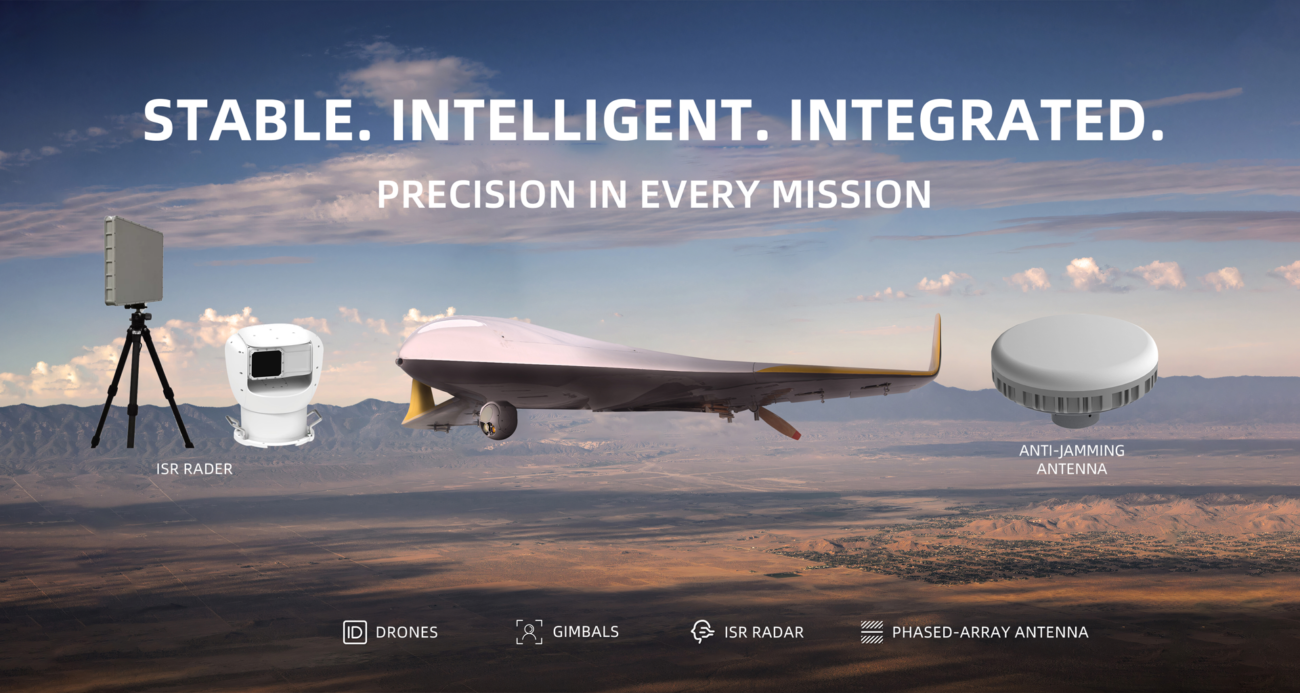
China Moneypro UAV specializes in unmanned aerial systems and advanced sensor technologies. Its product and solution scope includes UAV platforms, EO/IR gimbal cameras, radar systems, mesh radio communication, turbojet engines, GNSS antennas, infrared thermal and laser sensing, and other high-performance modules.
These technologies are relevant to professional applications such as industrial inspection, environmental monitoring, mapping, and other specialized missions. For buyers evaluating a VTOL configuration, the key step is to confirm which aircraft, payload, and communication options are compatible with the required mission profile.
What to discuss with a UAV supplier
- Whether the proposed airframe is a fixed-wing VTOL, multirotor, or conventional fixed-wing configuration.
- Whether the payload can be integrated without exceeding weight, power, or balance limits.
- Whether EO/IR, thermal, laser, radar, or other sensor options match the required deliverable.
- Whether GNSS, RTK, communication, and ground-control capabilities meet the operating environment.
- What performance data is available for the complete aircraft with the selected payload.
- What training, spare parts, technical support, and customization services are available.
For buyers comparing suppliers, it is also useful to review the broader market for UAV manufacturers in China and leading UAV manufacturers worldwide. A manufacturer should be evaluated on engineering capability, integration experience, documentation, production quality, and after-sales support—not just the number of models shown in its catalog.
Our recommendation: Start with the mission specification and ask the supplier to propose a complete configuration. For example, a mapping project may need a VTOL airframe, high-resolution camera, RTK positioning, flight-planning software, and processing workflow. An infrastructure inspection project may require a stabilized EO/IR payload and a reliable data link. A package that meets the mission is more valuable than a long list of optional features.
Explore Moneypro UAV drone platforms and solutions to discuss aircraft and sensor requirements for professional applications.
Expert Recommendation: Choose VTOL for the Mission, Not for the Label
Among the six applications discussed, infrastructure inspection, surveying and mapping, and precision agriculture are particularly strong use cases for fixed-wing VTOL UAVs. They often require broad coverage while operating from sites without suitable runways. Cargo delivery can also benefit, but payload-range performance, landing arrangements, and regulatory approval must be verified before a commercial service is viable.
Environmental monitoring and public safety operations offer further opportunities, especially when repeatable aerial data and access to remote locations are important. In these applications, sensor suitability and operational planning are just as important as the aircraft itself.
We recommend a VTOL aircraft when three conditions are met: the mission requires more coverage than a typical multirotor can efficiently provide, the operating location makes conventional fixed-wing launch and recovery difficult, and the aircraft can carry the required payload with adequate performance reserves.
If those conditions are not present, a multirotor or conventional fixed-wing UAV may be a better investment. The right platform is the one that completes the mission safely, consistently, and at a commercially sensible cost.
Frequently Asked Questions About Applications of VTOL Aircraft
1. What are the main applications of VTOL aircraft?
The main applications of VTOL aircraft include infrastructure inspection, surveying and mapping, precision agriculture, cargo and logistics delivery, environmental monitoring, and public safety or defense operations. They are useful where vertical access and efficient forward flight are both important.
2. Why are VTOL drones used for surveying and mapping?
VTOL drones can launch and land vertically without a conventional runway, then use fixed-wing flight to cover large areas. They can carry mapping cameras, RTK positioning systems, multispectral sensors, or LiDAR payloads depending on the project requirements.
3. Are VTOL aircraft better than multirotor drones?
Not for every mission. VTOL fixed-wing aircraft are generally more suitable for many large-area and long-route missions, while multirotors are better for hovering, close inspection, and precise positioning. The best choice depends on coverage, payload, endurance, and launch conditions.
4. Can VTOL drones be used for agriculture?
Yes. They can collect RGB, multispectral, and thermal data over large agricultural areas. These datasets can support crop monitoring, field mapping, and selected irrigation or plant-stress investigations when the sensors and analysis workflow are appropriate.
5. Can a VTOL aircraft carry cargo?
Some VTOL UAVs are designed for cargo delivery. Buyers must verify payload capacity, range with the intended cargo, loading arrangements, landing requirements, safety procedures, and applicable operating approvals. Maximum payload and maximum range should not be assumed to be achievable at the same time.
6. Are VTOL aircraft suitable for long-range inspection?
They can be suitable for long linear assets such as pipelines, power lines, roads, and railway corridors. The aircraft should have adequate endurance, sensor quality, navigation capability, communications coverage, and regulatory authorization for the planned route.
7. What is the difference between fixed-wing VTOL and conventional fixed-wing UAVs?
A fixed-wing VTOL UAV can take off and land vertically, while a conventional fixed-wing UAV generally requires a runway, launcher, or other launch and recovery arrangement. Both use fixed-wing cruise, but VTOL adds vertical lift and transition systems.
8. What sensors can VTOL aircraft carry?
Depending on payload capacity and integration, VTOL aircraft can carry RGB cameras, EO/IR gimbals, thermal cameras, multispectral sensors, LiDAR, radar, GNSS equipment, and specialized measurement systems. The payload must be compatible with the aircraft’s weight, power, balance, and data interfaces.
9. Can VTOL drones operate beyond visual line of sight?
Some platforms are designed with long-range navigation and communication capabilities, but aircraft capability does not equal legal authorization. BVLOS operations require compliance with the applicable aviation authority’s rules and any required approvals or exemptions.
10. What should I check before buying a VTOL UAV?
Evaluate payload capacity, endurance with the actual sensor, range, transition reliability, navigation, communication, weather limits, safety procedures, software compatibility, training, warranty, spare parts, and regulatory requirements. A representative field demonstration is strongly recommended before a bulk or high-value purchase.
References
- Federal Aviation Administration (FAA) – Small Unmanned Aircraft Systems Regulations (Part 107). Official information on U.S. small-UAS operating requirements, pilot responsibilities, airspace authorizations, and waivers.
- European Union Aviation Safety Agency (EASA) – Vertical Take-Off and Landing (VTOL). Regulatory background on dedicated technical specifications for VTOL aircraft certification.
- European Union Aviation Safety Agency (EASA) – Vertical Take-off and Landing (VTOL). Overview of VTOL aircraft characteristics, certification considerations, and the development of dedicated airworthiness requirements.