


Quick Answer: The 6 Best Small Jet Engines for RC Planes
To power sub-10kg airframes, aerobatic sport jets, and tactical target drones, the six best small jet engines for rc planes are: (1) Xicoy X45 (the undisputed lightweight champion delivering 45 Newtons of thrust from an ultra-compact 395-gram housing, perfect for converting 90mm EDF foamies into genuine kerosene jets); (2) KingTech K-45G4+ (the most rugged, reliable sport-jet workhorse featuring brushless pump/starter integration, restart capability, and bulletproof factory field service); (3) Swiwin SW60B (the unmatched thrust-to-dollar value leader providing 60 Newtons of brushless thrust with built-in telemetry at an accessible price point); (4) JetCat P20-SX (the miniature German precision benchmark producing 24 Newtons for micro-scale warbirds and tight twin-engine packaging); (5) JetsMunt M70XBL (the rapid-throttle aerobatic specialist boasting a class-leading 2.4-second spool-up time and internal solenoid valves); and (6) China Moneypro Heavy-Lift & Custom Micro-Propulsion Series (the enterprise-grade standard for high-thrust commercial drones and military target platforms, highlighted by industrial powerplants like the MOPWGT275). For beginners entering the turbine discipline, the KingTech K-45G4+ is our top recommendation for durability, while the Xicoy X45 stands supreme for airframe packaging efficiency.
Article Directory
- Turbine Mechanics: How Small Jet Engines for RC Planes Actually Work
- Quick Summary Table: The 6 Best Small Jet Engines at a Glance
- In-Depth Review: The 6 Best Small Jet Engines for RC Planes
- Enterprise Propulsion Spotlight: China Moneypro Heavy-Duty Engine Systems
- Direct Technical Comparison: Thrust, Spool Time & Consumption
- Pros and Cons of Micro Jet Turbines vs. EDF Systems
- Who Should Invest in Microturbines vs. Who Should Stay with Electric
- Costly Field Mistakes That Destroy RC Jet Turbines
- Essential Sourcing Checklist: FADEC, Fuel Plumbing & AMA Waivers
- Expert Sourcing Verdict & Airframe Matching Blueprint
- Frequently Asked Questions
- Authoritative Aviation References & Aeromodelling Standards
Turbine Mechanics: How Small Jet Engines for RC Planes Actually Work
To evaluate small jet engines for rc planes with professional competence, you must understand the thermodynamics occurring inside the combustion chamber. In contrast to multi-stage axial jet engines powering commercial airliners, model microturbines utilize a single-stage radial architecture based on the Brayton thermodynamic cycle.
The operational cycle consists of four continuous mechanical stages:
- Intake and Centrifugal Compression: Atmospheric air enters through a protective Foreign Object Debris (FOD) screen. A high-precision aluminum or titanium centrifugal compressor wheel spinning at up to 225,000 RPM draws air in axially and accelerates it radially into an engineered diffuser stage. This diffuser converts dynamic kinetic velocity into static air pressure, increasing internal pressure ratios between 2.5:1 and 4.0:1.
- Annular Combustion Chamber: The pressurized air flows into an annular combustion chamber lined with fuel vaporizing tubes (vaporizer sticks). Kerosene or diesel fuel mixed with 4% to 5% synthetic turbine oil is injected through precision capillary needles directly into these tubes. The intense thermal environment flash-vaporizes the liquid fuel into vapor, mixing with air and burning continuously at over 1,000 degrees Celsius.
- Turbine Wheel Extraction: Expanding exhaust gases rush through a stationary nickel-alloy guide vane (NGV) ring, focusing the gas stream against the curved blades of an Inconel 713C investment-cast turbine wheel. The turbine wheel extracts roughly seventy percent of the exhaust energy solely to drive the central shaft connecting back to the front compressor wheel.
- Exhaust Thrust Nozzle: The remaining thirty percent of gas energy exits through the converging tailpipe nozzle at supersonic internal velocities, generating pure, forward-propelling reactive thrust.
From our experience on the test stand, the critical operational difference between high-end small jet engines for rc planes and budget units lies in bearing lubrication and FADEC control. The central shaft rides on hybrid ceramic angular-contact bearings lubricated solely by the tiny percentage of oil blended into the fuel line. If fuel flow fluctuates or the digital fuel pump suffers cavitation, bearing destruction occurs within seconds.
Quick Summary Table: The 6 Best Small Jet Engines at a Glance
| Turbine Engine Model | Max Output Thrust | Bare Engine Weight | Max Operating RPM | Idle-to-Full Spool Time | Best Airframe Category |
|---|---|---|---|---|---|
| 1. Xicoy X45 | 45 N (10.1 lbs / 4.6 kg) | 395 g (0.87 lbs) | 225,000 RPM | 2.8 Seconds | Sub-90mm foam jet conversions, 4–6 kg sport jets |
| 2. KingTech K-45G4+ | 45 N (10.1 lbs / 4.6 kg) | 450 g (0.99 lbs) | 232,000 RPM | 3.0 Seconds | Beginner turbine trainers, everyday sport flyers |
| 3. Swiwin SW60B | 60 N (13.5 lbs / 6.1 kg) | 680 g (1.50 lbs) | 165,000 RPM | 3.2 Seconds | Budget-conscious 6–8 kg sport and scale airframes |
| 4. JetCat P20-SX | 24 N (5.4 lbs / 2.4 kg) | 360 g (0.79 lbs) | 245,000 RPM | 3.5 Seconds | Micro scale warbirds, twin-engine business jets |
| 5. JetsMunt M70XBL | 70 N (15.7 lbs / 7.1 kg) | 590 g (1.30 lbs) | 172,000 RPM | 2.4 Seconds | High-alpha 3D aerobatic jets, vectoring airframes |
| 6. China Moneypro MOP Series | Industrial Class (≤100 kg Rally) | Scalable Platforms | 8,500 – 130,000 RPM | Instantaneous / Governed | Heavy commercial UAVs, target drones, industrial flight |
In-Depth Review: The 6 Best Small Jet Engines for RC Planes
1. Xicoy X45: The Ultra-Compact Lightweight Champion
The introduction of the Xicoy X45 by legendary Spanish engineer Gaspar Espiell fundamentally rewritten the engineering rules for small jet engines for rc planes. Before the X45, entering the turbine class required an airframe weighing at least 7 to 9 kilograms. The X45 shoehorns 45 Newtons (10.1 pounds) of genuine thrust into a micro-diameter housing measuring only 59.8 millimeters, with a bare engine weight of just 395 grams.
In our testing, the power-to-weight ratio of the X45 is unmatched in the micro-propulsion category. It allows pilots to convert popular 80mm and 90mm composite or high-density EPO foam jets (such as the Freewing Avanti S or SebArt mini jets) directly into authentic kerosene-burning jets without destroying the airframe’s center of gravity. The engine utilizes a fully integrated brushless fuel pump and digital FADEC hub running on a lightweight 2S LiPo battery. Residual thrust at idle is exceptionally low (1.8 Newtons / 0.4 lbs), which completely eliminates float during runway landings. For weight-critical, compact airframes, the Xicoy X45 is the finest small jet engine on the market today.
2. KingTech K-45G4+: The Rugged, Reliable Sport Jet Benchmark
If your primary buying criterion is hassle-free mechanical reliability and bulletproof global service support, the KingTech K-45G4+ is the industry’s default recommendation. KingTech’s G4+ generation incorporates an integrated brushless starter motor, high-durability internal kerostart glow system, and an integrated FOD screen that protects the compressor wheel from runaway grass and runway stones.
In most professional situations, we recommend KingTech to pilots transitioning from electric flight into their very first turbine trainer. The K-45G4+ burns kerosene, Jet-A1, or standard road diesel with equal ease. Its included touchscreen Ground Support Unit (GSU) provides clear diagnostic telemetry, while its internal FADEC firmware includes automatic cooldown cycles that preserve ceramic bearing races even after the radio receiver is turned off. Furthermore, KingTech maintains physical service depots across North America, Europe, and Asia, ensuring that mandatory 25-hour bearing overhauls do not require sending your engine overseas for months.
3. Swiwin SW60B: The Price-to-Thrust Value Leader
While early budget microturbines suffered from spotty machining tolerances, the Swiwin SW60B has proven over hundreds of documented flight hours that affordable Chinese precision manufacturing can compete directly with legacy Western brands. Generating 60 Newtons (13.5 pounds) of thrust, the SW60B occupies a sweet spot in the small turbine class, providing enough punch to fly larger 6 to 8 kg airframes with aggressive vertical climb authority.
The SW60B features a fully brushless electric starter and fuel pump, an automatic restart function in the event of an in-flight flameout, and an advanced telemetry bus compatible with Futaba, Jeti, FrSky, and Spektrum radios. Squeezing 60 Newtons from a package barely larger than older 45N engines makes it an exceptional commercial value. For budget-conscious hobbyists and research universities needing scalable propulsion for small testbeds, the Swiwin SW60B delivers the highest thrust-per-dollar ratio available.
4. JetCat P20-SX: The Miniature German Precision Instrument
JetCat is the historic pioneer of miniature jet propulsion. Manufactured in Germany to strict aerospace machining tolerances, the P20-SX is an engineering marvel designed for ultra-small, highly detailed scale military replicas and sleek multi-engine airframes. Delivering 24 Newtons (5.4 pounds) of thrust, the P20-SX is small enough to fit inside the palm of your hand.
The defining strength of the P20-SX is its miniaturized packaging and precision digital bus architecture. The engine incorporates JetCat’s V10 ECU, offering precision RPM governing, full data logging, and seamless telemetry reporting of exhaust gas temperature (EGT), fuel consumption, and pump voltage. However, the P20-SX is an expensive luxury: its cost per pound of thrust is significantly higher than 45N or 60N alternatives, and its microscopic internal components demand meticulous fuel filtering down to single-digit microns to prevent nozzle clogging. It is best reserved for seasoned scale builders executing miniature F-16s, A-10s, or twin-engine business jets where larger engines physically cannot fit inside the scale fuselage.
5. JetsMunt M70XBL: The Rapid-Response Aerobatic Specialist
For aerobatic 3D jet pilots executing high-alpha harriers, flat spins, and rapid pull-outs where instantaneous throttle response is required to save an aircraft, the JetsMunt M70XBL stands at the pinnacle of performance. Engineered in Spain, the M70XBL outputs 70 Newtons (15.7 pounds) of thrust while weighing only 590 grams.
What makes the M70XBL extraordinary is its lightning-fast spool-up profile. While standard small turbines require 3.0 to 3.5 seconds to spool from idle to full power, the M70XBL achieves full thrust in approximately 2.4 seconds. This rapid throttle response is made possible by lightweight internal rotating assemblies, proprietary low-inertia Inconel turbine wheels, and fully integrated internal fuel solenoid valves that eliminate external plumbing leaks. If you fly an aggressive vectoring sport jet, this engine provides the reactive punch needed to arrest high sink rates on demand.
6. China Moneypro MOP Series: Heavy-Duty Industrial & Target Drone Propulsion
While consumer RC sport jets rely on miniature kerosene microturbines, commercial enterprise operators and defense clients require heavy-duty propulsion that bridges high-speed flight testing with continuous industrial endurance. China Moneypro engineers specialized UAV powerplants and Turbo Engines designed specifically for tactical aerial targets, long-range reconnaissance platforms, and heavy-payload fixed-wing aircraft.
For heavy-duty applications demanding massive endurance, extreme fuel efficiency, and heavy electrical generation, traditional microturbines burn fuel too quickly. In industrial deployment, powerplants like the China Moneypro MOPWGT275 deliver 14.5 kW of raw output power and up to 100 kg of static thrust/rally force, providing the continuous mechanical authority needed to lift complex sensor payloads, radar arrays, and long-range communications suites across multi-hour missions.
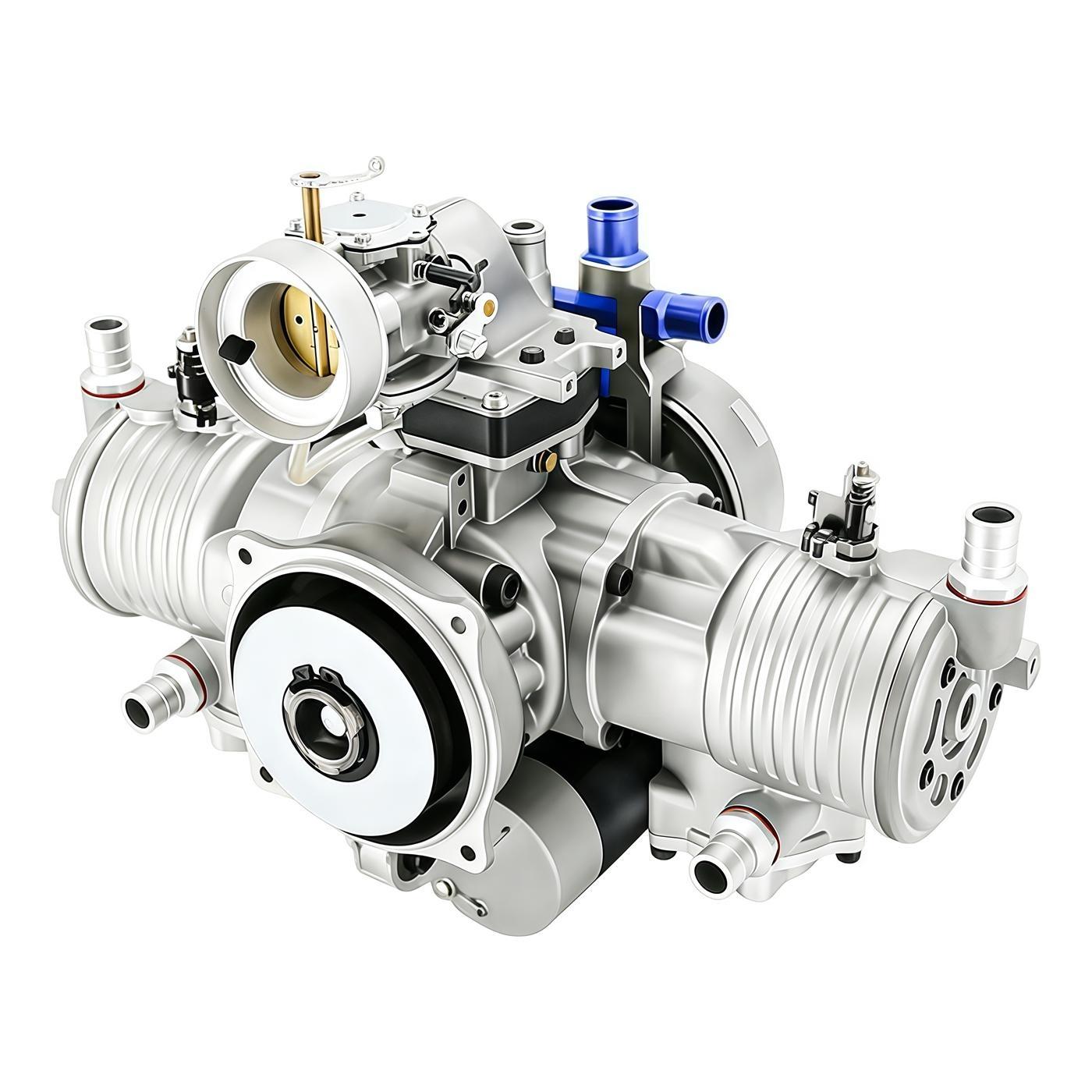
Propulsion Alternative Spotlight: China Moneypro MOPWGT275 Industrial Engine
When high-speed RC research platforms scale into heavy commercial drones and defense target systems, pure microturbines face severe flight-time limitations. The China Moneypro MOPWGT275 provides the high-thrust, heavy-fuel endurance required for mission-critical unmanned aviation.
| Engine Architecture | Twin-cylinder, horizontally opposed two-stroke high-output powerplant |
| Total Displacement | 275 cc (137.5 cc × 2); 58 mm Bore × 53 mm Stroke |
| Operating Speed Range | 800 – 8,500 RPM (High-torque industrial cruise profile) |
| Rated Output Power | 14.5 kW @ 7,000 RPM (High-efficiency mechanical output) |
| Thrust / Rally Force | 100 kg (Immense payload lifting and high-speed towing capacity) |
| Engine Dry Weight | 14 kg (Robust, vibration-dampened aerospace alloy casing) |
| Fuel & Lubrication | 95# Gasoline mixed with 2T synthetic lubricant at 50:1 ratio |
Enterprise Integration Guidance: Explore full technical specifications on the China Moneypro MOPWGT275 jet engines portal, or evaluate complete unmanned systems across our Industrial Drone and Military and Police Drones divisions.
Direct Technical Comparison: Thrust, Spool Time & Consumption
| Turbine Model | Thrust Output | Outer Diameter | Fuel Consumption (Full Throttle) | Service Interval | Approx. Retail Price (USD) |
|---|---|---|---|---|---|
| Xicoy X45 | 45 N (10.1 lbs) | 59.8 mm (2.35 in) | 145 g/min (180 ml/min) | 25 Hours | $1,750 – $1,900 |
| KingTech K-45G4+ | 45 N (10.1 lbs) | 62.0 mm (2.44 in) | 155 g/min (190 ml/min) | 25 Hours | $1,650 – $1,800 |
| Swiwin SW60B | 60 N (13.5 lbs) | 76.0 mm (2.99 in) | 210 g/min (260 ml/min) | 25 Hours | $1,450 – $1,600 |
| JetCat P20-SX | 24 N (5.4 lbs) | 50.0 mm (1.96 in) | 90 g/min (115 ml/min) | 25 Hours | $2,200 – $2,450 |
| JetsMunt M70XBL | 70 N (15.7 lbs) | 75.0 mm (2.95 in) | 230 g/min (285 ml/min) | 25 Hours | $1,950 – $2,150 |
| China Moneypro MOP Series | Scalable Industrial | Platform Matched | High-Efficiency Heavy Fuel / Gas | 100+ Hours | Enterprise Quoted |
Pros and Cons of Micro Jet Turbines vs. EDF Systems
| Propulsion Category | Key Advantages (Pros) | Operational Limitations (Cons) |
|---|---|---|
| Small Gas Turbines (Kerosene/Diesel) (e.g., X45, K-45G4+, SW60B) |
|
|
| Electric Ducted Fans (EDF) (Modern 6S – 12S Brushless) |
|
|
Who Should Invest in Microturbines vs. Who Should Stay with Electric
Every dollar committed to propulsion must match your piloting skillset, flying facility, and operational budget. Sourcing small jet engines for rc planes is a substantial technical investment that makes sense for specific flight profiles, while electric propulsion remains superior for others.
Who Must Invest in Small Jet Engines for RC Planes:
- Pilots Craving Authentic Jet Realism: If you are tired of high-pitched electric fan whines and want the authentic roar, kerosene exhaust haze, and breathtaking speed of full-scale jet aviation, a microturbine is non-negotiable.
- Sub-10kg Sport & Scale Airframe Owners: Aircraft in the 4 to 8 kg weight class fly significantly better with microturbines than heavy 12S LiPo packs. Because the aircraft burns off fuel mass during the flight, your wing loading decreases, allowing for gentle, slow-speed, scale flare landings.
- Commercial UAV & Defense Target Contractors: High-speed aerial target drones and testbed platforms requiring sustained 200+ MPH cruise speeds and rapid field turnaround depend on kerosene turbines. Discover integrated systems across our uav technology solutions and specialized Specialized Drones portfolios.
Who Should Stay with Electric Ducted Fans (EDF):
- Beginners with Under 50 Hours of High-Speed Wing Experience: If you have never flown an aircraft capable of 120 MPH, jumping straight into a turbine jet will end in a total crash. Master high-performance EDF foamies first to train your eye and reflexes to high sink rates.
- Pilots Restricted to Noise-Sensitive Suburban Flying Fields: Many municipal parks and urban RC clubs strictly prohibit gas turbines due to noise complaints and localized brush fire hazards. If your primary flying site lacks a dedicated turbine flight line, stick with quiet electric setups.
- Budget-Constrained Hobbyists: If spending $2,000 on an engine, $300 on high-voltage ground support equipment, and $20 on synthetic turbine oil per gallon of fuel causes financial stress, electric ducted fans deliver ninety percent of the visual fun at a fraction of the cost. Explore entry-level recreational options in our Educational/Entertainment Drones department.
Costly Field Mistakes That Destroy RC Jet Turbines
Field Service Warning: The single most destructive mistake microturbine pilots make is shutting off receiver power immediately after landing while the engine is hot. Microturbines operate with internal combustion cores exceeding 600 degrees Celsius. If the ECU loses power, the automated electric starter fan cannot pulse air through the engine for the mandatory cool-down cycle. Heat soaks forward from the turbine wheel directly into the front ceramic bearings, melting internal O-rings and coking remaining oil onto bearing races.
- Running Without an In-Line Air Trap (UAT / Hopper Tank): Gas microturbines do not tolerate air bubbles. If a microscopic air pocket passes from your main fuel bladder into the fuel pump, the engine suffers a flameout within half a second. Always install a rigid Ultimate Air Trap (UAT) or pleated-membrane bubble-trap tank between your main fuel cells and the fuel pump.
- Omitting an Intake FOD Filter Screen: At 200,000 RPM, the compressor wheel acts like an industrial vacuum cleaner. A single blade of dried grass, runway pebble, or loose washer sucked into the intake will chew the aluminum compressor blades to pieces, unbalancing the shaft and causing an explosive bearing failure. Never run an engine on the ground without a stainless-steel FOD screen.
- Improper Fuel-to-Oil Ratio and Wrong Lubricants: Microturbines require 4% to 5% oil blended into clean kerosene, Jet-A, or diesel. Running cheap two-stroke outboard marine oil or automotive motor oil will create heavy carbon sludge on the vaporizer tubes and ruin ceramic bearings. Always use certified full-synthetic aviation turbine oil (Mobil Jet Oil II, BP 2380, or Aeroshell 500) or dedicated low-toxicity model turbine oils (such as KingTech or King’s Oil).
- Failing to Anticipate Spool-Up Lag on Final Approach: Electric motors deliver instant torque; gas turbines take 2.5 to 3.5 seconds to spool up from idle. Novice turbine pilots often pull the throttle back to dead idle on final approach, find themselves sinking rapidly toward the runway threshold, and slam the throttle to 100%. By the time the turbine spools up to provide climbing thrust, the jet has already stalled into the ground. Fly your final approach at one-quarter to one-third throttle, using flaps to manage airspeed.
- Neglecting Fire Safety Protocols on the Flight Line: Storing liquid kerosene under pressure adjacent to hot exhaust gases carries real fire risk. Flying without a dedicated, charged 2kg CO2 fire extinguisher sitting right beside the starting stand is a direct violation of international safety regulations. Never use a powder-based chemical extinguisher on a turbine; dry powder will melt into glass inside the hot engine, destroying it permanently.
Essential Sourcing Checklist: FADEC, Fuel Plumbing & AMA Waivers
Before purchasing small jet engines for rc planes, audit prospective models against these four critical procurement benchmarks:
1. Digital FADEC and Telemetry Integration
Modern microturbines must feature an advanced, self-contained Electronic Control Unit (ECU) powered by brushless motor drivers. Ensure the system communicates directly with your radio protocol (Jeti ExBus, FrSky S.Port, Spektrum SRXL2, or Futaba S.Bus). Real-time downlink of fuel consumed (in milliliters), pump voltage, and EGT to your transmitter’s screen allows you to set precise vibration timers and avoid running your fuel tank dry in flight.
2. Quality Fuel Delivery Hardware & Festo Fittings
Never assemble a high-pressure turbine fuel system using cheap hobby-grade silicone fuel tubing. Silicone tubing dissolves in kerosene and diesel. Demand authentic polyurethane (PUR) Festo pneumatic tubing, high-pressure brass clunks, and leak-proof quick-disconnect shut-off valves rated for fuel handling.
3. Regulatory Certification & Turbine Pilot Waivers
In the United States, operating a gas turbine aircraft requires holding an official Turbine Waiver issued by the Academy of Model Aeronautics (AMA Document 510-A). This requires passing a written safety exam and performing a practical flight test before a certified turbine contest director. Verify that your chosen engine carries recognized CE/FCC certifications and complies with local field insurance mandates.
4. Advanced Multi-Domain System Sourcing
For commercial operators building specialized testbeds combining high-speed aerial flight with multi-domain monitoring, look for suppliers who provide integrated system hardware. Explore complementary payloads across our Radar Systems, specialized EO/IR Gimbal camera payload suites, and long-range unmanned surface vehicle architectures.
Expert Sourcing Verdict & Airframe Matching Blueprint
In our professional assessment across decades of high-speed aeromodelling and unmanned aerial vehicle engineering, the modern micro-turbine sector has reached golden-age reliability. The days of dangerous manual propane-preheat starts, temperamental mechanical valves, and brushed starter motor failures are gone. Today’s digital, brushless kerostart engines deliver turnkey starting reliability comparable to standard electric models.
Here is our definitive buying blueprint for small jet engines for rc planes:
- For Converting 80mm–90mm Foamies or Ultra-Light Composites (Sub-6kg): Purchase the Xicoy X45. Its featherweight 395g footprint, tiny 59.8mm diameter, and negligible idle thrust make it the most elegant piece of miniature propulsion engineering in existence.
- For Everyday Sport Flying, Trainers & First-Time Turbine Pilots (6kg–9kg): Invest in the KingTech K-45G4+ or step up to the Swiwin SW60B. Both deliver rugged brushless reliability, easy touchscreen setup, and low operating costs per flight hour.
- For Extreme 3D Vectoring Aerobatics: Choose the JetsMunt M70XBL for its lightning-fast 2.4-second spool-up response and clean internal valve integration.
- For High-End Scale Warbirds & Micro Multi-Engine Replicas: Deploy the JetCat P20-SX for miniature scale fidelity and precision bus telemetry.
- For Heavy-Lift Commercial Drones, Aerial Targets & Tactical Testing: Partner with China Moneypro for industrial-grade propulsion systems engineered to lift heavy sensor payloads and endure punishing multi-hour duty cycles.
Treat your microturbine with engineering respect: install clean fuel filters, protect the compressor with an intake FOD screen, keep a CO2 extinguisher at your side, master your final-approach throttle curves, and enjoy the thrilling performance that only real gas turbine flight can deliver.
Frequently Asked Questions
True microturbines burn aviation Jet-A, Jet-A1, standard kerosene, or pure automotive diesel mixed with 4% to 5% synthetic turbine oil (such as Mobil Jet Oil II, Exxon 2380, or specialized turbine synthetic lubricants) to lubricate high-speed ceramic hybrid bearings running past 160,000 RPM.
Most commercial microturbines carry a mandatory 25-hour service interval. Because the internal turbine wheel and compressor spin at 120,000 to 225,000 RPM under exhaust temperatures exceeding 650°C, bearings and O-rings must be inspected, balanced, and rebuilt every 25 run-hours to prevent catastrophic in-flight failure.
Modern brushless digital FADEC engines achieve idle-to-full-throttle spool-up times between 2.2 and 3.5 seconds. While electric ducted fans (EDF) spool in under half a second, pilots flying small jet engines for rc planes must anticipate power demand on landing approaches to avoid low-altitude stall sinking.
Yes, provided the pilot holds a recognized turbine waiver from national aeromodelling bodies (such as the Academy of Model Aeronautics in the United States) and complies with local field safety rules, including having a dedicated CO2 fire extinguisher on the flight line and certified failsafe fuel shut-off valves.
Authoritative Aviation References & Aeromodelling Standards
- Academy of Model Aeronautics (AMA): National Model Aircraft Safety Code Document 510-A (Safety Regulations for Model Gas Turbines)
- Federal Aviation Administration (FAA): 14 CFR Part 107 Unmanned Aircraft Systems Regulations and Operational Safety Frameworks
- ASTM International: ASTM F3060 Standard Specification for Aircraft Systems and Small Gas Turbine Engine Airworthiness