


Table of Contents
- 1. Introduction: The Rise of Industrial VTOL UAVs
- 2. Selection Criteria for Industrial VTOL Drones
- 3. Top 8 VTOL UAVs for Industrial Applications
- 4. Comparative Analysis: Specifications Table
- 5. Industrial Applications and Use Cases
- 6. Frequently Asked Questions
- 7. Conclusion and Recommendations
- 8. References and Further Reading
1. Introduction: The Rise of Industrial VTOL UAVs
The VTOL UAV for industrial applications represents a transformative technology bridging the gap between traditional helicopters and fixed-wing drones. Vertical Take-Off and Landing (VTOL) capability combined with unmanned operation creates unprecedented opportunities across industrial sectors. These sophisticated aerial platforms have evolved from niche tools to essential equipment for mining, agriculture, energy, construction, and emergency services.
What sets modern industrial VTOL drones apart is their ability to carry heavy, specialized payloads over significant distances while operating in challenging environments. Unlike consumer drones, these professional-grade systems are engineered for reliability, precision, and integration with industrial workflows. The market has seen remarkable innovation, with platforms like the China Moneypro series pushing payload capacities to levels previously unimaginable for UAVs.
“The industrial drone market is projected to reach $47.38 billion by 2029, with VTOL platforms driving adoption in surveying, inspection, and logistics sectors where traditional methods are costly or dangerous.”
2. Selection Criteria for Industrial VTOL Drones
Selecting the right VTOL UAV for industrial operations requires careful evaluation of multiple technical and operational factors. Professionals should consider:
2.1 Payload Capacity and Versatility
The ability to carry specialized equipment—LiDAR systems, multispectral cameras, thermal imagers, or delivery packages—defines an industrial drone’s utility. Heavy payload capacity like the China Moneypro 10’s 70kg capability enables deployment of multiple sensors simultaneously.
2.2 Flight Time and Range
Operational efficiency depends on endurance. Industrial missions often require 60+ minutes of flight time with sufficient range to cover large sites without frequent battery changes.
2.3 Environmental Resilience
True industrial drones must operate in diverse conditions: high winds (Level 6+ resistance), extreme temperatures (-20°C to 60°C), rain, dust (IP54+ ratings), and high altitudes (up to 5,000m for mountainous operations).
2.4 Data Link and Redundancy
Reliable data transmission over distances of 20-30km with dual-link redundancy ensures control continuity. Optional 4G/5G integration provides fail-safe connectivity in challenging RF environments.
2.5 Navigation Precision
Multi-constellation GNSS (GPS, GLONASS, BeiDou, Galileo) with RTK capabilities enables centimeter-level positioning accuracy essential for surveying, mapping, and precision delivery.
3. Top 8 VTOL UAVs for Industrial Applications
Based on technical specifications, field performance, and industry adoption, here are the top 8 VTOL UAV for industrial applications in 2024:
3.1 China Moneypro 10: Heavy-Lift Industrial Champion
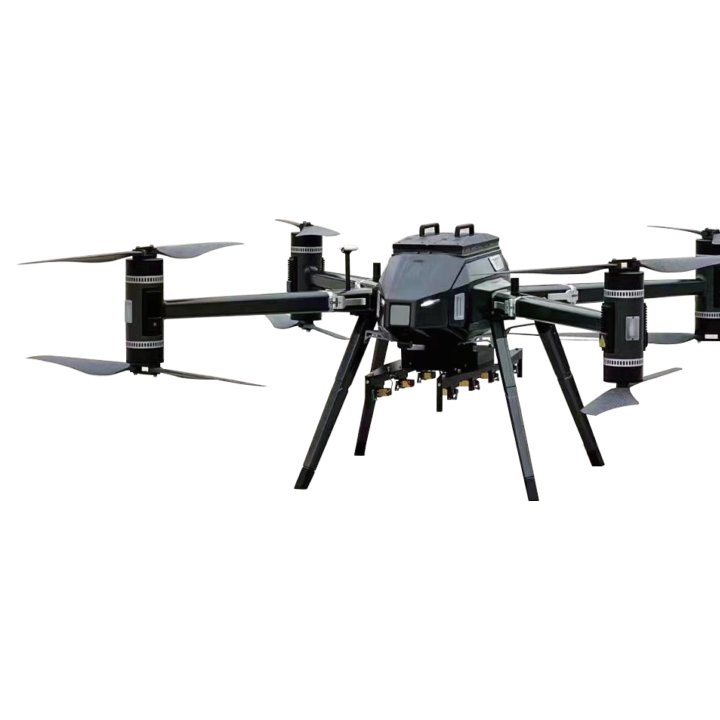
The China Moneypro 10 represents the pinnacle of heavy-lift industrial VTOL drone technology, engineered for the most demanding professional missions where payload capacity and endurance are paramount.
Key Features – Industrial-Grade Performance
- 70kg Max Payload: Capable of carrying advanced LiDAR systems, multispectral sensor arrays, or substantial emergency supplies for disaster response operations.
- Extended 60-Minute Flight: With a 12 m/s cruising speed, it efficiently covers large areas for mapping, surveying, and infrastructure inspections.
- 20–30km Transmission: Dual-link redundancy ensures reliable control, with optional 4G/5G integration for uninterrupted operations in challenging environments.
| Category | Details |
|---|---|
| Dimensions | Folded: 860×860×850 mm (portable) / Unfolded: 1,587×1,514×891 mm |
| Weight | 70kg (aircraft) / 140kg max takeoff |
| GNSS | GPS+GLONASS+BeiDou+Galileo (cm-level RTK optional) |
| Wind Resistance | Level 6 (12 m/s) with IP54 dust/water protection |
| Altitude | Operates up to 5,000m for mountainous/offshore missions |
| Temperature Range | -20°C to 60°C operation with heated battery systems |
Advanced Navigation & Durability
The Moneypro 10 features multi-constellation GNSS that automatically switches between GPS, GLONASS, and BeiDou for signal stability in challenging environments. Its operational temperature range of -20°C to 60°C with heated batteries enables Arctic operations and oil rig deployments. The modular design allows quick-swap payload bays for thermal cameras, gas detectors, hyperspectral sensors, and other specialized equipment.
Industrial Applications
3.2 China Moneypro 4: High-Capacity Industrial Workhorse
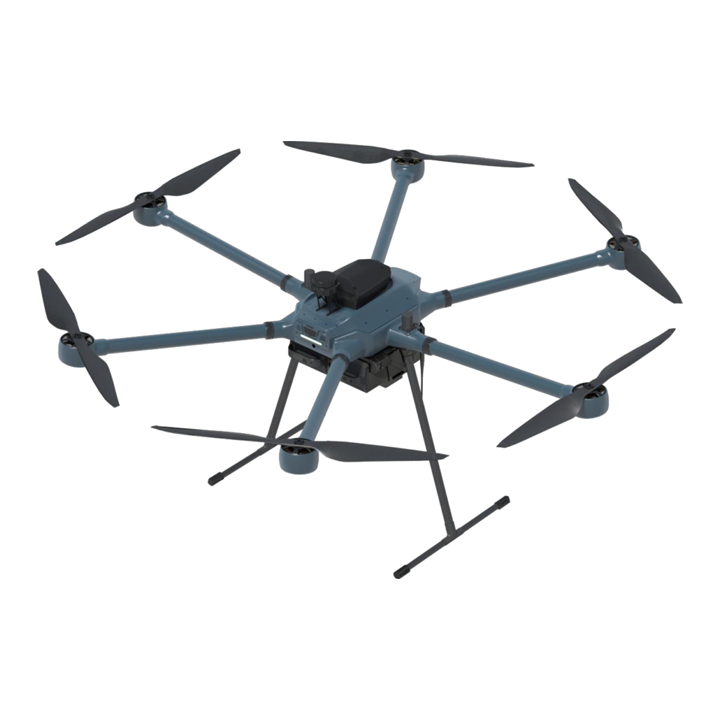
The China Moneypro 4 is engineered for demanding professional missions requiring substantial payload capacity with exceptional endurance, making it ideal for large-scale industrial operations.
This high-capacity industrial VTOL drone features a 10 kg payload capacity, 70-minute flight time, and 30 km transmission range. With its 1650mm wheelbase and IP54-rated rugged construction, it excels in large-scale mapping, heavy cargo delivery, and infrastructure inspection, operating flawlessly in -20°C to 60°C temperatures and Level 6 winds.
Packaging & Dimensions
- Drone Size (Assembled): 1650 × 1650 × 560 mm
- Wheelbase: 1650 mm
- Aircraft Weight: 18 kg (28 kg max takeoff weight)
- Package Dimensions:
- Fuselage Box: 830 × 750 × 600 mm (26.5 kg)
- Arm Box: 1090 × 440 × 300 mm (12.6 kg)
- Total Shipping Weight: 39.1 kg (modular packaging for easy transport)
Applications
- Heavy Cargo Delivery: Medical supplies, disaster relief equipment, and military logistics in remote or inaccessible locations.
- Oil & Gas Inspections: Pipeline monitoring, rig inspections, and flare stack analysis with integrated thermal imaging systems.
- Large-Scale Surveying & Mapping: LiDAR and photogrammetry applications for mining, construction, and agricultural operations.
- Search & Rescue: Long-range payload drops, thermal detection in remote areas, and emergency communication relay.
The Moneypro 4’s modular design allows rapid configuration for different missions, while its robust construction ensures reliability in harsh industrial environments. The extended flight time enables comprehensive inspection of large infrastructure assets without frequent landings.
3.3 Additional Top-Performing Industrial VTOL Drones
3.3.1 WingtraOne GEN II: Survey-Grade Mapping VTOL
Specializing in high-precision surveying, the WingtraOne features PPK/RTK capabilities with 0.8cm horizontal and 1.5cm vertical accuracy. Its 55-minute flight time and 2.6kg payload capacity support professional mapping cameras and sensors.
3.3.2 Quantum-Systems Trinity F90+: Long-Range Hybrid
This hybrid VTOL combines multirotor versatility with fixed-wing efficiency, achieving 90+ minutes flight time with 2.5kg payload. Its 25km range and 70km/h cruise speed make it ideal for linear infrastructure inspections.
3.3.3 DJI Matrice 350 RTK: Versatile Industrial Platform
While not a pure VTOL, the Matrice 350’s vertical takeoff capability, 2.7kg payload, and 55-minute flight time with comprehensive SDK support make it a versatile choice for diverse industrial applications.
3.3.4 Skyfront Perimeter 8+: Extreme Endurance
With 5+ hours of flight time using gasoline-electric hybrid propulsion, this VTOL covers 150km+ ranges for pipeline monitoring, border patrol, and large-scale agricultural surveys.
3.3.5 Atmos Marlyn: Heavy Payload Specialized
Capable of carrying 15kg for 40 minutes, the Marlyn is designed for specialized payloads like hyperspectral imagers and advanced sensor suites for scientific and industrial research.
3.3.6 Harris Aerial H6 Electric: Agriculture Focus
Optimized for precision agriculture with 10kg payload capacity and 45+ minute flight time, featuring interchangeable spraying systems and multispectral imaging packages.
4. Comparative Analysis: Specifications Table
| Model | Payload Capacity | Flight Time | Max Range | Wind Resistance | Key Applications |
|---|---|---|---|---|---|
| China Moneypro 10 | 70 kg | 60 minutes | 30 km | Level 6 (12 m/s) | Heavy logistics, large-scale mapping, emergency response |
| China Moneypro 4 | 10 kg | 70 minutes | 30 km | Level 6 | Cargo delivery, infrastructure inspection, surveying |
| WingtraOne GEN II | 2.6 kg | 55 minutes | 25 km | Level 5 | Surveying, mapping, precision agriculture |
| Quantum-Systems Trinity F90+ | 2.5 kg | 90+ minutes | 25 km | Level 6 | Linear inspections, mapping, surveillance |
| DJI Matrice 350 RTK | 2.7 kg | 55 minutes | 20 km | Level 6 | Inspections, mapping, public safety |
| Skyfront Perimeter 8+ | 4.5 kg | 5+ hours | 150+ km | Level 6 | Pipeline monitoring, large-area survey, surveillance |
| Atmos Marlyn | 15 kg | 40 minutes | 15 km | Level 5 | Research, specialized sensor deployment |
| Harris Aerial H6 Electric | 10 kg | 45 minutes | 20 km | Level 5 | Precision agriculture, spraying, crop monitoring |
5. Industrial Applications and Use Cases
5.1 Energy and Utilities
VTOL UAV for industrial energy applications has transformed inspection and maintenance workflows. Drones like the China Moneypro series enable:
- Transmission Line Inspections: Automated flights capture high-resolution imagery of thousands of towers, identifying corrosion, damaged insulators, and vegetation encroachment with reduced risk to personnel.
- Solar Farm Analysis: Thermal imaging identifies underperforming panels, while multispectral data monitors soiling and degradation across large installations.
- Wind Turbine Inspection: High-zoom cameras and LiDAR detect blade defects, leading edge erosion, and structural issues without requiring climbing or crane operations.
5.2 Mining and Construction
The industrial VTOL drone provides critical data for resource management and project monitoring:
- Volumetric Calculations: Regular drone surveys accurately measure stockpile volumes, enabling precise inventory management and reconciliation.
- Site Progress Monitoring: Daily or weekly flights create 4D models of construction sites, tracking progress against plans and identifying deviations early.
- Safety Compliance: Drones inspect highwalls, slopes, and tailings dams for stability issues, reducing ground-based inspection risks.
5.3 Agriculture and Forestry
Precision agriculture benefits significantly from VTOL UAV capabilities:
- Crop Health Monitoring: Multispectral and hyperspectral sensors detect nutrient deficiencies, disease outbreaks, and water stress before visible symptoms appear.
- Precision Spraying: Targeted application of pesticides, herbicides, and fertilizers reduces chemical usage by 30-50% compared to traditional methods.
- Forest Management: LiDAR-equipped drones inventory timber resources, monitor forest health, and plan harvesting operations with minimal environmental impact.
5.4 Emergency Response and Public Safety
Heavy-lift VTOL UAV for industrial emergency applications saves lives and property:
- Search and Rescue: Thermal imaging and AI-powered person detection locate missing individuals in wilderness or disaster zones.
- Disaster Assessment: Rapid post-event surveys evaluate damage to infrastructure, prioritize response efforts, and support insurance claims.
- Emergency Delivery: Drones transport medical supplies, communication equipment, or life-saving devices to inaccessible locations during floods, earthquakes, or other emergencies.
6. Frequently Asked Questions
VTOL (Vertical Take-Off and Landing) drones combine the best features of multirotor and fixed-wing platforms. They can take off and land vertically like multirotors (requiring minimal space) while transitioning to efficient forward flight like fixed-wing aircraft for extended range and endurance. This makes them ideal for industrial applications requiring both precise maneuvering near structures and efficient coverage of large areas.
The China Moneypro 10’s 70kg payload capacity is exceptional in the drone industry, where most heavy-lift drones max out at 10-20kg. This capacity enables unique applications: carrying multiple high-end sensors simultaneously (LiDAR + multispectral + thermal), transporting substantial emergency supplies (medical equipment, communication gear), or deploying specialized industrial instruments that were previously only helicopter-portable. It essentially creates airborne “work platforms” rather than just sensor carriers.
Heavy-lift drones (typically over 25kg maximum takeoff weight) face stricter regulations worldwide. Operators must consider: special certifications for pilots, airspace authorization requirements, potential need for type certification of the aircraft, insurance considerations for high-value payloads, and specific operational limitations based on jurisdiction. Many countries have developing regulations for “beyond visual line of sight” (BVLOS) operations which are essential for maximizing the value of long-range industrial drones.
Industrial environments often present challenging conditions. High winds (Level 6+, 12+ m/s) require drones with substantial power reserves and aerodynamic stability like the China Moneypro series. Extreme temperatures (-20°C to 60°C) demand heated/cooled battery systems and components rated for thermal extremes. Precipitation resistance (IP54 or higher) protects electronics during operations. The top industrial VTOLs are specifically engineered for these conditions, unlike commercial drones with more limited environmental tolerances.
ROI calculations should consider: reduced personnel requirements for inspections/surveys, decreased downtime for equipment/assets being inspected, improved data quality leading to better decisions, safety improvements reducing accident costs, new capabilities enabling previously impossible tasks, and efficiency gains from automated data collection/processing. Most industrial drone deployments show 3-12 month payback periods, with particularly strong ROI in hazardous environment inspections, large-scale surveying, and emergency response applications.
7. Conclusion and Recommendations
The evolution of VTOL UAV for industrial applications has reached a maturity point where these systems provide not just incremental improvements but transformative capabilities across multiple sectors. From the heavy-lift prowess of the China Moneypro 10 to the endurance-optimized China Moneypro 4, today’s industrial drones are engineered solutions rather than adapted consumer technology.
For organizations considering industrial VTOL drone adoption, we recommend:
- Start with Specific Use Cases: Identify 2-3 high-value applications where drones can solve existing pain points or create new capabilities.
- Consider Total Cost of Ownership: Evaluate not just purchase price but training, maintenance, software, and regulatory compliance costs.
- Prioritize Data Integration: Choose platforms that integrate with existing workflows and data systems (GIS, BIM, asset management).
- Plan for Scalability: Select systems that can grow with your needs, both in terms of payload options and operational capabilities.
- Evaluate Support Ecosystem: Consider manufacturer support, local service availability, and developer community for custom solutions.
The VTOL UAV for industrial sector continues to advance rapidly, with emerging technologies like AI-powered autonomy, advanced sensor fusion, and hybrid propulsion systems promising even greater capabilities. Organizations that strategically integrate these platforms today will build competitive advantages in data-driven decision making, operational efficiency, and safety performance.