


Quick Answer: Absolute Ramjet Velocity Limits
A conventional pure ramjet operates efficiently between Mach 2.0 and Mach 5.0 (approximately 1,500 to 3,800 mph, or 2,400 to 6,100 km/h). Its practical aerodynamic upper threshold is strictly capped at Mach 6.0. Beyond Mach 5.0 to 6.0, shock-induced decelerations slow incoming air down to subsonic speeds inside the combustor, generating extreme total temperatures that dissociate molecular oxygen and nitrogen. This chemical breakdown halts combustion efficiency and melts conventional combustion liners. To travel faster than Mach 6, vehicles must transition to supersonic combustion ramjets, known as scramjets.
Table of Contents
- What Is a Ramjet and What Governs Its Velocity?
- Quick Summary: Ramjet Velocity & Operating Envelopes
- Internal Aerodynamics: Why Ramjets Cannot Function Below Mach 1
- The Mach 5.0 to 6.0 Barrier: Dissociation and Thermal Limits
- Propulsion Comparison: Turbojet vs. Ramjet vs. Scramjet vs. Rocket
- Pros and Cons of Ramjet Systems in Practical Applications
- Mission Profiles: Who Needs Ramjets vs. Alternative UAV Propulsion
- Tactical Alternatives: High-Reliability Powerplants for Long-Endurance Drones
- Common Misconceptions When Evaluating Ramjet Propulsion
- System Integration & Procurement Considerations
- Expert Recommendation: Sourcing Strategy and Propulsion Choice
- Frequently Asked Questions (FAQ)
- Authoritative References
What Is a Ramjet and What Governs Its Velocity?
A ramjet is an air-breathing jet engine that uses the forward motion of the vehicle to ingest and compress incoming atmospheric air without a mechanical compressor. Unlike turbojets that rely on rotating axial or centrifugal turbine blades to compress air, a ramjet relies exclusively on geometric contraction within its inlet diffuser. Because there are no moving rotating components exposed to high combustion gas paths, the engine is mechanically simple, highly durable, and capable of extreme supersonic sprint speeds.
However, the question of how fast can a ram jet go is dictated by a strict aerodynamic compromise. At speeds lower than Mach 1.5, the compression ratio created by the forward ram effect is insufficient to achieve stable combustion or produce positive net thrust. As flight speeds increase past Mach 3.0, the ram effect creates exceptional thermal and propulsive efficiency. The propulsion threshold peaks near Mach 3.5 to 4.5. Beyond this speed, incoming dynamic pressure converts into tremendous friction-driven heat, introducing severe thermodynamic limits that dictate when an engine must either shut down or transition into scramjet mode.
Quick Summary: Ramjet Velocity & Operating Envelopes
To understand where conventional ramjets operate compared to adjacent aerospace technologies, review the practical operating ranges outlined below:
| Propulsion Type | Combustion Subsystem | Practical Operational Speed | Maximum Theoretical Limit | Primary Limiting Factor |
|---|---|---|---|---|
| Subsonic Gas Turbine | Subsonic Flameholder | Mach 0.0 to 0.9 | Mach 1.2 | Turbine blade centrifugal & heat stress |
| Supersonic Afterburning Turbojet | Subsonic Combustor / Afterburner | Mach 0.0 to 2.2 | Mach 3.2 | Compressor face total stagnation temperature |
| Pure Conventional Ramjet | Subsonic Combustor | Mach 2.0 to 5.0 | Mach 6.0 | Thermal dissociation of air molecules |
| Scramjet (Supersonic Ramjet) | Supersonic Combustor | Mach 5.0 to 10.0+ | Mach 15.0+ | Supersonic mixing time & leading-edge ablation |
| Solid / Liquid Chemical Rocket | High-Pressure Closed Chamber | Mach 0.0 to 25.0+ | Orbital Velocity | Onboard oxidizer mass consumption |
Internal Aerodynamics: Why Ramjets Cannot Function Below Mach 1
A ramjet operates using three sequential thermodynamic zones: the intake diffuser, the combustion zone, and the convergent-divergent exhaust nozzle. When traveling supersonically, the engine’s external cowl and internal intake centerbody generate complex conical oblique shock waves. These shock waves drop the speed of incoming supersonic air down to subsonic velocity (typically Mach 0.2 to 0.4) directly ahead of the fuel injectors.
From our experience with high-speed aerospace platforms, deceleration from supersonic to subsonic speed causes a sudden stagnation pressure and temperature surge. The subsonic airflow mixes with atomized jet fuel (such as kerosene, JP-10, or RJ-4) and passes through mechanical flameholders. Ignition generates continuous combustion, and the hot exhaust gases are expanded out the convergent-divergent nozzle to generate forward thrust.
Because static air cannot be compressed without forward motion, a pure ramjet produces zero static thrust at standstill. It cannot lift off from a runway or launch from a standard launch rail independently. In most professional situations, the platform must be boosted to at least Mach 1.5 to 2.0 using a solid-propellant rocket booster, a high-thrust booster rocket, or an air-dropped release from a supersonic carrier aircraft before the ramjet can ignite.
The Mach 5.0 to 6.0 Barrier: Dissociation and Thermal Limits
If higher velocities yield greater ram pressure, why can a conventional ramjet not achieve Mach 8 or Mach 10? The answer lies in total stagnation temperature and atmospheric chemistry.
When air traveling at Mach 6 is compressed subsonically inside the engine inlet, the kinetic energy of the incoming fluid converts into thermal energy. At Mach 6, the internal temperature of the unburned air inside the diffuser spikes beyond 1,700 degrees Celsius (3,100 degrees Fahrenheit) before combustion even starts. At these extreme temperatures, several insurmountable barriers occur:
- Chemical Dissociation: Ambient oxygen and nitrogen molecules physically tear apart (dissociate) into free radicals. When fuel is injected into dissociated air, standard combustion reactions fail to release net energy. Instead of releasing heat, additional fuel input causes endothermic reactions, reducing net thrust.
- Internal Pressure Losses: Strong normal shock waves in the diffuser cause massive stagnation pressure drop-offs. The pressure recovery drops sharply, meaning the engine burns fuel with rapidly declining thermal efficiency.
- Materials Breakdown: Standard nickel alloys, titanium structures, and ceramic thermal barrier coatings reach their structural limits. Active regenerative fuel cooling cannot absorb the ambient heat loads encountered at prolonged sustained speeds past Mach 5.
For these reasons, Mach 5.5 to 6.0 represents a hard physical ceiling for standard ramjets. Pushing higher requires changing the physical architecture entirely to a scramjet, where the combustion process occurs inside an air stream that remains supersonic throughout the entire engine core.
Propulsion Comparison: Turbojet vs. Ramjet vs. Scramjet vs. Rocket
Selecting an aerospace powerplant requires matching vehicle operational parameters, range targets, and flight profiles against propulsion characteristics:
| Evaluation Metric | Standard Turbojet | Conventional Ramjet | Scramjet System | Solid Rocket Motor |
|---|---|---|---|---|
| Static Takeoff Capability | Independent (Static Thrust > 0) | Zero (Requires Booster) | Zero (Requires Mach 4.5+ Boost) | Independent (High Instant Thrust) |
| Specific Impulse (Isp – Efficiency) | High (2,500 – 4,000 s) | Medium-High (1,000 – 1,800 s) | Medium (800 – 1,500 s) | Low (220 – 300 s) |
| Mechanical Complexity | Very High (Turbines, Bearings, Shafts) | Low (Zero Rotating Parts) | Low (Strict Geometry, Zero Moving Parts) | Very Low (Casing, Propellant Grain, Nozzle) |
| Cost per Flight Hour | High | Moderate (Single-mission / Target drone) | Extremely High (Experimental / Defense) | Low to Moderate (Single-use expendable) |
| Altitude Sweet Spot | 0 to 15,000 m (0 – 50,000 ft) | 12,000 to 30,000 m | 25,000 to 45,000 m | Sea Level to Vacuum (No air limit) |
Pros and Cons of Ramjet Systems in Practical Applications
Before committing capital to high-speed propulsion platforms, engineers and procurement specialists must weigh the performance benefits against structural and operational complexities:
| Advantages (Pros) | Disadvantages & Operational Drawbacks (Cons) |
|---|---|
| High Specific Impulse vs. Rockets: Because ramjets scoop oxygen directly from ambient air, they carry only fuel, providing two to four times the specific impulse of chemical rockets in the Mach 2 to 4 band. | Zero Zero-Speed Launch Capability: Requires expensive, heavy two-stage propulsion systems or booster rockets to accelerate to ignition speeds above Mach 1.5. |
| No Moving Parts in Gas Path: Absence of turbine blades, shafts, and lubrication loops makes manufacturing cheaper and shelf-storage life significantly longer for target drones and missiles. | Severe Thermal Dissociation Limits: Hard-capped at Mach 5.5 to 6.0. Cannot achieve hypersonic sprint speeds without transitioning into full supersonic combustion scramjet mode. |
| Extended Supersonic Dash Range: Maintains high cruising speeds over long distances far more efficiently than an afterburning turbojet, which consumes excessive fuel when supersonic. | Inlet Unstart Risk: Small changes in angle-of-attack or flight attitude can disrupt diffuser shockwave geometry, causing instantaneous engine flameout or airframe structural shock. |
Mission Profiles: Who Needs Ramjets vs. Alternative UAV Propulsion
In aerospace and uncrewed vehicle operations, platform speed must match the mission payload and surveillance profile. Ramjets are specialized engines designed for narrow operational bands.
Who Needs a Ramjet:
- Long-Range Supersonic Strike Systems: Military defense programs developing standoff missiles that cruise at Mach 3.0 to 4.0 to penetrate modern air defense radars.
- High-Speed Threat Simulation: Defense testing agencies utilizing target drones to simulate anti-ship cruise missile threats against naval combat vessels.
- Supersonic Interceptor Platforms: Autonomous or piloted quick-reaction defensive interceptors that climb rapidly to high altitudes to intercept airborne threats.
Who Should NOT Use a Ramjet:
- Tactical Surveillance and Reconnaissance: For persistent optical and infrared surveillance, platforms need loiter time, not Mach 3 transit. High-speed vibration degrades sensor accuracy in an EO/IR Gimbal camera payload and limits loiter time over target zones.
- Border Patrol and Security Drones: Units monitoring perimeters using Military and Police Drones need multi-hour flight endurance and quiet operational signatures, which ramjets cannot provide.
- Multi-Sensor Industrial Mapping: Commercial users carrying survey systems with GPS RTK / GNSS Antenna Modules require stable platforms operating at subsonic speeds under controlled airspace envelopes.
- Environmental and Agricultural Applications: Low-altitude aerial dispersion conducted by an Agriculture Drone operates around 15 to 30 km/h, making high-thrust turbine or piston powerplants the only viable option.
Tactical Alternatives: High-Reliability Powerplants for Long-Endurance Drones
While theoretical discussions focus on Mach 4 ramjet sprints, real-world commercial and defense deployments depend on accessible, reliable propulsion systems. For commercial users, defense contractors, and specialized drone builders, piston and turbine engines provide predictable operational costs, simple maintenance, and high payload-to-weight ratios without complex rocket booster stages.
For heavy-duty applications requiring sustained thrust, extended loiter times, and low fuel consumption, professional two-stroke internal combustion aircraft engines remain the primary workhorse across mid-to-large tactical UAVs.
Professional Heavy-Duty UAV Powerplant: China Moneypro MOPWGT275
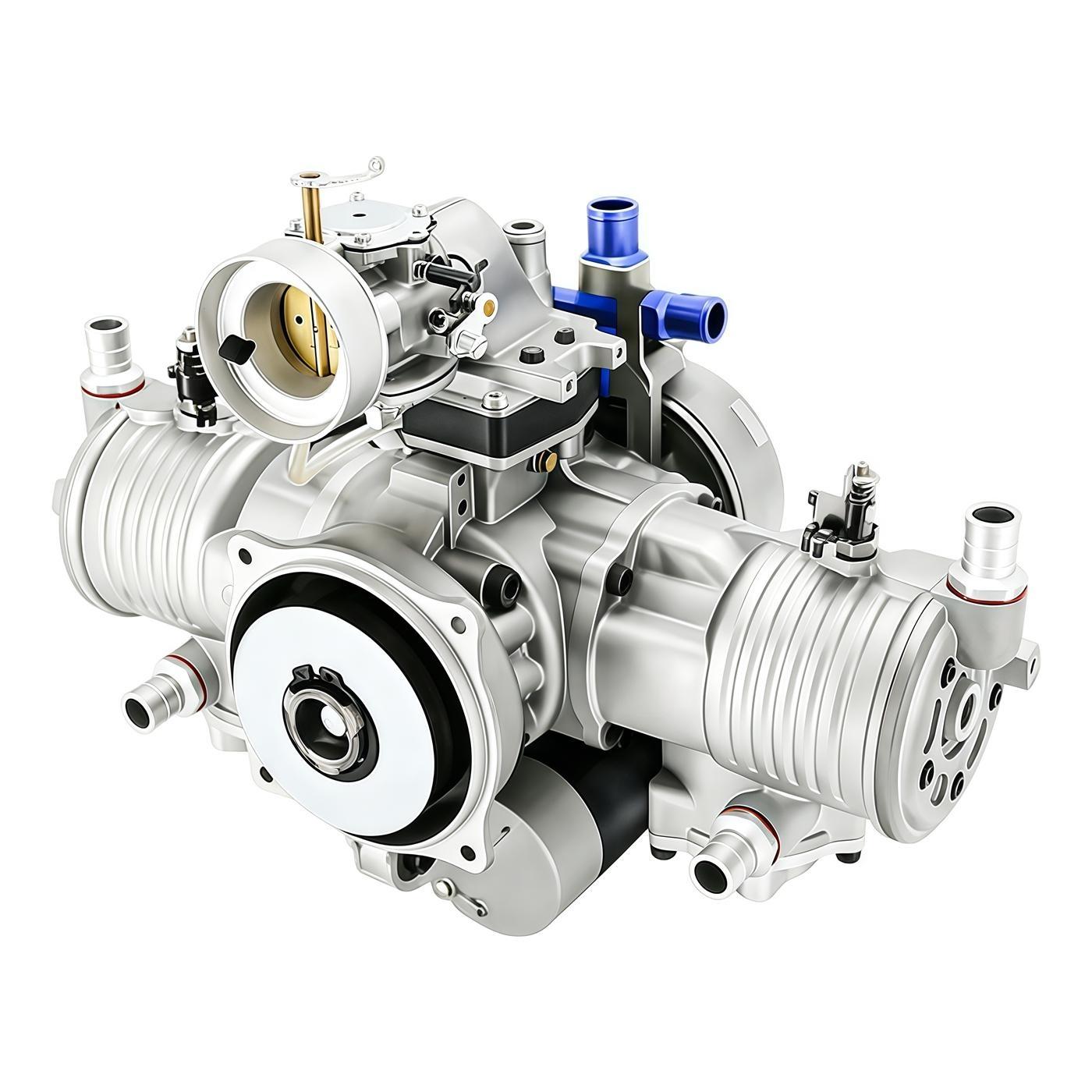
When operational missions demand high reliability, sustained endurance, and independent field takeoff, high-speed experimental ramjets are impractical. For tactical platforms, target drones, and industrial mapping aircraft, the China Moneypro MOPWGT275 provides industrial-grade propulsion built for demanding flight hours.
Engineered for high-end uncrewed aircraft systems, this twin-cylinder horizontally opposed powerplant delivers stable torque across varied altitudes, offering a proven propulsion baseline for platforms equipped with advanced Radar Systems and synthetic aperture sensors.
View complete engineering specifications on the China Moneypro MOPWGT275 product page.
For platforms seeking higher altitude operational ceilings or clean-fuel integration, explore dedicated Turbo Engines engineered for high power-to-weight output, or configure custom airframes with Industrial Drone platforms for long-range missions.
Common Misconceptions When Evaluating Ramjet Propulsion
In our testing and review of engineering specs across early-stage programs, project teams frequently make critical assumptions regarding ramjet viability:
- Myth 1: A ramjet can operate from a runway with an afterburner. False. A pure ramjet cannot produce thrust at zero airspeed. Without an integrated turbine core (like a turboramjet) or a secondary rocket booster, the vehicle will not move off the ramp.
- Myth 2: Ramjets and scramjets are interchangeable terms. False. A ramjet drops incoming air to subsonic velocity before the fuel injector array. A scramjet slows the air down somewhat, but keeps it traveling supersonically through the entire combustion chamber. Scramjets operate above Mach 5, whereas conventional ramjets stall chemically near Mach 5.5 to 6.0.
- Myth 3: Mach 3 flight works with standard commercial sensors. False. Operating at Mach 3+ creates severe aerodynamic skin heating. Standard radomes and sensor pods melt. Vehicles need specialized sensor glass or thermal management loops, such as those integrated into high-speed Infrared Thermal & Laser Sensing systems.
- Myth 4: Faster speed always improves mission effectiveness. False. Flying at Mach 4 cuts target identification times to split seconds. If your data link lacks ultra-low latency, real-time control is lost. High-bandwidth communication lines, such as a Wireless Broadband Mesh Network Radio, must be matched with vehicle velocity to prevent signal degradation through plasma sheaths or rapid directional changes.
System Integration & Procurement Considerations
When selecting a high-speed propulsion system, evaluate the complete balance-of-plant requirements rather than just raw engine cost:
- Booster Integration Overhead: Calculate the cost, weight, and regulatory compliance of integrating a solid-propellant booster to accelerate your vehicle to Mach 2. In many tactical systems, the booster stage accounts for over 50% of launch mass and substantial procurement expense.
- Inlet Aerodynamic Sensitivity: Off-design flight attitudes can trigger “inlet unstart,” expelling the shock wave system forward out of the cowl. This results in sudden loss of thrust, intense asymmetric drag, and airframe failure. Verify whether your flight control computer can handle rapid shock wave stability adjustments.
- Thermal Shielding and Fuel Coking: Fuel acts as a primary heat sink in high-speed systems before injection. At speeds approaching Mach 4.5, high temperatures inside fuel delivery lines cause hydrocarbon fuels to “coke,” depositing solid carbon that blocks injector nozzles. Specialized endothermic fuels or heat-resistant additives must be factored into your operating budget.
- Payload Environment: Ensure interior avionics bays are insulated. Operating in the Mach 3 to 5 range subjects payloads to sustained structural heating, necessitating specialized payload bays.
Expert Recommendation: Sourcing Strategy and Propulsion Choice
From our experience across aerospace test programs and commercial drone manufacturing, we recommend the following practical approach:
For speed-critical strike and supersonic target operations: If your operational profile strictly mandates sprint speeds between Mach 2.5 and Mach 4.5 across medium-to-high altitudes, a ramjet is the most efficient chemical propulsion system available. It provides superior specific impulse compared to solid rockets while eliminating the mechanical failure points of rotating turbine discs. Ensure your team budgets adequately for the primary solid-fuel booster stage and high-temperature carbon-carbon or ceramic matrix structural components.
For tactical surveillance, cargo, industrial inspection, and defense patrols: Do not design around a ramjet. The mechanical simplicity of the engine is overshadowed by the operational penalties of booster staging, thermal degradation, and brief flight endurance. For commercial users and industrial platforms, standard high-efficiency internal combustion systems, such as the China Moneypro MOPWGT275, or advanced turboprops provide reliable power, zero-boost runway launches, and hours of continuous airborne loiter time at a fraction of the cost.
Frequently Asked Questions (FAQ)
How fast can a ram jet go at maximum theoretical efficiency?
A conventional ramjet achieves its maximum efficiency between Mach 3.0 and Mach 4.0. Its absolute physical ceiling is bounded between Mach 5.5 and Mach 6.0. Beyond this speed, incoming air heats up to levels that cause oxygen dissociation, preventing combustion from producing positive net thrust.
Can a ramjet take off from a runway on its own?
No. A pure ramjet produces zero static thrust at zero airspeed because it lacks rotating compressor blades to compress stationary air. It requires external assistance, such as a rocket booster, a catapult, or an air drop from a mothership, to reach speeds above Mach 1.5 before it can ignite.
What is the difference between a ramjet and a scramjet?
The primary difference is the internal airflow speed inside the combustor. A ramjet uses intake shock waves to slow incoming supersonic air down to subsonic speeds before it reaches the fuel injectors. A scramjet (Supersonic Combustion Ramjet) maintains supersonic airflow throughout the entire engine core, allowing it to operate efficiently above Mach 5.0 up to Mach 10.0 or higher.
What is the fastest ramjet-powered vehicle ever flown?
The Lockheed SR-71 Blackbird’s Pratt & Whitney J58 engines functioned as turboramjets, operating as continuous bleed ramjets at cruise speeds above Mach 3.2. Dedicated experimental ramjet missile systems, such as the French ASMP and Russian P-800 Oniks, routinely operate between Mach 3.0 and Mach 4.5.
Why are ramjets rarely used on commercial civilian aircraft?
Ramjets are impractical for civil aviation because they cannot operate at low speeds or taxi on runways. They generate intense noise, lack fuel efficiency at subsonic cruising speeds, and require auxiliary rocket boosters to get airborne. Turbofans remain the industry standard for commercial travel.