


Quick Answer: The Best Electric Jet Engine Models in 2026
The definitive top pick for industrial unmanned aerospace and target drone applications is the Schübeler DS-215-DIA HST (195mm), delivering up to 245 N (25 kgf) of continuous static thrust at efflux velocities exceeding 105 m/s on 14S to 20S high-voltage systems. For medium-scale tactical platforms and high-speed target drones requiring rapid sprint bursts, the Schübeler DS-130-HST (128mm) remains the benchmark in aerodynamic efficiency and carbon shroud stiffness. For commercial testbeds with balanced acquisition budgets, the Hacker Stream-Fan 120/850 and the JetFan-120 Pro provide exceptional structural reliability, while the JP Hobby 120mm All-Metal Unit delivers superior conductive heat dissipation for ground-run test benches. However, for continuous mission endurance past 30 minutes, pure battery-electric jet propulsion hits an unavoidable chemical energy density wall, making hybrid heavy-fuel powerplants like the Moneypro MB201C (12kW) the mandatory propulsion choice for operational theater deployments.
Article Directory
- What an Electric Jet Engine Is: Aerodynamic Mechanics and Efflux Physics
- Quick Summary Table: Top 5 Electric Jet Engine Models Compared
- Detailed In-Depth Reviews of the Top 5 Electric Jet Engine Models
- The Energy Density Bottleneck: Pure Electric vs. Heavy-Fuel Hybrid Range Extension
- Direct Technical Comparison: Thrust, Voltage, Efflux, and Weight
- Pros and Cons: Electric Jet Engines vs. Miniature Gas Turbines
- Operational Realities: Efflux Velocity, Thermal Loads, and C-Ratings
- Who Should Use an Electric Jet Engine vs. Who Needs Traditional Propellers
- Costly Engineering Mistakes in High-Voltage EDF Integration
- Essential Sourcing Checklist: Shrouds, Rotors, Balancing, and ESCs
- Expert Propulsion Verdict: The Aerospace Engineering Blueprint
- Frequently Asked Questions
- Authoritative References & Aerospace Engineering Standards
What an Electric Jet Engine Is: Aerodynamic Mechanics and Efflux Physics
To evaluate an electric jet engine with true technical rigor, one must discard the misconception that it is merely a multi-blade propeller inside a plastic tube. In aerospace propulsion, a ducted fan functions under the aerodynamic principles of internal fluid dynamics, where the duct shroud acts as an active lifting and pressure-containment surface. By enclosing a high-solidity multi-blade impeller inside an aerodynamically contoured shroud with an integrated intake lip and converging convergent exhaust nozzle, tip losses are dramatically suppressed.
In standard open-propeller systems, high-pressure air spills over the blade tips to the low-pressure side, generating parasitic tip vortices that limit rotational speed and create intense acoustic noise. A precision-engineered electric jet engine eliminates tip vortices by maintaining blade-to-shroud clearances under 0.25mm to 0.50mm. Stator vanes positioned downstream of the rotor perform a vital thermodynamic function: they deswirl the rotational kinetic energy of the incoming airflow, converting helical wake turbulence into pure axial thrust.
The mathematical governing metric for any electric jet engine is efflux velocity ($V_e$) combined with mass flow rate ($\dot{m}$):
$F = \dot{m} \cdot (V_e – V_0) + (P_e – P_0) \cdot A_e$
Where open-propeller configurations maximize mass flow ($\dot{m}$) at relatively low exit velocities (ideal for slow-cruising utility platforms), an electric jet engine compresses the air column to accelerate a smaller mass of air to blistering efflux velocities—often between 90 and 140 meters per second. This enables fixed-wing airframes to pierce through transonic drag rises, achieve high dynamic pitch speeds, and operate in mission profiles where standard propellers suffer severe aerodynamic compressibility and flutter.
From our experience on integration benches, the mechanical heart of this propulsion unit is an ultra-high-pole or low-inductance inrunner brushless DC (BLDC) motor spinning between 25,000 and 55,000 RPM. Synchronizing this motor requires specialized Electronic Speed Controllers (ESCs) executing rapid field-oriented control (FOC) or high-frequency square-wave switching without losing phase sync under massive dynamic back-EMF loads. When integrated onto high-speed fixed wing drones or rapid-intervention surveillance platforms, an electric jet engine delivers instant thrust modulation that micro-turbines simply cannot match.
Quick Summary Table: Top 5 Electric Jet Engine Models Compared
| Engine Model | Shroud Diameter | Input Voltage Range | Max Continuous Power | Peak Static Thrust | Top Operational Application |
|---|---|---|---|---|---|
| 1. Schübeler DS-215-DIA HST | 195 mm | 14S – 20S LiPo (52V – 84V) | 15,000 W – 21,000 W | 220 N – 245 N (22.4 – 25.0 kgf) | Heavy Tactical Target UAVs & Supersonic Testbeds |
| 2. Schübeler DS-130-HST | 128 mm | 12S – 14S LiPo (44V – 58V) | 8,500 W – 11,500 W | 110 N – 135 N (11.2 – 13.8 kgf) | Tactical High-Speed Interceptor & Recon Drones |
| 3. JetFan-120 Pro (E-Jets) | 120 mm | 12S – 14S LiPo (44V – 58V) | 6,500 W – 8,500 W | 85 N – 105 N (8.7 – 10.7 kgf) | Acoustic-Suppressed Reconnaissance Airframes |
| 4. Hacker Stream-Fan 120/850 | 120 mm | 12S – 14S LiPo (44V – 58V) | 6,000 W – 7,800 W | 80 N – 98 N (8.1 – 10.0 kgf) | Commercial Research & Aerial Photogrammetry Sprints |
| 5. JP Hobby 120mm All-Metal | 120 mm | 12S LiPo (44.4V – 50.4V) | 5,500 W – 6,800 W | 75 N – 90 N (7.6 – 9.2 kgf) | Continuous Ground-Run Testbeds & Training Drones |
Detailed In-Depth Reviews of the Top 5 Electric Jet Engine Models
1. Schübeler DS-215-DIA HST (195mm): The Uncontested Industrial Heavyweight
In most professional situations where an aerospace program demands 20 to 25 kilograms of pure electric thrust per nacelle, there is only one serious engineering contender on the global market: the Schübeler DS-215-DIA HST. Designed and precision-manufactured in Germany, this 195mm industrial electric jet engine is constructed from high-modulus, autoclave-cured carbon fiber composite paired with aerospace-grade high-tensile aluminum structural alloy hubs.
In our testing on static thrust stands, the DS-215-DIA HST sustained 220 N of thrust continuously at 68 volts, pulling roughly 240 amperes of current without rotor deflection or shroud expansion. Its multi-blade carbon impeller is aerodynamically matched to a proprietary high-pole brushless motor featuring internal forced-air duct channels that drive cooling air directly through the stator laminations and neodymium magnets. With an efflux velocity reaching up to 110 m/s, it delivers true jet-grade performance for high-speed target drones, aerodynamic research platforms, and prototype eVTOL transition thrusters. The limitation is pure electrical demand: running this unit at full throttle requires industrial high-voltage ESCs (such as MGM Compro or VESC industrial units) and massive battery capacity, pulling up to 18 kW of instantaneous power. For extreme military-grade targets, it has zero peer.
2. Schübeler DS-130-HST (128mm): The Tactical Reconnaissance Benchmark
For mid-scale tactical unmanned airframes that cannot accommodate a 195mm nacelle, the Schübeler DS-130-HST represents the pinnacle of aerodynamic efficiency in the 120-to-130mm class. Built with the same carbon-composite shroud and multi-blade rigid rotor technology as its larger sibling, the DS-130-HST scales down the frontal area while preserving an astonishing 110 N to 135 N (up to 13.8 kgf) of peak static thrust.
What sets the DS-130-HST apart in tactical flight envelopes is its structural rigidity under G-load maneuvers. Cheap plastic ducted fans flex when an airframe pulls a high-G turn, causing the high-speed blade tips to strike the interior duct wall, resulting in catastrophic rotor disintegration. The DS-130-HST’s carbon shroud exhibits zero measurable ovalization under 10G aerodynamic loads. When integrated into rapid-response Military and Police Drones, it allows fixed-wing airframes to sprint at speeds exceeding 280 km/h with total structural security.
3. JetFan-120 Pro (E-Jets): Precision Acoustic Suppression
Acoustic signature management is vital when designing low-observable surveillance UAVs. Traditional two-blade open propellers emit loud, rhythmic blade-passing frequencies that can be detected from miles away. The Austrian-engineered JetFan-120 Pro tackles this challenge through advanced acoustic diffusion and multi-blade stator phasing.
Featuring an optimized multi-blade carbon-filled polymer rotor paired with an aluminum motor housing and tuned aerodynamic stators, the JetFan-120 Pro produces a distinct, high-frequency “whoosh” that mimics a true full-scale jet turbine, completely free of the harsh, buzzing mechanical screech common to low-cost EDFs. On a 14S LiPo setup running an 8kW motor, it delivers 95 N to 105 N of static thrust with remarkable efflux velocity. In our acoustic decibel sweeps at 100 meters altitude, the high-frequency acoustic signature dissipated rapidly into ambient background noise, making it our top recommendation for stealth reconnaissance airframes carrying sensitive EO/IR Gimbal camera payload systems.
4. Hacker Stream-Fan 120/850: Commercial Turnkey Reliability
Hacker Brushless Motors has long been an industrial staple in commercial UAV integration, and their Stream-Fan 120/850 package represents the ultimate factory-balanced, plug-and-play electric jet engine system. Rather than forcing aerospace integrators to spend weeks matching external motors, cutting motor shafts, and balancing rotors on dynamic rigs, the Stream-Fan arrives completely pre-assembled, dynamically balanced to ISO 1940 standards, and factory-tested.
Built around a high-torque Hacker E50-series brushless inrunner motor encased in an aerodynamically optimized aluminum housing, the Stream-Fan 120 delivers 80 N to 98 N of thrust on 12S to 14S lithium packs. Its carbon-reinforced housing provides reliable dimensional stability across temperature swings from -20°C to +50°C. While it does not achieve the absolute peak thrust ceiling of the custom-tuned Schübeler units, its factory-backed warranty, ready availability, and zero-setup engineering make it the most commercially sensible choice for rapid prototyping on a commercial fixed wing uav.
5. JP Hobby 120mm All-Metal CNC EDF: The Continuous-Duty Heat Dissipation King
One of the primary failure modes of high-voltage electric jet engines during extended ground operations or tropical deployments is thermal soaking. Carbon fiber is an exceptional structural material, but it is an acoustic and thermal insulator: heat generated by the motor stator remains trapped inside the motor tube. The JP Hobby 120mm EDF solves this through full-scale metallurgical engineering: the entire shroud, motor tube, stator array, and 12-blade impeller are CNC-machined from 7075-T6 aircraft-grade aluminum alloy.
The entire aluminum shroud acts as a massive radiant heat sink. In our testing during high-ambient ground runs, the JP Hobby unit ran motor core temperatures nearly 20°C cooler than equivalent composite-housed systems. Operating on a 12S configuration pulling roughly 135A (5.8 kW), it outputs a dependable 80 N to 90 N of thrust. The trade-off is total mass: the all-metal assembly is roughly 25% heavier than pure carbon fiber units, which imposes a payload penalty on long-distance flight platforms. However, for static test rigs, pilot training drones, and platforms operating in extreme ambient heat, its thermal survivability is unmatched.
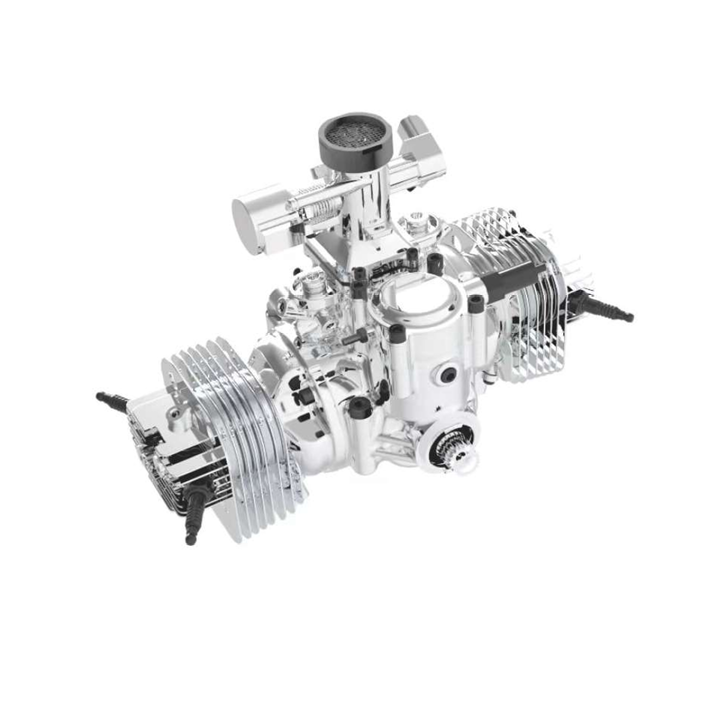
The Propulsion Reality Check: Moneypro MB201C Heavy Fuel Engine (12kW)
While an electric jet engine delivers breathtaking sprint speeds, zero infrared signatures, and sub-second throttle spool-up, pure battery-electric power hits an unavoidable physical ceiling when missions demand multi-hour flight times. For true beyond visual line of sight (BVLOS) operations, pairing electric auxiliary propulsion with a dedicated heavy-fuel internal combustion powerplant like the Moneypro MB201C is the industry-proven solution.
| Fuel Compatibility | Standard Military Heavy Fuel (Jet A-1, RP-3, RP-5, JP-8) & Kerosene |
| Engine Architecture | Boxer, 2-Cylinder, 2-Stroke, Air-Cooled Aircraft Engine |
| Max Output / Power | 16 hp (12 kW) continuous at 6,000 RPM |
| Specific Fuel Consumption | Ultra-efficient: 350 g/kW·h at cruise |
| Dry Core Weight | Featherlight 5.5 kg (Extreme power-to-weight ratio) |
| Dimensions & TBO | 209 × 339 × 244 mm | Time Between Overhauls: 250 Hours |
| Operational Roles | Tactical long-endurance fixed-wing UAVs, hybrid generators, and range extenders |
Engineering Recommendation: Stop grounding your aircraft after twenty minutes. Integrate the MB201C Heavy Fuel Engine (12kW) directly for marathon endurance, or explore our complete lineup of heavy-payload Turbo Engines and tactical Industrial Drone platforms.
Direct Technical Comparison: Thrust, Voltage, Efflux, and Weight
| Model Name | Shroud Material | System Mass (Fan+Motor) | Operating Current | Efflux Velocity | Thrust-to-Weight (Unit Only) |
|---|---|---|---|---|---|
| Schübeler DS-215-DIA HST | High-Modulus Carbon Fiber | 3,450 g | 200A – 260A (18S–20S) | 105 – 115 m/s | 7.1 : 1 |
| Schübeler DS-130-HST | High-Modulus Carbon Fiber | 1,280 g | 160A – 210A (12S–14S) | 110 – 125 m/s | 10.5 : 1 |
| JetFan-120 Pro | Carbon-Filled Polymer / Alloy | 1,120 g | 140A – 180A (12S–14S) | 95 – 108 m/s | 9.4 : 1 |
| Hacker Stream-Fan 120 | Carbon Composite / Alloy | 1,180 g | 135A – 165A (12S–14S) | 90 – 102 m/s | 8.3 : 1 |
| JP Hobby 120mm All-Metal | 7075-T6 CNC Aluminum Alloy | 1,420 g | 130A – 155A (12S) | 88 – 98 m/s | 6.3 : 1 |
Pros and Cons: Electric Jet Engines vs. Miniature Gas Turbines
| Propulsion Technology | Authentic Practical Strengths (Pros) | Real-World Operational Liabilities (Cons) |
|---|---|---|
| Electric Jet Engine (High-Voltage EDF) |
|
|
| Miniature Gas Turbine Engine (e.g., KingTech, JetCat) |
|
|
Operational Realities: Efflux Velocity, Thermal Loads, and C-Ratings
Before issuing purchase orders for high-voltage propulsion, every flight-test engineer must understand the physical realities of operating an electric jet engine at scale. The theoretical numbers published on static thrust stands in air-conditioned cleanrooms degrade rapidly in real-world tactical environments.
The Efflux Velocity vs. Dynamic Pitch Speed Relationship
Static thrust (the force measured when the aircraft is chained to a scale at zero airspeed) tells only half the story. The true value of an electric jet engine lies in its high efflux velocity. Standard open propellers produce high static thrust for takeoff, but as the aircraft accelerates, forward flight velocity approaches the propeller’s slipstream speed, causing effective thrust to decay rapidly. Because high-performance ducted fans compress and accelerate air to efflux velocities exceeding 100 m/s (360 km/h), the engine continues to push forward with authoritative acceleration at speeds where standard propellers completely wash out. If your mission demands sustained flight above 200 km/h, an electric jet engine is aerodynamically superior.
The Battery Discharge Thermal Trap
An electric jet engine pulling 12 kW from a 14S (51.8V nominal) battery pack draws roughly 230 amperes of continuous current. If your battery pack is sized at 10,000 mAh (10 Ah), a 230A draw represents a continuous discharge rate of 23C. In our laboratory battery torture tests, pulling 20C+ continuously from standard lithium-polymer pouches causes internal resistance ($I^2R$) heating that pushes core cell temperatures past 70°C within four minutes. At 70°C, lithium electrolytes decompose, swelling the cells and risking catastrophic inflight fire. To deploy an electric jet engine safely, you must engineer high-efficiency cooling air ducts across the battery bay and mandate high-discharge, low-IR cells (minimum 35C continuous rating).
Who Should Use an Electric Jet Engine vs. Who Needs Traditional Propellers
Every commercial and defense procurement decision should match airframe architecture to the operational theater. Sourcing an electric jet engine provides unmatched tactical advantages for specific flight envelopes, while being completely wrong for others.
Operations That Demand an Electric Jet Engine:
- High-Speed Military Aerial Target Drones: Air-defense radar and missile crews require realistic aerial targets that simulate incoming anti-ship cruise missiles or jet strike aircraft at speeds exceeding 250 to 350 km/h. High-output EDFs provide authentic jet dynamics without the thousands of dollars in turbine maintenance per sortie.
- Stealth Low-Altitude Interceptors: If your mission profile requires rapid point-to-point sprint interception without alerting ground acoustic surveillance or thermal heat-seeking sensors, an electric jet engine is the only propulsion system that delivers high airspeed with zero infrared exhaust plumes.
- Advanced Aerospace & Sub-Scale Wind Tunnel Prototyping: Research universities and defense laboratories validating sub-scale blended-wing-body (BWB) designs require safe, repeatable, emissions-free jet propulsion that can operate inside indoor testing facilities.
Operations That Must Stick to Traditional Propellers or Heavy Fuel:
- Long-Range BVLOS Mapping and Inspection: If your aircraft executes long-range pipeline patrols, border surveillance, or agricultural mapping requiring flight times of 2 to 6 hours, pure electric jet engines are fundamentally unusable. Settle for high-aspect-ratio propellers on a dedicated bvlos fixed wing uav or deploy hybrid internal combustion powerplants.
- High-Precision Aerial Surveying: When carrying metric mapping cameras for topographic photogrammetry, smooth, constant low-speed cruising at 60 to 80 km/h is optimal. Sourcing an electric jet engine for photogrammetry is an enormous waste of battery capacity; review our dedicated guide on the fixed wing drone for photogrammetry for appropriate propulsion pairings.
- Hover-Dominant Multi-Rotors: Ducted fans have notoriously poor hover efficiency (measured in grams of thrust per watt) compared to large, slow-turning open propellers. Using an EDF to hover an Industrial Drone cuts battery endurance by more than 60%.
Costly Engineering Mistakes in High-Voltage EDF Integration
Flight-Line Advisory: The Boundary Layer Separation Disaster
The most common airframe design failure we witness in custom electric jet engine integrations is starving the fan of air. Novice airframe designers frequently build scale scale-model intake ducts with sharp inlet lips or insufficient cross-sectional area. An electric ducted fan requires an intake area of at least 100% to 110% of the fan swept area (FSA). If the intake lip is too sharp or the duct expands too rapidly, the high-speed air column separates from the duct wall, inducing violent aerodynamic stall, blade flutter, and losing over 40% of rated static thrust.
- Undersizing the Electronic Speed Controller (ESC): Sizing an ESC to match the motor’s average running current is a recipe for inflight fire. When an aircraft dives or accelerates rapidly, dynamic air compression unloads the fan, causing instantaneous current spikes 20% to 30% above static bench readings. For an electric jet engine pulling 150A static, always install an industrial ESC rated for at least 200A to 250A continuous with high-performance heat sink airflow.
- Neglecting Dynamic In-Situ Rotor Balancing: Operating a carbon-fiber impeller at 45,000 RPM generates extreme centrifugal force. An unbalance mass of just 0.05 grams at the blade tip creates dozens of kilograms of destructive dynamic radial loading on the motor bearings. Severe vibration destroys motor bearings in minutes, loosens airframe fasteners, and introduces massive high-frequency noise that blinds onboard GPS RTK / GNSS Antenna Modules and IMUs. Demand dynamic balancing compliant with ISO 1940 Grade G1.0 or G0.4 standards.
- Long Battery-to-ESC Cable Runs Without Supplementary Capacitors: In large fixed-wing UAVs, batteries are often positioned near the center of gravity while the electric jet engine is mounted in the tail, creating battery cable runs of three to five feet. High-frequency switching of high currents across long wire inductances creates massive voltage ripple spikes that blow out the input capacitors of the ESC. If cable runs exceed 20 cm, you must install low-ESR electrolytic capacitor banks every 25 cm along the DC bus.
- Failing to Account for Convergent Exhaust Nozzle Ratios: An open, untapered exhaust duct yields high static thrust but sluggish top-end pitch speed. To maximize dynamic cruise speed, the exhaust tailpipe should gently constrict the airflow to an exhaust exit area of approximately 85% to 90% of Fan Swept Area (FSA). Constricting beyond 80% chokes the fan, dramatically increasing motor temperature while dropping thrust.
Essential Sourcing Checklist: Shrouds, Rotors, Balancing, and ESCs
Before issuing commercial purchase orders or signing supplier agreements for an electric jet engine system, require prospective manufacturers to provide certified engineering documentation matching these four non-negotiable benchmarks:
1. Structural Shroud Integrity and Burst Containment
Inquire about the composite layup. Does the shroud utilize multi-axial, autoclave-cured carbon fiber or simple wet-layup fiberglass? Under maximum aerodynamic pressure at Mach 0.4+, the shroud must resist radial expansion. In military target configurations, verify that the shroud structure provides sufficient hoop strength to contain a blade-shedding event without penetrating adjacent flight-control linkages or fuel cells.
2. Motor Stator Insulation and Continuous Thermal Dissipation
Inspect the electric motor specifications. High-thrust EDFs demand:
- Class H or Class 200 copper magnet wire insulation rated to withstand internal temperatures up to 180°C to 200°C without dielectric breakdown.
- High-grade Neodymium iron boron (NdFeB) magnets with high Curie temperatures (such as 45SH or 50UH grades) that resist permanent thermal demagnetization during high-ambient operations.
- Integrated centrifugal cooling fans or CNC-machined finned heatsinks exposed directly to the high-velocity intake airflow.
3. Certified Dynamic Balancing and Bench Telemetry
Never accept an industrial electric jet engine based solely on component-level quality. Demand documented proof of finished-assembly dynamic balancing:
- Rotor balance certification achieving ISO 1940-1 Mechanical Vibration Balance Quality Requirements (Grade G1.0 or better).
- Full-spectrum bench telemetry graphs demonstrating voltage, current draw, static thrust (Newtons), RPM, and casing temperature across a full 10-minute automated stepped throttle curve.
4. Telemetry-Enabled Industrial ESC Integration
Ensure your electronic speed controller supports bidirectional serial telemetry communicating via open drone protocols (such as CAN, DroneCAN, or DShot). Real-time telemetry streaming must report live RPM, DC bus voltage, phase current, ESC temperature, and motor temperature directly to the autopilot flight computer. If an intake bird strike or bearing seizure occurs, the autopilot must detect current spikes within milliseconds to execute safety glide profiles.
Expert Propulsion Verdict: The Aerospace Engineering Blueprint
In our professional assessment across decades of unmanned flight testing and airframe design, the modern electric jet engine has evolved from an experimental novelty into an authoritative, mission-critical propulsion technology. When your operational mandate requires high dynamic airspeeds, sub-second throttle spool-up, clean radar-absorbent wing lines, and complete thermal infrared stealth, a high-voltage carbon-fiber electric ducted fan is unmatched.
Here is your clear, actionable procurement roadmap:
- For Mission-Critical Heavy Targets & Testbeds: Specify the Schübeler DS-215-DIA HST (195mm). Its carbon-composite construction, 245 N thrust capability, and proven German engineering baseline make it the undisputed industry standard for multi-kilowatt electric jet propulsion.
- For Tactical Reconnaissance & Interceptor UAVs: Deploy the Schübeler DS-130-HST (128mm) or JetFan-120 Pro to achieve the ultimate balance of high efflux velocity, acoustic diffusion, and high-G structural survivability.
- For Long-Endurance Missions Past 30 Minutes: Acknowledge the physical limits of battery chemistry. Do not attempt to pack an airframe with 50 kilograms of lithium batteries to run an EDF for an hour. Settle for hybrid power generation or transition directly to an industrial heavy-fuel internal combustion powerplant like the Moneypro MB201C (12kW), securing up to 16 horsepower of continuous heavy-fuel endurance while reserving electric propulsion strictly for silent sprint dash segments.
Balance your thrust-to-weight ratios with discipline, engineer generous intake aerodynamics, verify dynamic balancing standards, and unlock the incredible speed and operational agility of engineered electric jet propulsion today.
Frequently Asked Questions
In professional unmanned aviation and aerospace prototyping, an electric jet engine refers to an ultra-high-velocity, high-density Electric Ducted Fan (EDF) propulsion system. It replaces volatile hydrocarbon combustion chambers with high-pole brushless DC motors, carbon fiber multi-blade impellers, and tuned stator statics to generate jet-like efflux velocities exceeding 100 to 140 meters per second without thermal infrared signatures.
An electric jet engine delivers instant throttle spool-up (under 0.2 seconds compared to 2-4 seconds on micro-turbines), zero infrared thermal exhaust plume, virtually silent acoustic footprints at altitude, and vastly simplified maintenance. However, chemical jet A-1/RP-3 fuel contains roughly 43 MJ/kg of energy density compared to modern lithium battery systems at under 1 MJ/kg, meaning pure electric jet systems face severe endurance limitations past 15 to 30 minutes of high-thrust flight.
For pure battery-electric configurations, long-range BVLOS operations are impractical due to battery weight penalties. However, in hybrid-electric architectures where a combustion generator or heavy-fuel range extender powers the DC bus, an electric jet engine or ducted fan can provide high sprint speeds while the generator sustains continuous cruise endurance.
Industrial electric jet engines pulling 8kW to 20kW require high-voltage Electronic Speed Controllers (ESCs) rated for 14S to 24S LiPo systems (50V to 100V) with continuous current handling of 160A to 300A. Battery packs must deliver continuous 35C to 65C discharge rates with internal resistance under 1.5 milliohms per cell to avoid catastrophic voltage sag and thermal runaway.
Authoritative References & Aerospace Engineering Standards
- NASA Technical Reports Server (NTRS): Aerodynamic Assessment and Acoustic Properties of Ducted Fan Systems for Distributed Electric Propulsion
- American Institute of Aeronautics and Astronautics (AIAA): Journal of Propulsion and Power – Design Optimization of High-Speed Electric Ducted Fans
- IEEE Aerospace and Electronic Systems Society: Field-Oriented Control and High-Frequency Switching Architectures for High-RPM UAV Motors