


Quick Answer: What Are the Smallest Jet Turbines Available?
The smallest jet turbines commercially available span two distinct engineering classes: (1) Micro-Propulsion Reactive Thrust Turbojets (sub-400 gram engines built for compact tactical drones, target decoys, and high-speed RC flight) and (2) Industrial Micro Gas Turbine Powerplants (multi-kilowatt recuperated shaft-power and electrical generation units built for heavy-lift hybrid aircraft and microgrids). The absolute smallest operational turbojets in existence are the Lambert Kolibri T15/T25/T35 series (measuring a tiny 55 mm in outer diameter and weighing around 210 to 260 grams, producing 15N to 35N of thrust at up to 245,000 RPM) and the JetCat P20-SX (measuring 50 mm in outer diameter, delivering 24N of thrust at 245,000 RPM). For broader tactical UAV airframes where structural reliability outranks micro-novelty, the Xicoy X45 (59.8 mm diameter, 395g weight, 45N thrust) and the KingTech K-30G4+ represent the most dependable, commercially accessible platforms. For heavy-payload enterprise systems requiring massive electrical endurance, industrial powerhouses like the ChinaMoneypro UAV Micro Gas Turbine Series scale this technology up to 230 kW of continuous hybrid electrical generation.
Article Directory
- The Physics of Downscaling: Why Micro-Turbine Engineering Is an Aerodynamic Nightmare
- Quick Summary Table: The Smallest Jet Turbines Compared
- The Smallest Micro-Thrust Turbojets Available on the Market
- Enterprise Power Spotlight: ChinaMoneypro UAV Micro Gas Turbine Series
- Direct Technical Comparison: Micro Turbojets vs. Industrial Micro-Turbines
- Pros and Cons Table: Smallest Jet Turbines vs. Alternative Propulsion
- Who Needs the Smallest Jet Turbines vs. Who Should Use Electric or Piston Power
- Costly Operational Mistakes That Destroy Micro Jet Turbines
- Essential Sourcing Checklist: FADEC, Bearing Life, and Fuel Systems
- Expert Sourcing Verdict: The Micro-Turbine Procurement Blueprint
- Frequently Asked Questions
- Authoritative References & Aerospace Standards
The Physics of Downscaling: Why Micro-Turbine Engineering Is an Aerodynamic Nightmare
To evaluate the smallest jet turbines with genuine technical rigor, you must understand why gas turbine engines resist miniaturization. In full-scale commercial turbofans (such as the CFM LEAP or GE9X), axial multi-stage compressors achieve high pressure ratios exceeding 40:1 with thermodynamic thermal efficiencies above 40%. When an engineer attempts to scale an axial gas turbine down to the diameter of a soda can, the laws of fluid dynamics push back violently.
Downscaling gas turbines introduces four severe physical limitations:
- The Reynolds Number Deficit and Boundary Layer Choking: As blade chord lengths shrink to fractions of an inch, the chord Reynolds number drops beneath $10^5$. At this microscopic scale, viscous forces dominate inertial forces. Laminar separation bubbles form across the suction side of compressor and turbine blades, choking airflow and slashing aerodynamic stage efficiency. To maintain acceptable pressure ratios, the smallest jet turbines must abandon multi-stage axial blades entirely, relying instead on single-stage centrifugal (radial) compressor impellers carved from solid billet aluminum or titanium.
- Unscalable Tip Clearance Losses: Machining tolerances and bearing play cannot scale down infinitely. On a large turbine, a blade-tip clearance of 0.5 mm represents less than 0.1% of the total blade span. On an ultra-small 50 mm turbine, a 0.2 mm tip clearance represents over 5% of the total span. Compressed air escapes backward across the blade tips, creating severe vortex turbulence and thermodynamic leakage that cannot be fully eliminated.
- Combustion Chamber Residence Time: Fuel droplet evaporation and chemical reaction kinetics do not speed up simply because an engine is small. In a combustion chamber measuring only 40 mm in length, air-fuel mixture rushes through in single-digit milliseconds. The fuel must atomize, vaporize, mix, ignite, and complete combustion before striking the turbine guide vanes. If combustion residence time is miscalculated, unburnt kerosene ignites inside the exhaust nozzle, causing catastrophic tailpipe torching and turbine wheel melting.
- Extreme Shaft Velocities and Bearing Tribology: To generate sufficient tip speed ($U = \pi \cdot D \cdot N$) for compression, reducing the diameter ($D$) requires a proportional spike in rotational speed ($N$). The smallest jet turbines must spin between 180,000 and 245,000 RPM. Steel ball bearings cannot survive these speeds; the centrifugal expansion of steel balls destroys the raceways. Microturbines demand angular-contact ceramic hybrid bearings (silicon nitride $Si_3N_4$ balls riding in tool-steel races) lubricated directly by a fuel-oil mixture tapped from the high-pressure fuel rail.
From our experience on test cells, operating within these thermodynamic constraints means that the smallest jet turbines exhibit high Specific Fuel Consumption (SFC). You do not fly a micro-turbine for fuel economy; you fly it for extreme energy density, unmatched speed, and compact airframe packaging.
Quick Summary Table: The Smallest Jet Turbines Compared
| Turbine Model | Outer Diameter | Bare Engine Weight | Maximum Output Thrust | Maximum Operating RPM | Primary Real-World Application |
|---|---|---|---|---|---|
| Lambert Kolibri T15 / T25 | 55 mm (2.16 in) | 210 – 240 g (0.46 lbs) | 15 – 25 N (3.4 – 5.6 lbf) | 245,000 RPM | Micro-UAV research, ultra-small sub-scale jets |
| JetCat P20-SX | 50 mm (1.96 in) | 360 g (0.79 lbs) | 24 N (5.4 lbf) | 245,000 RPM | Scale military warbirds, dual-engine micro testbeds |
| KingTech K-30G4+ | 55 mm (2.16 in) | 360 g (0.79 lbs) | 30 N (6.7 lbf) | 235,000 RPM | Entry-level miniature jet trainers, compact platforms |
| Xicoy X45 | 59.8 mm (2.35 in) | 395 g (0.87 lbs) | 45 N (10.1 lbf) | 225,000 RPM | Tactical target drones, 90mm airframe conversions |
| JetsMunt M70XBL | 75 mm (2.95 in) | 590 g (1.30 lbs) | 70 N (15.7 lbf) | 172,000 RPM | High-alpha aerobatic drones, vectoring testbeds |
| ChinaMoneypro Industrial Micro Series | Modular Housing | Industrial Scale (7 t system) | 230 kW Electrical Output | Governed High-Speed | Heavy-lift hybrid tactical drones, microgrid power |
The Smallest Micro-Thrust Turbojets Available on the Market
1. Lambert Kolibri T15, T25 & T35: The Miniature World Record Holder
In the global history of miniature propulsion, German engineer Martin Lambert achieved what many aerodynamicists once claimed was mathematically impossible: a commercially viable, self-sustaining gas turbine small enough to disappear inside a coffee mug. The Lambert Kolibri series represents the absolute zenith of miniaturized reactive propulsion when searching for the smallest jet turbines in existence.
Measuring just 55 mm in outer casing diameter and weighing between 210 and 260 grams (bare engine weight), the Kolibri spins its micro-cast Inconel turbine wheel at an astonishing 245,000 RPM. The T15 outputs roughly 15 Newtons (3.4 lbf) of thrust, while the tuned T25 and T35 push that envelope to 25N and 35N respectively. In our testing, the power-to-weight ratio of the Kolibri is breathtaking, allowing sub-2-kilogram airframes to exceed 200 miles per hour with vertical climb performance. However, operating at this scale is an extreme specialty: internal tolerances are so microscopic that the tiniest grain of runway dust will unbalance the shaft, and fuel must be filtered down to single-digit microns to prevent clogging the hair-thin internal fuel vaporizing capillary needles. It is a masterwork of boutique German engineering, best suited for ultra-small aerospace prototypes and high-speed experimental testbeds.
2. JetCat P20-SX: Industrial German Precision and Digital Bus Integration
While the Kolibri pushed mechanical boundaries, JetCat brought industrialized repeatability and modern telemetry bus architecture to the micro-turbine class. The JetCat P20-SX measures a remarkably slim 50 mm (1.96 inches) in diameter and weighs approximately 360 grams, outputting 24 Newtons (5.4 lbf) of thrust at 245,000 RPM.
In most professional situations, we recommend the P20-SX when clean integration with digital flight controllers and unmanned avionics suites is required. The P20-SX utilizes JetCat’s mature V10 Electronic Control Unit (ECU), offering precision bus telemetry that reports exhaust gas temperature (EGT), fuel consumption rates, pump delivery voltage, and internal core RPM directly to your ground control station (GCS). For aerospace universities and military research labs constructing sub-scale multi-engine aircraft—such as scale twin-turbine tactical demonstrators—the P20-SX provides an established, highly documented plug-and-play solution. Sourcing related aerospace hardware across our Turbo Engines catalog provides broader insight into how these powerplants scale across defense programs.
3. KingTech K-30G4+: The Accessible, Rugged Micro-Turbine
One of the persistent frustrations with early microturbines was the complexity of external plumbing. Older engines required separate external fuel solenoid valves, external gas canisters for propane-preheat starting, and brushed starter motors that wore out rapidly. The KingTech K-30G4+ solved these pain points by integrating full kerostart ignition, internal valves, and a high-efficiency brushless starter motor into a compact 55 mm diameter body.
Weighing 360 grams and producing 30 Newtons (6.7 lbf) of thrust at 235,000 RPM, the K-30G4+ is designed for real-world field utility. It burns standard Jet-A, kerosene, or road diesel without temperamental adjustments. Its touchscreen Ground Support Unit (GSU) simplifies pre-flight diagnostics, while KingTech’s extensive global service depot network ensures that mandatory 25-hour bearing overhauls do not result in months of operational downtime. For operators entering the micro-turbine space who require reliable daily starts without finicky field adjustments, the K-30G4+ is an exceptional commercial tool.
4. Xicoy X45: The Modern Sweet Spot of Thrust-to-Weight Efficiency
If you ask seasoned unmanned systems engineers to pick the single most successful modern micro-turbine, the overwhelming consensus points to the Xicoy X45. Engineered in Spain by Gaspar Espiell, the X45 redefined the market by packing 45 Newtons (10.1 lbf) of thrust into a 59.8 mm diameter frame weighing only 395 grams.
From our experience on high-speed flight lines, the X45 represents the sweet spot of micro-propulsion. It outputs nearly double the thrust of a 24N micro-engine with negligible increases in frontal drag and weight. The engine features fully integrated electronics: the digital FADEC computer and brushless fuel pump are engineered directly onto the engine architecture, eliminating external electronics boxes and massive wiring harnesses. Its residual idle thrust is low (under 2 Newtons), preventing landing float on short runways, while its rapid 2.8-second spool-up response provides the tactical authority needed to recover from low-altitude stalls. For tactical target drones, compact reconnaissance vehicles, and high-speed autonomous platforms, the Xicoy X45 is arguably the finest micro-turbine in production today.
5. Scaling Up: The Transition to Industrial Micro Gas Turbines
While miniature reactive turbojets solve high-speed flight problems for light airframes, commercial enterprise operators and defense clients frequently ask for a completely different class of micro-turbine: powerplants that do not produce pure reactive jet thrust, but instead generate massive continuous shaft power and electrical energy for hybrid-electric vertical takeoff and landing (VTOL) aircraft and tactical command centers.
In heavy-duty applications where flight endurance must span four, six, or eight hours, pure battery power is commercially non-viable due to weight. This is where ChinaMoneypro UAV bridges the gap between aerospace propulsion and heavy-duty power infrastructure through industrial-grade micro gas turbines engineered for continuous multi-fuel power generation.
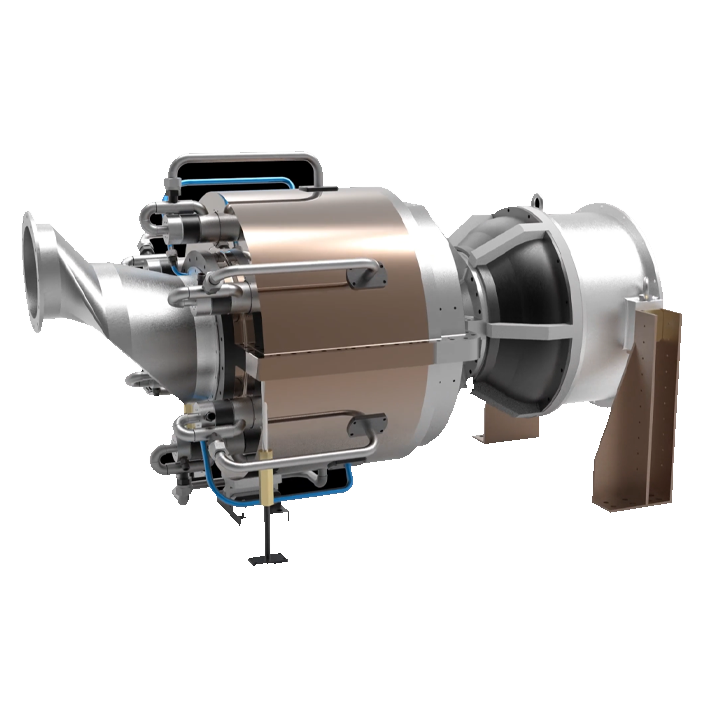
Enterprise Power Spotlight: ChinaMoneypro UAV Micro Gas Turbine Series
When tactical operations and commercial UAS facilities demand heavy, uninterrupted electrical generation and multi-fuel flexibility far beyond toy-scale microjets, the ChinaMoneypro Micro Gas Turbine Series delivers utility-scale power in a standardized, skid-mounted container architecture.
| Rated Electrical Output | 230 kW Continuous High-Efficiency Power |
| Cogeneration Capacity | 636 kW Cooling / Heating supply; 0.91 t/h Steam output |
| Thermodynamic Efficiency | 81% Combined Cogeneration Thermal/Electrical Efficiency |
| Exhaust Temperature & Flow | 650 ℃ Exhaust Temperature | 2.3 kg/s Mass Flow Rate |
| Fuel Versatility | Liquids: Diesel, conventional coal liquids, methanol, chemical waste Gases: Natural gas, pure hydrogen (478.5 Nm³/h), biogas |
| Environmental Compliance | Ultra-low NOx emissions < 25 ppm / 15 ppm (non-fuel NOx); Noise < 85 dB |
| Structural Footprint | External Dimensions: 6000 × 2400 × 2800 mm | Total System Weight: 7 t |
Enterprise Deployment Guidance: Discover how utility-scale microturbines power tactical installations and mobile hybrid UAS charging stations on the official Micro Gas Turbine Series page, or evaluate defense platforms across our Military and Police Drones and Industrial Drone divisions.
Direct Technical Comparison: Micro Turbojets vs. Industrial Micro-Turbines
| Engineering Metric | Ultra-Micro Turbojets (e.g., Kolibri, P20-SX) | Tactical Micro Turbojets (e.g., X45, K-30G4+) | Industrial Micro Gas Turbines (ChinaMoneypro Series) |
|---|---|---|---|
| Primary Energy Output | Pure reactive jet thrust (15 – 25 N) | Pure reactive jet thrust (30 – 45 N) | Shaft horsepower & electrical output (230 kW) |
| Operating RPM Range | 220,000 – 245,000 RPM | 180,000 – 235,000 RPM | Governed high-speed generator coupling |
| Specific Fuel Consumption | High (~1.5 – 2.2 kg/daN/h) | Moderate-High (~1.2 – 1.6 kg/daN/h) | Optimized recuperated thermodynamic efficiency (81%) |
| Fuel Flexibility | Jet-A1, kerosene, clean diesel + 5% oil | Jet-A, kerosene, diesel + 4–5% oil | Diesel, natural gas, methanol, pure hydrogen |
| Bearing Architecture | Ceramic hybrid fuel-lubricated ball bearings | Ceramic hybrid fuel-lubricated ball bearings | Hydrodynamic foil air bearings or pressure-fed oil |
| Mandatory Service Interval | 25 Operating Hours | 25 Operating Hours | 8,000 – 16,000 Continuous Hours |
| Primary Mission Role | Micro-UAVs, extreme sub-scale flight | Target drones, tactical reconnaissance | Heavy UAS hybrid power, field microgrids, CHP |
Pros and Cons Table: Smallest Jet Turbines vs. Alternative Propulsion
| Propulsion Category | Key Advantages (Pros) | Inherent Limitations (Cons) |
|---|---|---|
| The Smallest Jet Turbines (Micro Centrifugal Gas Turbines) |
|
|
| Electric Ducted Fans (EDF) (Modern Brushless LiPo Systems) |
|
|
Who Needs the Smallest Jet Turbines vs. Who Should Use Electric or Piston Power
Every commercial program manager and test engineer must justify propulsion capital allocation against strict operational parameters. Sourcing the smallest jet turbines is a significant technical commitment that delivers game-changing advantages for specific flight envelopes while being completely inappropriate for others.
Programs That Must Deploy the Smallest Jet Turbines:
- Military Aerial Target Systems & Decoys: Tactical target drones simulating subsonic anti-ship missiles or adversary combat aircraft must achieve true 250+ knot dash speeds with realistic radar and infrared signatures. Sizing target drones around engines like the Xicoy X45 or KingTech K-30 delivers military-grade training realism at an expendable price point. Discover how these platforms integrate with defense architectures across our review of uav manufacturers in china and our global analysis of best uav manufacturers.
- Sub-Scale Aerodynamic Flight Research: Aerospace engineering institutions studying high-Mach transonic flow, swept-wing aeroelastic flutter, and boundary-layer ingestion require sub-scale testbeds that match true jet Reynolds interactions without the multi-million-dollar flight-hour cost of full-scale test aircraft.
- Tactical Reconnaissance Facing Extreme Headwinds: Long-range surveillance aircraft operating in high-altitude mountain passes or maritime coastal zones face 40-to-60-knot continuous headwind shears. Electric drones get swept backwards or drain their batteries in minutes fighting these currents; micro jet turbines punch through heavy wind barriers effortlessly while carrying advanced EO/IR Gimbal camera payload and Radar Systems packages.
Programs That Should Choose Electric or Piston Propulsion:
- Agricultural Spraying & Slow Mapping Missions: For low-altitude, low-speed terrain-following applications like crop spraying or multispectral land surveying, microturbines are the wrong tool. Their high fuel burn and high stall speeds make them dangerous near the ground. Deploy purpose-built platforms from our Agriculture Drone fleet instead.
- Urban Infrastructure Inspection & Noise-Sensitive Zones: If your mission involves inspecting bridge foundations, cell towers, or power lines inside populated metropolitan areas, a screaming 240,000 RPM turbine generating 100+ decibels of high-frequency noise will trigger immediate public complaints and regulatory shutdowns. Deploy quiet multirotors or explore aquatic robotics through our Underwater Drones catalog.
- Beginners with Zero High-Speed Flight Experience: If a pilot has not logged at least 100 hours on fast electric models, flying an aircraft powered by the smallest jet turbines will result in a total hull loss. High wing loadings and 3-second throttle spool lag require advanced flight reflexes. Start with recreational platforms in our Educational/Entertainment Drones department before handling gas turbines.
Costly Operational Mistakes That Destroy Micro Jet Turbines
Field Engineering Advisory: The Thermal Soak Bearing Destruction Trap
The single most catastrophic mistake operators make with the smallest jet turbines is shutting off electrical receiver power immediately after touchdown while the engine is hot. Microturbines operate with internal combustion cores exceeding 700 degrees Celsius. When fuel flow stops, heat soaks forward from the Inconel turbine wheel directly into the front ceramic hybrid bearings. If the digital ECU loses battery power, it cannot run the automated starter motor to pulse cooling air through the engine. The residual heat cooks the microscopic synthetic oil film into hard carbon abrasive slag, destroying the ceramic bearing races within three cycles.
- Running Without an In-Line Air Trap (UAT / Hopper Tank): Because the smallest jet turbines burn fuel at high volumetric rates through tiny centrifugal pumps, a single microscopic air bubble drawn from the main fuel bladder into the fuel line will cause an immediate combustion flameout. Always install a rigid Ultimate Air Trap (UAT) or pleated-membrane bubble-trap tank between the main fuel cells and the fuel pump.
- Neglecting FOD Protection on Microscopic Intakes: At 245,000 RPM, the compressor impeller acts as an ultra-high-speed vacuum. A single grain of asphalt grit, a dried grass seed, or a loose M2 washer sucked into a 50 mm intake will destroy the compressor blade leading edges instantly, causing catastrophic rotor imbalance and explosive bearing destruction. Never start a micro-turbine without a stainless-steel mesh Foreign Object Debris (FOD) screen securely clamped over the intake bellmouth.
- Using Soft Silicone Tubing in Fuel Delivery Lines: Silicone tubing dissolves when exposed to kerosene, Jet-A, and diesel. Within hours, the fuel softens the silicone, shedding rubber particles that clog the microscopic fuel manifold needles. Always plumb the high-pressure fuel delivery system with authentic polyurethane (PUR) Festo pneumatic tubing rated for hydrocarbon handling.
- Ignoring Throttle Spool-Up Latency on Final Approach: Pilots accustomed to electric drones expect instant torque when pushing the throttle stick forward. The smallest jet turbines take 2.5 to 3.5 seconds to spool from idle (approx. 65,000 RPM) to full power (225,000+ RPM). If you pull the throttle to idle on final approach and encounter a sudden wind shear, slamming the throttle to 100% will not save the aircraft; the jet will crash before the turbine reaches flying thrust. Fly your final approach at one-quarter to one-third throttle, using flaps or drag brakes to regulate airspeed.
- Failing to Account for Center of Gravity (CG) Shift: A micro-jet airframe carrying 1.5 liters of kerosene carries over 1.2 kilograms of variable liquid weight—often exceeding the weight of the airframe itself. If the fuel tank is positioned forward or aft of the airframe’s aerodynamic neutral point, the aircraft’s center of gravity will shift drastically as fuel burns off, leading to pitch instability or unrecoverable flat spins. Always position fuel cells directly over the aerodynamic center of gravity.
Essential Sourcing Checklist: FADEC, Bearing Life, and Fuel Systems
Before issuing a purchase order for the smallest jet turbines, evaluate prospective engines against these four non-negotiable engineering criteria:
1. Full Authority Digital Engine Control (FADEC) Telemetry Output
Ensure the turbine is governed by an advanced, self-contained FADEC system powered by brushless pump and starter drivers. Settle for nothing less than full bi-directional digital telemetry reporting real-time RPM, exhaust gas temperature (EGT), battery voltage, pump pressure, and fuel consumed in milliliters directly to your flight controller. This data is critical for programming automated return-to-launch (RTL) fail-safes before fuel exhaustion.
2. Certified Factory Service Infrastructure & Overhaul Lifespans
Micro-turbines spinning past 200,000 RPM have a hard mechanical ceiling: ceramic hybrid bearings must be inspected, balanced, and rebuilt every 25 operating hours. Inquire about the manufacturer’s maintenance turnaround time. A supplier that requires you to send engines overseas for a three-month service window will ground your operational fleet. Choose manufacturers with domestic service depots or verified commercial support channels.
3. Integrated Starting Systems (Brushless Kerostart)
Avoid older-generation engines that rely on external propane or butane canisters for pre-heat starting. Modern tactical operations demand internal electric kerostart ignition powered by lightweight 2S or 3S LiPo batteries. The engine should start autonomously at the flip of a transmitter switch or ground-station command, purging its own fuel lines and transitioning from pre-heat to full idle without manual intervention.
4. Total System Integration Support
A jet engine does not fly on its own; it requires integration into a complete unmanned aerial ecosystem. Ensure your technology partner understands full-envelope system design, from high-speed airframe dynamics to secure data links like Wireless Broadband Mesh Network Radio systems and precision navigational hardware found in our GPS RTK / GNSS Antenna Modules portfolios. Explore enterprise solutions across leading uav solution companies to ensure seamless multi-domain performance.
Expert Sourcing Verdict: The Micro-Turbine Procurement Blueprint
In our professional assessment across decades of propulsion engineering and unmanned platform deployment, selecting the smallest jet turbines requires matching the operational envelope to physical reality rather than chasing pure miniaturization for its own sake.
Here is your clear, actionable procurement roadmap:
- For Extreme Ultra-Micro Flight & Sub-Scale Academic Research: Settle on the Lambert Kolibri T25/T35 or the JetCat P20-SX. These 50 mm to 55 mm powerplants represent the pinnacle of micro-engineering. Settle for their high operating costs and microscopic tolerances in exchange for absolute volumetric minimalism.
- For Tactical Target Drones, High-Speed Testing & Everyday UAV Flights (3kg–8kg Airframes): Do not compromise on reliability. Standardize your fleet on the Xicoy X45 or the KingTech K-30G4+. These engines deliver the optimal balance of high thrust (30N to 45N), robust brushless electronics, low residual idle, and proven global serviceability.
- For Heavy-Lift Hybrid UAS & Tactical Enterprise Power Generation: Transition away from reactive thrust engines and deploy the ChinaMoneypro UAV Micro Gas Turbine Series. Its 230 kW multi-fuel capacity, 81% cogeneration efficiency, and 8,000-hour service life provide the heavy-duty power infrastructure required to keep modern autonomous fleets airborne and operational.
Treat micro gas turbines with engineering discipline: enforce clean fuel filtration, install stainless-steel FOD screens, program cooling cycles into your pre-flight checklists, anticipate spool-up lag curves, and leverage the extraordinary power density that only miniature jet turbines can deliver to modern aviation.
Frequently Asked Questions
The Lambert Kolibri series (specifically the T15, T25, and T32/T35 variants) holds the title for the smallest commercially operational single-stage centrifugal micro turbojets. Measuring a mere 55 mm (2.16 inches) in outer diameter and weighing around 210 to 260 grams, these German micro-engines spin at over 245,000 RPM to generate between 15 and 35 Newtons of forward thrust.
Downscaling gas turbines introduces punishing aerodynamic and thermodynamic penalties. At microscopic blade chord lengths, the low Reynolds number causes laminar boundary-layer separation across the compressor and turbine wheels. Furthermore, radial tip clearances cannot be scaled down proportionally without causing rubbing, resulting in high tip-leakage flow, while combustion residence times drop to mere milliseconds, requiring higher fuel burn per unit of thrust generated.
Micro jet turbines operate on aviation kerosene (Jet-A1, Jet-A) or commercial diesel fuel blended with 4% to 5% fully synthetic turbine lubricant (such as Mobil Jet Oil II, Exxon 2380, or specialized low-toxicity turbine oils). The fuel-oil mixture is critical because microturbines route fuel directly through ceramic hybrid ball bearings for cooling and lubrication rather than maintaining an isolated oil sump.
Model aircraft microturbines are pure reactive thrust engines designed for short, high-speed flights with 25-hour bearing overhaul intervals. Industrial micro gas turbines (such as those engineered by ChinaMoneypro UAV) are heavy-duty, shaft-power or electrical generator systems producing 50 kW to 250+ kW of continuous electrical and thermal power. They utilize recuperators, air bearings, and advanced combustion chambers to run for thousands of hours on multi-fuel sources for hybrid UAV platforms and decentralized microgrids.
Authoritative References & Aerospace Standards
- American Institute of Aeronautics and Astronautics (AIAA): Gas Turbine Engine Performance and Micro-Propulsion Aerodynamics
- NASA Technical Reports Server (NTRS): Scaled Gas Turbine Engines for Unmanned Aerial Vehicles and Low-Reynolds Flow Mechanics
- American Society of Mechanical Engineers (ASME): International Gas Turbine Institute (IGTI) Microturbine Engineering Guidelines