🚨 Industry Pain Points
Modern precision strike and UAV deployment systems face several operational challenges:
- Limited launch adaptability for different deployment platforms (ground or airborne)
- Structural failure risk under high acceleration launch conditions
- Dependence on GPS signals in GPS-denied or jammed environments
- Low accuracy in dynamic target tracking scenarios
- Lack of multi-platform coordination and formation capability
- Insufficient seeker compatibility for complex missions
These limitations reduce mission flexibility, survivability, and strike accuracy.
⚙ Product Advantages
Our system is engineered to overcome these critical challenges:
- ✔ Compatible with both ground launch and airborne launch tube systems
- ✔ Withstands up to 50G launch acceleration for high-impact deployment
- ✔ Supports multi-vehicle formation operations for coordinated missions
- ✔ Integrated support for EO (video) seekers and radar seekers
- ✔ High-precision guidance system for dynamic moving targets
- ✔ Fully supports GPS-denied operation using inertial navigation (INS)
- ✔ Designed for stable performance in complex and contested environments
🎯 Product Applications
This system is suitable for advanced mission-critical aerospace and defense scenarios:
- Tactical UAV and loitering munition systems
- Precision strike and guided mission platforms
- Border security and surveillance operations
- Maritime and ship-based deployment systems
- High-speed dynamic target interception missions
- Electronic warfare and GPS-denied environments
⭐ Why Choose Us
- Proven high-G launch survivability (up to 50G)
- Dual-platform deployment flexibility (ground + airborne)
- Advanced multi-sensor seeker integration capability
- Reliable operation in GPS-denied and contested environments
- High-precision guidance for moving and dynamic targets
- Scalable architecture for different mission requirements
We provide mission-ready guidance and deployment technology designed for modern high-performance UAV and tactical systems.
| Parameter | Specification |
|---|---|
| IMU Sensor | 1 |
| GPS Quantity | 1 |
| Power Supply | 8–60V |
| Operating Temperature | -20 to +55 °C |
| Built-in IMU Shock Absorption | × |
| Built-in RTK | × |
| Built-in Dual-Antenna Direction Finding | × |
| Payload (Gimbal/Seeker) Support | √ |
| Engine Support | × |
| Airspeed Measurement Method | Single Pitot Tube (Dynamic Pressure) |
| Power Consumption | < 3W |
| Attitude Accuracy | 1° |
| Heading Accuracy | 2° |
| Gyroscope Range | ±450 °/s |
| Accelerometer Range | ±8g |
| Positioning Accuracy | 2.5 m |
| Velocity Accuracy | 0.1 m/s |
| Airspeed Range | 0–100 m/s |
| PWM Channels | 14 channels |
| SBUS Channels | 1 input |
| Voltage Monitoring Channels | 2 |
| Voltage Monitoring Range | 0–60V (optional high-voltage module) |
| CAN Interface | 1 |
| Serial Ports | 4 × TTL |
| Ethernet | None |
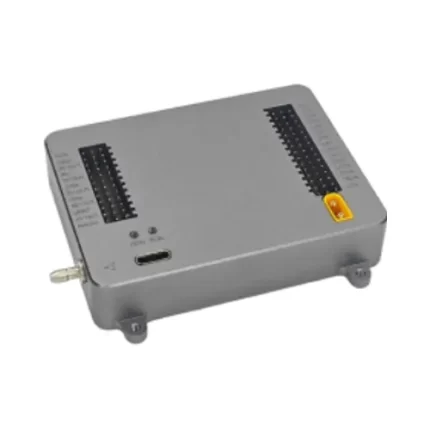
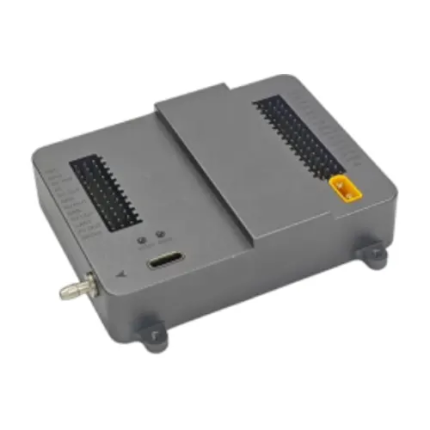
| Dimensions | 82 × 62 × 18 mm |
| Weight | 94 g |
❓ Frequently Asked Questions (FAQ)
Q1: Can the system operate without GPS?
Yes, it fully supports inertial navigation (INS) for GPS-denied environments.
Q2: What launch platforms are supported?
It supports both ground-based launch tubes and airborne launch tube systems.
Q3: Can it withstand high launch acceleration?
Yes, it is designed to survive up to 50G launch overload.
Q4: Does it support target tracking?
Yes, it supports high-precision guidance against dynamic moving targets.
Q5: What types of seekers are supported?
It supports both video (EO) seekers and radar seekers.