


Finding the best fpv drone video transmitter is the single most critical hardware decision you will make when building or upgrading an unmanned aerial system. In the world of First-Person View (FPV) flight, your video transmitter (VTX) is your lifeline. If a motor desyncs, you crash. If your flight controller reboots, you crash. But if your video link fails while you are threading a needle through a concrete bando or flying beyond visual line of sight over dense forestry, you do not just crash; you lose the aircraft entirely. The market is currently saturated with competing digital ecosystems and high-power analog boards, making the procurement process incredibly opaque.
From our experience engineering and deploying complex drone communication systems for commercial applications at Moneyprouav, a consumer-grade 800mW analog VTX is entirely insufficient for industrial operations, just as a heavy 8W mesh radio is catastrophic for a 5-inch freestyle quad. You must apply commercial and practical judgment to match the hardware to your operational parameters. In this guide, we bypass the generic marketing claims to evaluate the 6 best fpv drone video transmitter systems available today, analyzing latency, penetration, thermal throttling, and ecosystem integration.
Quick Answer: Which VTX Should You Buy?
The best fpv drone video transmitter depends entirely on your application scale. For cinematic prosumers, the DJI O3 Air Unit is the undisputed champion of high-definition digital penetration. For hardcore racers demanding sub-millisecond latency, the HDZero Freestyle V2 is the required standard. For heavy-duty applications, industrial surveying, and long-range tactical operations, the Moneyprouav UAV Data Link System provides an encrypted, 10km range IP mesh network that consumer systems cannot legally or physically match. Do not buy a digital system if your budget cannot accommodate the corresponding proprietary goggles.
Table of Contents
- What It Is: The Heart of Your Video Link
- How It Works: RF Modulation and Frequencies
- The 6 Best FPV Drone Video Transmitter Systems
- Benefits of High-End VTX Systems
- Limitations and Thermal Throttling
- Who Should Upgrade
- Who Does Not Need a High-Power VTX
- Common Installation Mistakes
- Critical Buying Considerations
- Expert Recommendation
- Summary and Comparison Tables
- Frequently Asked Questions
What It Is: The Heart of Your Video Link
A video transmitter (VTX) is a radio frequency module that takes the raw visual data from your drone’s camera, modulates it into a radio wave, and blasts it out through an antenna to your ground station or FPV goggles. When searching for the best fpv drone video transmitter, you are fundamentally choosing between two technological paradigms: Analog and Digital. Analog sends standard definition video via raw RF waves, offering zero latency but highly susceptible to multi-path interference (static). Digital systems compress the video into data packets, resulting in crystal-clear high-definition images, but introducing a slight, variable processing latency.
How It Works: RF Modulation and Frequencies
In most professional situations, FPV video operates on the 5.8GHz frequency band. This frequency offers a massive bandwidth capable of carrying heavy video data, but it suffers from poor physical penetration. A 5.8GHz wave will bounce off concrete and be absorbed by dense foliage. To combat this, manufacturers increase the output power (measured in milliwatts or Watts). Pushing a VTX from 25mW to 1000mW (1W) significantly increases the signal’s ability to blast through obstacles and maintain a connection over long distances. However, increasing power exponentially increases heat generation, requiring robust heatsinks or active cooling.
The 6 Best FPV Drone Video Transmitter Systems
1. DJI O3 Air Unit (Best Digital for Cinematic Prosumers)
The DJI O3 Air Unit remains the apex of digital FPV. It provides stunning 4K/60fps onboard recording and transmits a 1080p/100fps feed to your goggles. Its penetration through buildings and trees is unmatched in the consumer space due to its sophisticated two-way transmission protocol. However, it is expensive, heavy, and locks you entirely into the DJI ecosystem.
2. Walksnail Avatar HD Pro (Best Low-Light Digital)
Walksnail has aggressively challenged DJI’s dominance. The Avatar HD Pro kit features a massive 1/1.8 inch Sony Starvis sensor, making it the best fpv drone video transmitter for dusk and night flying. It offers 1080p transmission and supports Canvas Mode for full Betaflight OSD integration. It is highly recommended for pilots who want digital clarity without DJI’s restrictive firmware limitations.
3. HDZero Freestyle V2 (Best for Zero-Latency Racing)
If you are flying proximity freestyle or professional racing, variable latency will cause you to clip gates. HDZero transmits uncompressed digital video. The result is a static 3-millisecond latency that feels identical to analog, but with 720p clarity. The V2 transmitter outputs up to 1W of power, making it incredibly robust for bando bashing.
4. TBS Unify Pro32 HV (Best Premium Analog)
Analog is not dead. For pilots operating in environments where digital systems stutter and freeze, analog degrades gracefully into static, allowing you to fly out of blind spots. The Team BlackSheep Unify Pro32 HV is a bulletproof component. It cleanly outputs over 1000mW, accepts direct LiPo voltage (up to 6S), and is a staple in long-range mountain surfing builds.
5. RushFPV Rush Solo Tank (Best Budget High-Power Analog)
For heavy-duty applications where you need massive power on a budget, the Rush Solo Tank pushes up to 1.6W of output power. It features a massive aluminum heatsink shell that prevents the VTX from thermal throttling during long, slow flights. It is bulky, making it difficult to fit in micro frames, but perfect for 7-inch long-range cruisers.
6. Moneyprouav UAV Data Link System (Best for Commercial/Industrial Applications)
When you transition from hobbyist flying to commercial operations—such as pipeline inspection, border patrol, or deploying military drones—standard 5.8GHz systems fail completely. You require encrypted, long-range IP mesh networks. As one of the leading uav manufacturers in china, Moneyprouav provides industrial-grade video and data transmission designed for uncompromising reliability.
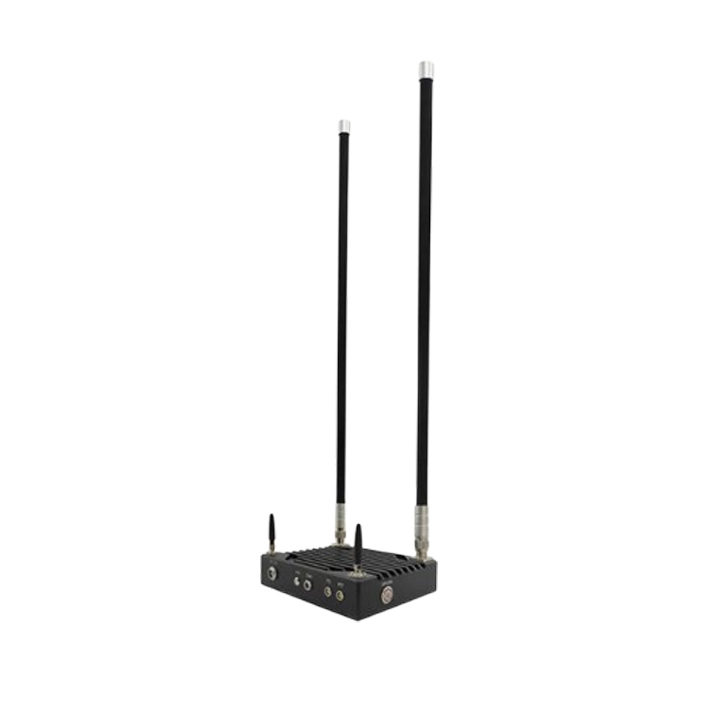
UAV Data Link System Unmanned Model 10km Range IP Mesh Radio and Video Transmitter
This is not a consumer VTX. This is a heavy-duty, AES-encrypted wireless transmission module designed for complex multi-node operations. Operating on lower frequencies (1.4GHz) for massive penetration and featuring 8W of raw transmitting power, this module guarantees secure video and telemetry over a 10km radius.
| Frequency Range | 1428~1448MHz(Std) / 1100~1500MHz(Customized) |
|---|---|
| Networking | ≥ 52 Nodes (Mesh capability) |
| Encryption | AES128/256 (Military-grade security) |
| Transmitter Power | 8W (4W * 2) |
| Max Data Rate | 90Mbps @ 20MHz Bandwidth |
Benefits of High-End VTX Systems
Upgrading to the best fpv drone video transmitter available yields immediate operational advantages. For consumer systems, pushing a clean 1W signal means you can fly deep into abandoned buildings or dense forests without your video feed dropping out. For commercial users operating an eo ir gimbal payload, investing in a high-bandwidth IP mesh radio ensures that critical thermal imaging data is relayed to the command center in real-time without signal degradation, regardless of topographical obstacles.
Limitations and Thermal Throttling
We must apply practical judgment: extreme power output generates extreme heat. A 1W or 8W transmitter will rapidly reach temperatures exceeding 90°C if powered on without adequate airflow. In our testing, powering a high-output VTX on the workbench for more than two minutes without a cooling fan will cause the unit to thermal throttle (drop its power output to protect the silicon) or fry completely. Furthermore, high-power systems draw massive amperage, which can sag your drone’s battery and reduce total flight time.
Who Should Upgrade
We recommend upgrading your VTX if you consistently experience “micro-failsafes” behind trees, or if you are transitioning to professional cinematic work where video breakup ruins the client’s monitoring experience. For industrial integrators building long-range fixed-wing platforms utilizing a turbojet engine for drone propulsion, standard 5.8GHz modules are useless. You must upgrade to lower-frequency mesh radio systems to maintain beyond visual line of sight (BVLOS) capabilities.
Who Does Not Need a High-Power VTX
If you fly sub-250g tiny whoops indoors or in small parks, you do not need a 1W VTX. A standard 25mW to 200mW analog transmitter is more than sufficient for line-of-sight proximity flying. Adding a heavy, high-power VTX to a micro drone will destroy its flight characteristics and drain its tiny battery in seconds.
Common Installation Mistakes
The most catastrophic mistake any pilot can make is powering on a video transmitter without the antenna securely attached. Without an antenna to dissipate the RF energy, the power reflects back into the VTX amplifier, instantly frying the board. Secondly, many beginners wire a high-power VTX directly to a 5V pad on their flight controller. A 1W VTX pulls too much current for a standard 5V BEC, causing the flight controller to brownout mid-air. Always power heavy-duty VTX modules from a dedicated 9V/12V pad or directly from the battery (Vbat), assuming the VTX is rated for that voltage.
Critical Buying Considerations
When selecting the best fpv drone video transmitter, audit your frame space. DJI O3 and Walksnail units are bulky and require specific 25.5×25.5mm or 20x20mm mounting holes with adequate vertical clearance. Analog boards are generally much smaller. Secondly, verify the input voltage. If you fly 6S batteries (25.2V fully charged), ensure your VTX can handle a direct 6S input, or ensure you have a robust voltage regulator inline to step the power down safely.
Expert Recommendation
From our experience supplying uav solution companies globally, consumer-grade digital systems (DJI, Walksnail) are phenomenal for solo cinematic operators and hobbyists. However, if your operational mandate includes multi-node surveillance, tactical deployment, or integrating a thermal camera payload for search and rescue, consumer tech is a liability. You must invest in 1.4GHz/800MHz IP mesh networks. They provide the encryption, penetration, and network redundancy required for serious commercial aviation.
Summary and Comparison Tables
| VTX System | Technology | Best Suited For |
|---|---|---|
| DJI O3 Air Unit | Digital | Cinematic recording, high-definition prosumer flying. |
| HDZero Freestyle V2 | Digital (Uncompressed) | Professional racing, zero-latency freestyle. |
| TBS Unify Pro32 HV | Analog | Long-range mountain surfing, high-reliability bashing. |
| Moneyprouav IP Mesh | Encrypted Digital Data Link | Commercial, industrial, and military drone applications. |
| Feature | Digital FPV (e.g., DJI/Walksnail) | Analog FPV (e.g., TBS/RushFPV) |
|---|---|---|
| Image Quality | Stunning (720p to 1080p resolution) | Low (Standard definition, interlaced) |
| Latency | Variable (20ms to 40ms) | Fixed/Zero (Sub 5ms) |
| Signal Degradation | Pixelation, stuttering, sudden freezing | Static, progressive snow (flyable through breakup) |
| Hardware Cost | High ($100+ per VTX) | Low ($30 – $50 per VTX) |
| Pros (Benefits) | Cons (Limitations) |
|---|---|
| Massive signal penetration through lower frequencies (1.4GHz). | Heavy hardware footprint, unsuitable for small drones. |
| Self-healing mesh networks allow drones to relay signals for each other. | High power consumption requires robust drone engine systems. |
| Military-grade AES-256 encryption prevents signal hijacking. | Significant capital investment compared to consumer VTX modules. |
| Transmits video, telemetry, and RC control over a single link. | Requires commercial spectrum licensing in many jurisdictions. |
Frequently Asked Questions
Is a higher mW rating always better for a video transmitter?
Not necessarily. While higher milliwatt (mW) output increases range and penetration, it also generates massive amounts of heat and draws significant battery power. If you are flying in close proximity with other pilots, blasting a 1000mW signal will bleed into their channels and blind their video feeds. You should use the lowest power necessary to maintain a clear signal for your specific flight environment.
Can I mix and match digital VTX systems with different goggles?
No. Digital FPV systems are closed, proprietary ecosystems. A DJI O3 Air Unit will only work with specific DJI goggles (Goggles 2, Goggles 3, Integra). A Walksnail VTX requires Walksnail Avatar goggles or external receivers. HDZero requires HDZero hardware. You must commit to a single digital ecosystem, unlike analog systems where any 5.8GHz analog VTX works with any analog receiver module.
What happens if I power on my VTX without an antenna?
Powering a video transmitter without an antenna attached will almost instantly destroy the internal amplifier. The RF energy generated by the VTX has nowhere to escape, so it reflects back into the circuitry as heat, frying the components. Always ensure your antenna is firmly secured before plugging in your battery.
Authoritative Industry References
To ensure regulatory compliance and engineering accuracy in our transmission hardware recommendations, we reference standards from the following authoritative bodies:
- Federal Communications Commission (FCC) – Regulatory standards governing the legal transmission power limits and frequency band allocations for 5.8GHz amateur radio and commercial UAV communications in the United States.
- Federal Aviation Administration (FAA) – Operational guidelines regarding Visual Line of Sight (VLOS) and waivers for Beyond Visual Line of Sight (BVLOS) flights utilizing commercial data links.
- Institute of Electrical and Electronics Engineers (IEEE) – Technical engineering standards for wireless network protocols, digital video compression latency, and IP mesh radio hardware performance metrics.
For more insights into integrating high-end transmission hardware with specialized platforms, explore our analysis of night vision military drones and how they utilize encrypted data links for secure operations.