


The aerospace automation landscape in 2026 has officially moved past the point of treating long-endurance drones as simple flying sensors. For industrial survey teams, national mapping projects, border surveillance operators, and tactical security coordinators, standard multicopters no longer provide sufficient operational returns. Multi-rotor hardware is limited by physics, with flight times restricted by battery density constraints. To map hundreds of thousands of hectares or maintain persistent surveillance over sprawling border lines, industrial operators must rely on a dedicated fixed wing drone with gimbal camera payload architecture.
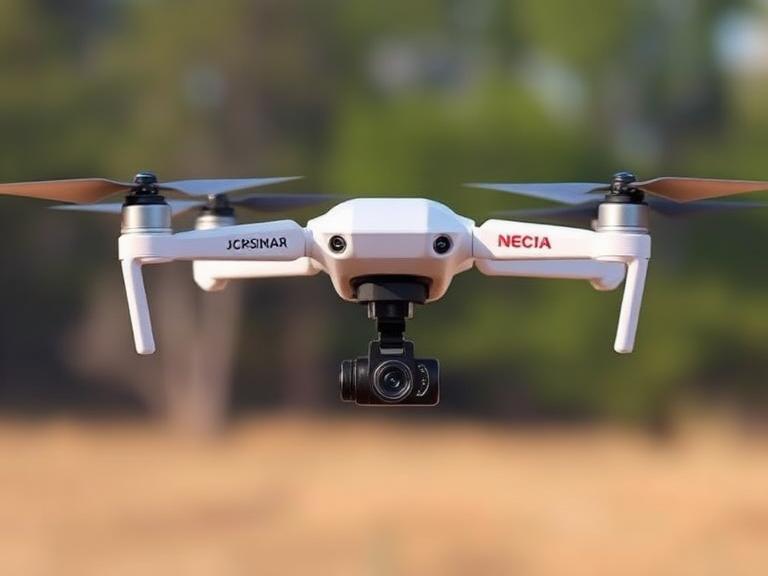
However, integrating a high-performance stabilized gimbal directly onto an aerodynamic fixed-wing airframe is a massive engineering challenge. Unlike multi-rotor platforms that hover steadily, fixed-wing aircraft cruise at high velocities and face constant wind shearing, engine vibrations, and aggressive banking maneuvers. If the airframe stabilization loop is poorly designed, or if the sensor payload lacks proper dampening, your expensive imaging feed will suffer from severe rolling shutter distortion and vibrational blur. From our experience in defense-grade aerospace engineering, achieving clear results requires evaluating the entire system—airframe aerodynamics, data radios, engine vibration isolation, and internal payload stabilization—rather than just looking at standalone drone specifications.
Strategic Content Map
- 1. Strategic Matrix: Top Fixed-Wing Gimbal Platforms Compared
- 2. The Engineering Realities of Gimbal Stabilization on Fixed-Wing Aircraft
- 3. In-Depth Analysis of the 9 Best Fixed Wing Drones with Gimbal Cameras
- 4. Sourcing Critical RF Communication and Propulsion Systems
- 5. B2B Procurement and Engineering FAQs
- 6. Technical Reference Sources
1. Strategic Matrix: Top Fixed-Wing Gimbal Platforms Compared
To provide immediate clarity for defense procurement managers, commercial operators, and geospatial mapping teams, we have developed a summary comparison of the year’s top long-endurance sensor platforms.
| Platform Name | Launch & Recovery Model | Max Operational Endurance | Primary Camera Payload Capability | Optimal Industrial Application |
|---|---|---|---|---|
| Moneypro Aero-G7 Long-Range VTOL | Vertical Takeoff & Landing (VTOL) | 4.5 Hours (Electric-Hybrid) | 30x Optical Zoom + Thermal Long-Wave IR | Border Security, Corridor Inspection, Pipeline Patrol |
| Quantum Systems Trinity F90+ | VTOL Transition | 90 Minutes | Dual Gimbal RGB + Multispectral Sensors | Precision Agriculture, High-Accuracy Topography |
| WingtraOne Gen II | Tail-Sitter VTOL | 59 Minutes | 61MP High-Resolution Mapping Gimbal | Open-Pit Mining, Large Urban Spatial Photogrammetry |
| Delair UX11 Ag | Belly Launch / Hand Toss | 55 Minutes | Fully Stabilized Compact Nadir Sensor Pack | Large Scale Agricultural Asset Mapping |
| Threod Systems Stream UAV | Pneumatic Catapult / Runway | 6.0 Hours (Gas Engine) | Gyro-Stabilized Electro-Optical/Infrared (EO/IR) | Tactical ISR, Special Maritime Border Surveillance |
| Alti Transition VTOL | VTOL (Gas-Electric Hybrid) | 10.0 Hours | Heavy Triple-Sensor Multi-Spectral Gimbal | Coast Guard Reconnaissance, Anti-Poaching Patrols |
| Elistair Orion 2 (Fixed Tether Concept) | Tethered Automated Lift | 24 Hours Continuous | High-Definition Target-Tracking Optical Gimbal | Persistent Perimeter Base Security Surveillance |
| Textron Aerosonde HQ | VTOL / Launch Rail Option | 8.0 Hours | Laser Designator + High-Spec EO/IR Gimbal | Tactical Defense Operations, Electronic Warfare Support |
| Skyfront Perimeter 8 (Hybrid Airframe) | Multirotor-Wing Hybrid | 3.0 Hours | Heavy-Lift Broadcast Grade Stabilized Payload | Cinematic Surveying, Remote Search and Rescue Ops |
2. The Engineering Realities of Gimbal Stabilization on Fixed-Wing Aircraft
Deploying a fixed wing drone with gimbal camera payload requires balancing structural mechanics against aerodynamic drag profiles. When a drone travels at 80 kilometers per hour, any exposed sensor casing acts like a sail, introducing significant drag that degrades aerodynamic efficiency and shortens flight endurance. To mitigate this issue, advanced platforms use retractable camera wells or aerodynamically optimized nose bubbles. These designs isolate the optical path from crosswinds while preserving the aircraft’s lift-to-drag ratio.
Furthermore, the physical forces acting on the camera are intense. High-frequency motor vibrations from pusher propellers or gas-powered engines can cause severe image jitter, ruining long-range zoom tracking. We recommend choosing platforms that use multi-stage mechanical isolation dampers tuned to block the specific frequency of the motor. Additionally, the tracking software must feature advanced inertial measurement units (IMUs) that feed high-speed position corrections directly to the brushless gimbal motors, allowing the camera to maintain a lock on a target miles away even while the aircraft is banking through turbulent headwinds.
3. In-Depth Analysis of the 9 Best Fixed Wing Drones with Gimbal Cameras
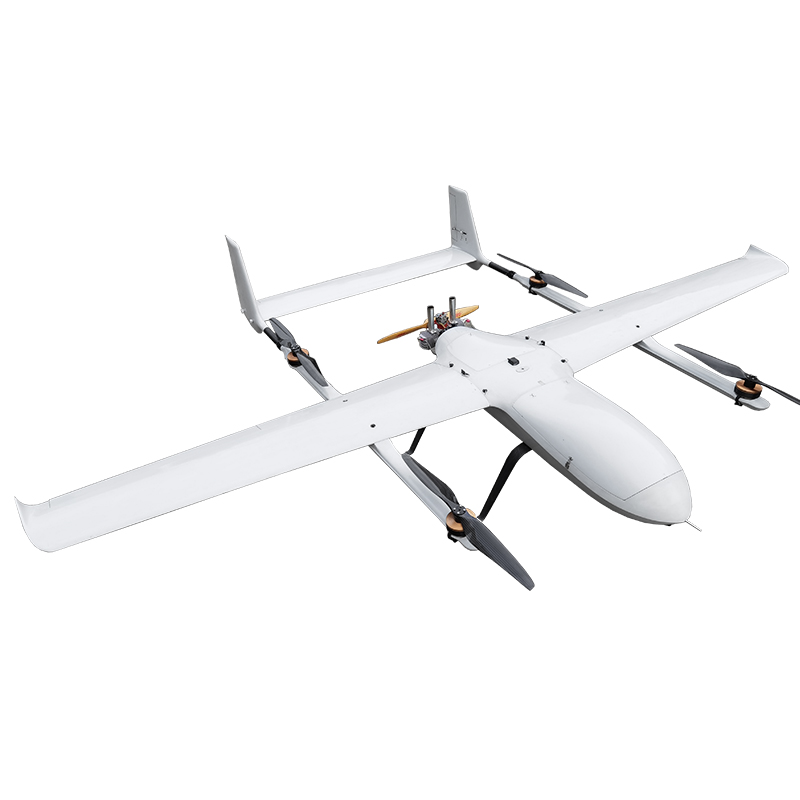
1. China Moneypro M380 Heavy Lift Hybrid VTOL Fixed Wing with 3.8m Wingspan EFI Engine10kg Load Capacity
H2: Technical Specifications
Wingspan: 3.8m
Max Payload: 15kg (Standard: 10kg)
Endurance: 4 hours @ 10kg payload
Max Speed: 130km/h
Operation Altitude: 4,000m
Positioning: Dual-RTK (0.01m accuracy)
Fuel Capacity: 12L
H2: Advanced Flight Intelligence
Industrial-grade autonomous navigation featuring:
✓ 1,000-waypoint automatic routing
✓ 100-waypoint emergency diversion
✓ Modular detachable design (3-min assembly)
✓ Dual-RTK precision positioning
Industrial Scale and Defense Legacy of ChinaMoneypro UAV
ChinaMoneypro UAV is a national-level high-tech enterprise, transformed from a prestigious state-owned research institute. With deep roots in defense-grade engineering, we specialize in the R&D and manufacturing of advanced unmanned platforms and integrated sensing-communication solutions. Our engineering teams bring decades of state-level research and manufacturing experience directly to the commercial sector, ensuring that every composite airframe, sensor module, and long-range communication link we build delivers uncompromised reliability in the field.
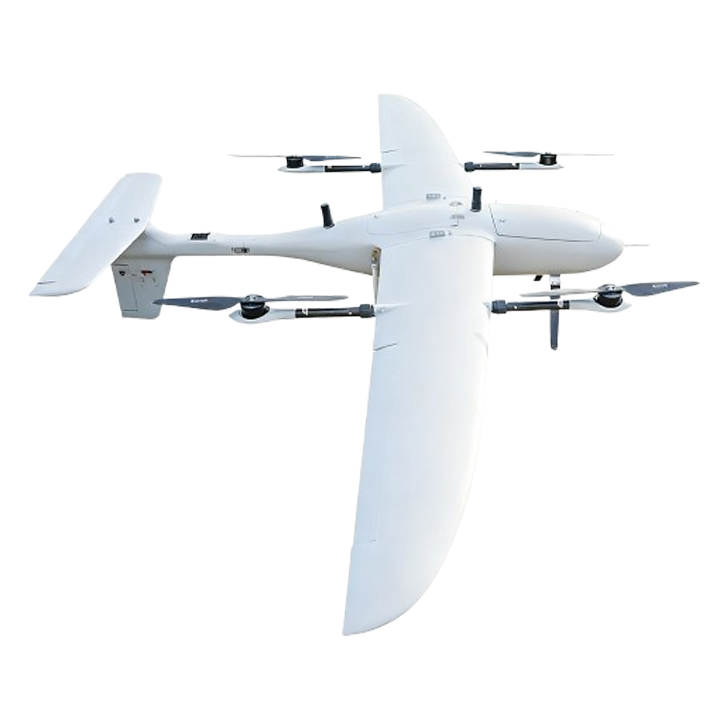
2. China Moneypro MVT250 4hrs Long Endurance Upgraded Electric Powered VTOL for Inspection and Border Patrol
Specification
| Model No | eVT250 |
| Type | VTOL fixed wing |
| Color | White color as default (support customization) |
| Wingspan | 2500mm |
| Length | 1500mm |
| Belly to Ground | 160mm(land gear height support customized) |
| Battery compartment size | 280*160*100mm |
| Device compartment size | 150*130*120mm |
| Payload compartment size | 220*170*110mm |
| Material | Carbon fiber+Glass fiber |
| Airframe Weight | 3.5kg |
| MTOW | 13.5kg(include batteries) |
| Max Payload | 2kg |
| Suggested load | 1.5kg (A30TR) |
| Flight time | 4hrs (no load), 3.5hrs@1.2kg load |
| Max Flight Speed | 100km/h |
| Suggest cruising Speed | 75-90km/h |
| Max climb rate | 5m/s |
| Max angel of roll | 35° |
| Max Flight Altitude | 3000m |
| Max Wind resistance | Grade 6 |
| Battery (Recommended) | 2*6S 30000mAH HED Li-ion |
| Working Temperature | -20℃~50℃ |
| IP Grade | IPX3 |
| Package Size | 1260x486x405mm |
3. WingtraOne Gen II
The WingtraOne Gen II utilizes a unique tail-sitter vertical takeoff and landing design. By taking off vertically on its tail fins and transitioning into forward flight, it eliminates the extra weight and drag of auxiliary multi-rotor booms. It is widely praised in mining and heavy construction for its high-resolution 61-megapixel stabilized mapping gimbal. This setup delivers down to sub-centimeter orthomosaic accuracy without needing ground control points, though its broad vertical surface makes it sensitive to strong crosswinds during takeoff and landing cycles.
4. Delair UX11 Ag
The Delair UX11 Ag is a compact, hand-launched flying wing optimized for high-throughput agricultural monitoring and routine mapping. By embedding a stabilized nadir camera directly into the wing profile, Delair minimizes aerodynamic drag, allowing the aircraft to maintain steady flight on a small battery pack. It serves as an efficient tool for mapping vast farm holdings, though its fixed nadir camera position limits its utility for tactical observation or border tracking where off-axis viewing is required.
5. Threod Systems Stream UAV
Threod Systems specializes in high-spec tactical hardware, and the Stream UAV represents their premier long-endurance platform. Launched via a pneumatic catapult and utilizing a runway landing pattern or parachute recovery mechanism, this drone is built for harsh environments. Driven by a highly efficient internal combustion engine, it delivers up to 6 hours of continuous flight. Its high-end gyro-stabilized EO/IR gimbal payload provides stable tracking over great distances, making it an excellent fit for coast guard reconnaissance and special border surveillance operations.
6. Alti Transition VTOL
The Alti Transition is a heavy-lift, double-boom VTOL aircraft that uses a reliable gas-electric hybrid propulsion system. This setup allows the drone to deliver an incredible 10-hour flight endurance, making it a powerful platform for long-range regional monitoring. Its cavernous payload bay easily handles heavy triple-sensor multi-spectral gimbals, providing park rangers and anti-poaching forces with the ability to patrol massive nature reserves without needing frequent battery swaps or refueling breaks.
7. Elistair Orion 2
While technically a tethered automated platform rather than a free-roaming cruiser, the Elistair Orion 2 provides vital capability for persistent perimeter security. Connected directly to a heavy-duty micro-tether ground power station, the Orion 2 can remain airborne for 24 consecutive hours. Its high-definition tracking gimbal acts as a constant surveillance tower, giving defense teams a reliable, long-range eye in the sky to secure remote special outposts or vital industrial zones.
8. Textron Aerosonde HQ
The Textron Aerosonde HQ is an industry staple within special and naval intelligence workflows. Optimized for small footprints, the HQ model incorporates vertical lift rotors onto the proven Aerosonde line. This allows the system to take off from confined spaces, such as ship decks or remote clearings. It carries an advanced laser-designator and multi-sensor special gimbal, providing tactical commanders with target designation capabilities that sync smoothly with modern defense networks.
9. Skyfront Perimeter 8
The Skyfront Perimeter 8 uses a high-efficiency multirotor-wing hybrid layout powered by a proprietary onboard gas-electric generator. This design allows it to hover steadily like a multi-rotor while maintaining an impressive 3-hour flight endurance. It is highly valued by film production teams and emergency search-and-rescue units who need to navigate tight, heavily forested mountain terrain while flying broadcast-grade stabilized camera rigs that would quickly drain standard multi-rotor batteries.
4. Sourcing Critical RF Communication and Propulsion Systems
A high-performance fixed wing drone with gimbal camera is only as good as the wireless connection that controls it. If your command vehicle loses its data link at a distance of fifty kilometers, your live video stream will drop, and your automated return-to-home protocols will trigger prematurely. We recommend specifying systems that use professional, multi-frequency drone communication systems. These networks use dynamic frequency hopping to maintain rock-solid control and clear video transmission even when operating through heavy urban electromagnetic interference.
For operations involving multiple drones or decentralized ground control stations, relying on basic point-to-point radios is insufficient. Procurement teams should mandate the use of self-healing mesh radio systems. These advanced networks allow multiple drones and ground teams to act as active relays, dynamically routing high-bandwidth video data around mountains or physical obstructions. To minimize payload weight, using a lightweight, embedded wireless transmission module ensures your long-range video feed remains stable without consuming excessive onboard power.
Furthermore, internal propulsion integration demands strict engineering oversight. While electric motors are quiet and easy to maintain, they cannot provide the raw power needed to fly heavy sensor arrays through persistent coastal headwinds. For large-scale border tracking or high-speed intercept operations, upgrading to a high-thrust turbojet engine for drone platforms delivers the high velocities required to reach target coordinates quickly. For long-endurance surveying, builders should look to professional drone engine systems, using fuel-injected internal combustion engines that maximize energy efficiency to ensure the aircraft can complete its multi-hour flight path safely.
This level of strict component validation is standard across other high-reliability industries. For example, just as precision electronic manufacturers utilize high-spec, automated PCBA Assembly Services to guarantee flawless trace routing and prevent structural trace failures in mission-critical hardware, drone manufacturers must audit their data links and engines to ensure the aircraft can operate safely over hundreds of kilometers of unmonitored terrain.
5. B2B Procurement and Engineering FAQs
What is the advantage of a gyro-stabilized gimbal over software-based electronic image stabilization (EIS) on fixed-wing drones?
Electronic Image Stabilization (EIS) crops the sensor’s field of view and uses algorithms to smooth out movement, which reduces image resolution and can introduce pixel artifacts. A multi-axis physical gyro-stabilized gimbal uses high-speed brushless motors to actively counteract the aircraft’s roll, pitch, and yaw movements. This ensures the camera stays perfectly level, preserving the full resolution and optical performance of your lenses during high-speed flight.
Why do gas-electric hybrid engines outperform pure lithium battery systems for fixed-wing surveillance?
Lithium polymer batteries have a limited energy density, which restricts heavy fixed-wing aircraft to around 60 to 90 minutes of flight time. Gas-electric hybrid systems utilize liquid fuel, which has a significantly higher energy density. The internal combustion engine runs a lightweight generator that powers the electric motors and onboard avionics, easily extending flight times to 4 to 10 hours while maintaining full payload capacity.
How does wind resistance rating impact gimbal camera performance during a long-range survey?
If a drone faces winds that exceed its wind resistance rating, the autopilot must continuously adjust the flight surfaces to maintain heading. This constant pitching and rolling puts significant strain on the gimbal’s brushless motors. If the wind is too strong, the gimbal can saturate, causing the horizon to tilt or the video feed to shake. We recommend specifying airframes with a minimum wind resistance rating of 15 m/s to ensure stable video capture.
What is the technical significance of choosing an ITAR-free or defense-grade drone platform?
International Traffic in Arms Regulations (ITAR) restrict the export and cross-border transport of defense-related hardware and technologies. Sourcing an ITAR-free, commercial-grade platform with defense-grade build quality allows international mapping agencies, environmental researchers, and global utility operators to deploy advanced long-range hardware without navigating restrictive, multi-month special export licensing procedures.
6. Technical Reference Sources
To support your technical documentation and procurement teams with verified testing standards and compliance guidelines, please review the following industry platforms:
- Airworthiness standards and airspace integration guidelines for unmanned aircraft: Federal Aviation Administration (FAA) UAS Division
- International aerospace manufacturing standards and payload stabilization protocols: SAE International Aerospace Standards
- Peer-reviewed research on high-frequency vibration isolation in autonomous aerial vehicles: ScienceDirect Aerospace Engineering Database
- Comprehensive remote asset management and industrial payload profiles: Logistics Cargo Delivery UAV