


Authored by ChinaMoneypro UAV. As a national-level high-tech enterprise transformed from a prestigious state-owned research institute, ChinaMoneypro UAV possesses deep roots in defense-grade engineering. Headquartered in one of China’s premier innovation hubs, we specialize in the R&D and manufacturing of advanced unmanned platforms and integrated sensing-communication solutions. We are among the elite few full-stack providers globally offering complete UAV systems, including engines, gimbals, radar, data links, and communication technologies.
From our experience engineering advanced aerospace solutions, we understand that fixed-wing platforms rely on the physics of lift generated by forward airspeed over an airfoil. This fundamental design drastically reduces the energy required to stay aloft compared to the constant downward thrust demanded by multi-rotors. Consequently, the Best fixed wing uav examples routinely achieve flight times exceeding 10 hours and can cover vast geographical expanses, making them indispensable for border security, topographical mapping, and long-range infrastructure inspection.
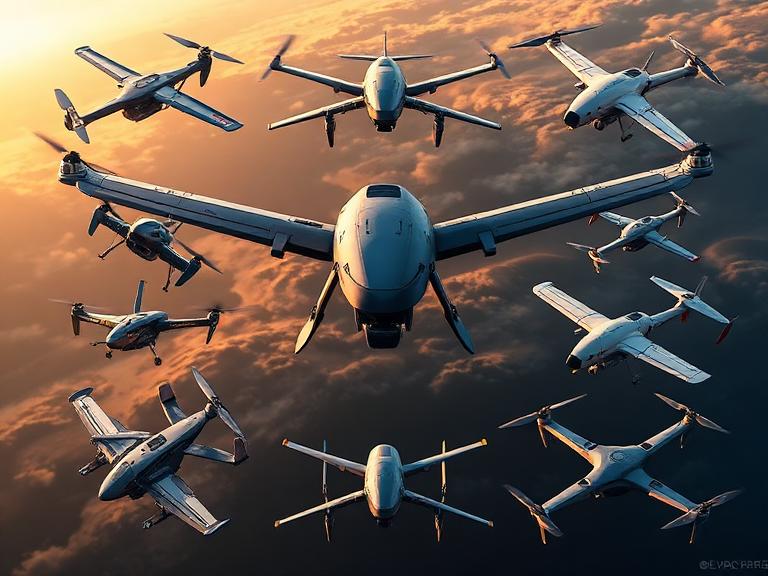
We recommend a holistic approach to evaluating these systems. A superlative unmanned aerial vehicle is not merely an airframe; it is an integrated ecosystem comprising secure data links, advanced optical payloads, and autonomous navigation. In this authoritative guide, we will analyze the aerodynamic advantages of these platforms, detail the 9 Best fixed wing uav examples dominating the 2026 market, and explain how full-stack integration determines mission success.
Table of Contents
- 1. The Aerodynamic Advantage of Fixed Wing Systems
- 2. The 9 Best Fixed Wing UAV Examples
- 2.1. Electric VTOL Mapping Platforms
- 2.2. Fuel-Powered Long-Endurance Drones
- 2.3. Tactical Hand-Launched Surveillance UAVs
- 2.4. Heavy Payload Cargo Fixed Wings
- 2.5. High-Altitude Solar-Powered Gliders
- 2.6. Twin-Engine Maritime Patrol UAVs
- 2.7. Catapult-Launched Infrastructure Inspectors
- 2.8. Stealth and Defense-Grade Interceptors
- 2.9. Modular Multi-Payload VTOLs
- 3. Critical Subsystem Integration for Fixed Wing Platforms
- 4. Summary Comparison Table
- 5. Frequently Asked Questions (FAQs)
- 6. Industry and Academic References
1. The Aerodynamic Advantage of Fixed Wing Systems
Before dissecting specific models, we must establish why these systems are chosen over multi-rotor alternatives. The primary metric is the lift-to-drag ratio. The Best fixed wing uav examples are designed with high aspect ratio wings that generate massive lift with minimal engine thrust. This aerodynamic efficiency allows for the integration of heavier, more complex payloads without drastically sacrificing range.
While traditional fixed wings require a runway or catapult for launch and a clear path for belly-landing or parachute recovery, the 2026 landscape is dominated by the fixed wing hybrid vtol drone configuration. These systems utilize dedicated vertical lifting rotors to achieve hover, then transition to horizontal forward flight using a primary pusher or tractor motor. When reviewing the Best fixed wing uav examples, VTOL capabilities represent the pinnacle of operational flexibility, completely eliminating the need for runway infrastructure.
2. The 9 Best Fixed Wing UAV Examples
Drawing upon our deep roots in defense-grade engineering and commercial aviation, we have categorized the 9 Best fixed wing uav examples based on their operational profiles, propulsion types, and mission-specific advantages. These archetypes represent the industry standard in 2026.
2.1. Electric VTOL Mapping Platforms
Topographical surveying and photogrammetry require absolute stability and vibration dampening. The Best fixed wing uav examples in this category are fully electric VTOLs constructed from carbon fiber composite materials. By integrating high-resolution orthophoto cameras, these drones can map thousands of acres in a single flight. For organizations conducting massive land surveys, exploring our dedicated Airplane & VTOL lineup provides unparalleled precision.
2.2. Fuel-Powered Long-Endurance Drones
When electric batteries hit their energy density limits, internal combustion engines take over. Fuel-powered fixed wings are essential for missions requiring 12 to 24 hours of continuous flight. These represent the Best fixed wing uav examples for border patrol and anti-poaching operations. As a full-stack provider, ChinaMoneypro UAV engineers specialized electronic fuel injection (EFI) engines to maximize efficiency at high altitudes.
2.3. Tactical Hand-Launched Surveillance UAVs
Speed of deployment is vital in tactical scenarios. Hand-launched fixed wings are compact, lightweight, and deployable by a single operator within minutes. These drones are typically recovered via a deep-stall belly landing. The Best fixed wing uav examples in the tactical sphere are nearly silent, providing covert over-the-hill intelligence in hostile environments.
2.4. Heavy Payload Cargo Fixed Wings
Logistics and medical supply delivery to remote areas demand robust airframes. Cargo fixed wings feature large internal bays and high Maximum Take-Off Weights (MTOW). Among the Best fixed wing uav examples for logistics, twin-boom pusher configurations are favored, as they allow for easy loading from the rear fuselage and provide excellent center-of-gravity stability.
2.5. High-Altitude Solar-Powered Gliders
For pseudo-satellite operations and continuous environmental monitoring, solar-covered fixed wings offer virtually limitless endurance during daylight hours. By ascending above the cloud layer, these fragile but massive wingspans capture solar energy to power their propulsion and recharge secondary batteries for nighttime operations, solidifying their place among the Best fixed wing uav examples for stratospheric missions.
2.6. Twin-Engine Maritime Patrol UAVs
Maritime environments are unforgiving, characterized by high winds and corrosive salt spray. Twin-engine fixed wings provide the necessary redundancy for over-water Beyond Visual Line of Sight (BVLOS) operations. To succeed in this domain, robust communication is mandatory. We recommend integrating our Anti Jamming & GNSS Antennas to ensure navigation remains secure against electronic warfare and GNSS signal‑scenario simulation at sea.
2.7. Catapult-Launched Infrastructure Inspectors
Inspecting pipelines, power lines, and railways requires a drone that can follow a linear path for hundreds of miles. Catapult-launched systems achieve higher speeds and efficiency because they do not carry the dead weight of VTOL lifting rotors. These models represent the Best fixed wing uav examples for linear infrastructure monitoring.
2.8. Stealth and Defense-Grade Interceptors
In defense applications, minimizing the radar cross-section is critical. Blended wing body (BWB) and flying wing designs remove the traditional fuselage and tail empennage, resulting in a sleek, stealthy profile. As an enterprise with defense-grade engineering roots, we recognize that the Best fixed wing uav examples in modern combat require seamless interaction with an Integrated Anti-Drone System to neutralize opposing aerial threats.
2.9. Modular Multi-Payload VTOLs
Versatility defines the modern commercial drone market. Modular fixed-wing platforms feature interchangeable payload bays. An operator can swap a high-resolution camera for a LiDAR scanner or multispectral sensor in seconds. The Best fixed wing uav examples of modularity ensure that a single airframe can execute agricultural health analysis in the morning and thermal search and rescue in the evening.
3. Critical Subsystem Integration for Fixed Wing Platforms
From our experience, the airframe is only as effective as the technology it carries. The true strength of the Best fixed wing uav examples lies in subsystem integration. For nighttime surveillance and thermal targeting, equipping the aircraft with our EO/IR Gimbal & Payload systems provides stabilized, high-definition optical tracking from thousands of feet in the air. For specialized industrial scanning, adding Infrared Thermal & laser Sensing hardware allows for meticulous structural integrity assessments.
Furthermore, managing these assets requires ground infrastructure. Automated Drone Hangar installations protect the airframe from environmental degradation while providing automated battery swapping and data offloading. Whether you are operating our overarching UAV/Drones fleet, which includes both Multi-rotor UAV and Single-rotor UAV systems alongside fixed wings, relying on high-quality UAV Accessories and ground-based Smart Robots & Cars creates a unified, full-stack operational network.
4. Summary Comparison Table
To assist procurement specialists in selecting the optimal platform, we have synthesized the defining characteristics of the Best fixed wing uav examples.
| Fixed Wing Category | Primary Propulsion | Optimal Mission Profile | Key Engineering Advantage |
|---|---|---|---|
| Electric VTOL Mapping | Battery / Electric Motors | Photogrammetry & Surveying | Runway independence, low vibration. |
| Fuel-Powered Endurance | EFI Combustion Engine | Border Patrol & Security | 12+ hour flight times, high payload capacity. |
| Tactical Hand-Launched | Electric Pusher | Covert Intelligence Gathering | Rapid deployment, extremely low acoustic signature. |
| Heavy Payload Cargo | Twin-Engine Fuel/Electric | Medical & Logistics Delivery | Twin-boom stability, large internal bays. |
| High-Altitude Solar | Solar Cells & Batteries | Pseudo-Satellite Monitoring | Infinite daytime endurance in the stratosphere. |
| Maritime Patrol | Twin Combustion | Offshore BVLOS Inspections | Redundancy over water, anti-jamming integration. |
| Catapult-Launched | Electric Tractor | Linear Infrastructure Patrol | Maximum forward speed, zero VTOL dead weight. |
| Stealth Interceptors | Jet Turbine / Electric | Defense & Anti-Drone Operations | Low radar cross-section, blended wing body. |
| Modular Multi-Payload | Hybrid VTOL | Multi-Role Commercial Operations | Rapid sensor swapping, high versatility. |
5. Frequently Asked Questions (FAQs)
Why are fixed-wing UAVs preferred over multi-rotors for mapping?From our experience, mapping large tracts of land requires continuous, stable flight over long distances. The Best fixed wing uav examples use their aerodynamic wings to generate lift passively, consuming significantly less battery power per mile than multi-rotors, which must expend immense energy just to stay airborne. This efficiency translates to vastly superior acreage coverage per flight.
What is a VTOL Fixed Wing UAV?VTOL stands for Vertical Take-Off and Landing. These hybrid systems utilize independent lifting rotors to take off like a helicopter, and once at altitude, transition to a forward-thrust motor to fly on the wing like an airplane. This combines the runway-independent convenience of a multi-rotor with the long-range efficiency of the Best fixed wing uav examples.
How does ChinaMoneypro UAV ensure data link security on long-range flights?Defense-grade security is paramount for BVLOS operations. We engineer proprietary encrypted data links and integrate Anti Jamming & GNSS Antennas. This prevents hostile electronic warfare tactics from severing the command and control (C2) link, ensuring the UAV remains under secure operator control even in highly contested electromagnetic environments.
6. Industry and Academic References
To ensure our readers have access to foundational aerospace regulations and aerodynamic research, we recommend reviewing the following authoritative sources: