


In the rapidly advancing field of unmanned aerial systems, understanding the underlying physics and engineering principles is critical for operators, integrators, and procurement officers. When clients transition from commercial quadcopters to defense-grade or industrial platforms, the most common inquiry we receive is exactly how does fixed wing UAV work. Unlike rotorcraft, which rely entirely on vertical thrust to defy gravity, fixed-wing platforms leverage forward momentum and aerodynamic design to generate lift. This fundamental difference dictates their efficiency, endurance, and payload capacities.
About the Author: ChinaMoneypro UAV is a national-level high-tech enterprise, transformed from a prestigious state-owned research institute. With deep roots in defense-grade engineering, we specialize in the R&D and manufacturing of advanced unmanned platforms and integrated sensing-communication solutions. Headquartered in one of China’s premier innovation hubs, ChinaMoneypro UAV is among the few full-stack providers offering complete UAV systems, engines, gimbals, radar, data links, and communication technologies.
From our experience engineering advanced platforms, a comprehensive understanding of how does fixed wing UAV work allows organizations to optimize their flight profiles, select the appropriate propulsion systems, and integrate complex payloads successfully. We recommend that before investing in high-end platforms, stakeholders deeply analyze the aerodynamic forces, control surface mechanics, and avionics architectures that define these systems. In this authoritative guide, we will break down the engineering components that make fixed-wing flight possible, explore modern hybrid VTOL innovations, and share our insights as a premier full-stack UAV manufacturer.
Table of Contents
- Summary Table: Core Mechanics of Fixed-Wing UAVs
- Aerodynamics and Lift: The Foundation of Flight
- Control Surfaces and Flight Dynamics
- Propulsion Systems and Energy Management
- Avionics, Data Links, and Payloads
- The VTOL Evolution: Bridging Multi-Rotor and Fixed-Wing
- Applying Fixed-Wing Technology to Industry
- Frequently Asked Questions
- References
Summary Table: Core Mechanics of Fixed-Wing UAVs
To provide a high-level overview of how does fixed wing UAV work, we have compiled a summary table detailing the primary components and their specific functions within the flight envelope.
| System Component | Primary Function | Engineering Principle |
|---|---|---|
| Airfoil (Wings) | Generate lift to overcome the force of gravity. | Bernoulli’s Principle and Newton’s Third Law of Motion. |
| Propulsion (Engine/Motor) | Generate thrust to overcome aerodynamic drag. | Conversion of electrical or chemical energy into kinetic energy. |
| Control Surfaces (Aileron, Elevator, Rudder) | Control roll, pitch, and yaw axes. | Manipulation of airflow to alter aerodynamic pressure distribution. |
| Flight Controller (Autopilot) | Autonomous stabilization and navigation. | IMU sensor fusion, GPS triangulation, and PID control loop execution. |
| Data Link / Communication | Transmit telemetry and receive command signals. | High-frequency RF transmission or fiber-optic data transfer. |
Aerodynamics and Lift: The Foundation of Flight
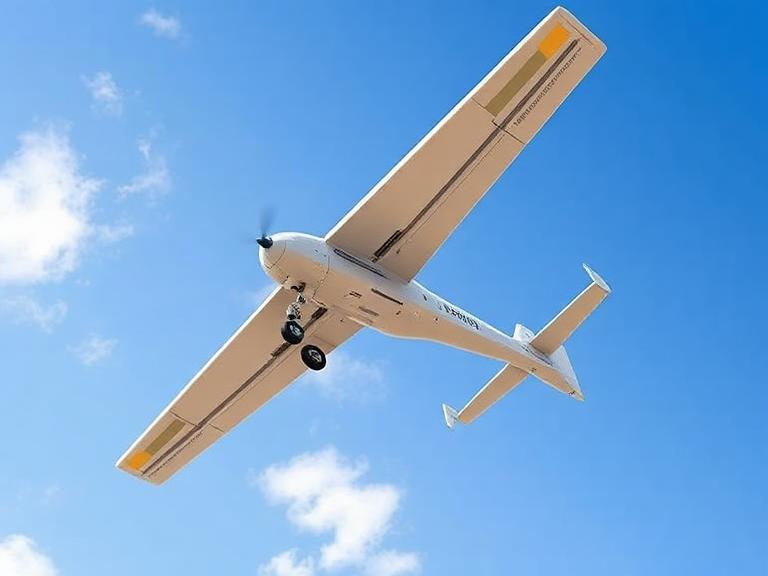
The fundamental principle of how does fixed wing UAV work revolves around aerodynamics—specifically, the generation of lift. Unlike a Multi-rotor UAV or a Single-rotor UAV, a fixed-wing aircraft features stationary wings shaped as airfoils. When the UAV is propelled forward, the asymmetrical shape of the airfoil forces air traveling over the top of the wing to move faster than the air moving underneath it.
According to Bernoulli’s principle, this difference in air velocity creates a region of lower pressure above the wing and higher pressure below the wing. The resulting upward force is what we call lift. Additionally, Newton’s third law of motion applies as the wing’s angle of attack deflects air downward, resulting in an equal and opposite upward reaction. From our experience in wind-tunnel testing, optimizing the airfoil design is paramount. High-aspect-ratio wings (long and narrow) provide excellent efficiency and endurance, which is why our Airplane & VTOL designs frequently utilize them for long-range surveillance missions.
Control Surfaces and Flight Dynamics
To fully grasp how does fixed wing UAV work, one must understand how the aircraft is steered and stabilized in three-dimensional space. An aircraft moves along three axes: roll (longitudinal), pitch (lateral), and yaw (vertical). This movement is manipulated through hinged sections on the trailing edges of the wings and tail, known as control surfaces.
- Ailerons: Located on the outer trailing edges of the main wings. They move in opposite directions to control the roll of the aircraft, allowing it to bank and turn.
- Elevators: Located on the horizontal stabilizer at the tail. By moving up or down together, they control the pitch, causing the nose to point up (climb) or down (descend).
- Rudder: Located on the vertical stabilizer. It controls the yaw, pointing the nose left or right.
The mechanics of how does fixed wing UAV work dictate that a flight controller sends precise PWM (Pulse Width Modulation) signals to high-torque servos, which physically actuate these surfaces. We recommend utilizing defense-grade servos with metal gears for maximum reliability, as failure in a single control surface can lead to catastrophic loss of the airframe.
Propulsion Systems and Energy Management
Thrust is the forward force that propels the UAV through the air, overcoming aerodynamic drag. Exploring how does fixed wing UAV work in various environments reveals that the choice of propulsion system drastically alters the mission profile. Purely electric propulsion, utilizing brushless DC motors and lithium-polymer (LiPo) or solid-state batteries, offers stealth, low vibration, and extreme reliability for short to medium-range missions.
However, for extended endurance, heavy payload delivery, and beyond visual line of sight (BVLOS) operations, internal combustion engines or hybrid setups are vastly superior. Our Petrol Electric Hybrid VTOL systems represent the pinnacle of this technology. By combining a fuel-burning engine for forward flight and electric motors for vertical lift, we achieve an unmatched balance of power density and operational flexibility. Understanding how does fixed wing UAV work with hybrid propulsion is critical for military and industrial clients who require hours of continuous flight time without sacrificing the convenience of runway-independent takeoffs.
Avionics, Data Links, and Payloads
A critical aspect of how does fixed wing UAV work involves the internal brain—the avionics stack. A fixed-wing drone is essentially a flying sensor node. The flight controller uses an Inertial Measurement Unit (IMU), barometers, pitot tubes (for airspeed), and GNSS/GPS modules to understand its exact position and orientation in the sky. This allows for fully autonomous waypoint navigation, from takeoff to landing.
Furthermore, the data link is what connects the UAV to the ground control station (GCS). At ChinaMoneypro UAV, we manufacture integrated sensing-communication solutions that ensure encrypted, high-bandwidth data transfer. For highly secure or localized tactical operations, we have also developed the Fiber Optic FPV Drone System, which guarantees unjammable, zero-latency communication. Depending on the mission, these platforms carry various payloads, including electro-optical/infrared (EO/IR) gimbals, synthetic aperture radars, or specialized agricultural spraying equipment.
The VTOL Evolution: Bridging Multi-Rotor and Fixed-Wing
Historically, fixed-wing aircraft required a runway or a pneumatic launcher to achieve the forward airspeed necessary for lift. This logistical requirement severely limited their deployment in rugged terrain or maritime environments. Modern engineering has solved this through Vertical Takeoff and Landing (VTOL) technology.
Many operators wonder how does fixed wing UAV work during a VTOL transition. Our VTOL Fixed Wing UAV System utilizes a Quadplane configuration. It features four dedicated electric lifting rotors that hoist the aircraft vertically into the air. Once the target altitude is reached, the forward propulsion system engages. As forward airspeed increases, the fixed wings begin to generate lift. The flight controller smoothly tapers off power to the vertical lifting rotors until the wings are supporting 100% of the aircraft’s weight. The lifting rotors are then locked aerodynamically to reduce drag.
We recommend our Composite Wing Flight Platform for clients who need the endurance of a fixed-wing aircraft but lack the infrastructure for traditional runways. This technology combines the best of both worlds, entirely eliminating the reliance on catapults or recovery nets.
Applying Fixed-Wing Technology to Industry
To fully grasp how does fixed wing UAV work in commercial sectors, we must look at application-specific designs. For instance, the Agricultural Drone sector utilizes fixed-wing and hybrid platforms for rapid multispectral mapping of thousands of hectares, identifying crop stress far faster than multi-rotors. For persistent surveillance or border patrol, a Multifunctional Drone equipped with long-range radar provides invaluable situational awareness.
Additionally, while fixed-wing systems excel at covering large areas, some localized missions require continuous, uninterrupted flight that batteries cannot support. For these specific scenarios, Tethered Drones utilizing a high-voltage Tether Box are deployed to provide perpetual overwatch, demonstrating that the UAV industry requires a diverse array of platforms—from fixed-wing to tethered rotorcraft—to solve complex operational challenges.
Frequently Asked Questions
The primary advantage is aerodynamic efficiency. Because fixed-wing UAVs use an airfoil to generate lift from forward motion, they consume significantly less energy to stay aloft compared to multi-rotors, which must constantly expend high amounts of energy to push air downward. This results in vastly superior flight endurance and range.
Traditional fixed-wing UAVs without VTOL capabilities rely on hand-launching (for small models), bungee catapults, or pneumatic launchers to achieve takeoff velocity. For landing, they use belly landings, parachutes, or capture nets. However, modern systems like our VTOL Fixed Wing UAV System bypass this entirely by using dedicated vertical lifting motors to ascend before transitioning to forward flight.
From our experience in defense-grade manufacturing, we strictly utilize carbon fiber, Kevlar, and aerospace-grade fiberglass composites. These materials offer an incredibly high strength-to-weight ratio. Lighter airframes require less thrust to achieve flight, directly increasing payload capacity and mission endurance.
A stall occurs when the angle of attack of the wing becomes too steep, causing the smooth airflow over the top of the airfoil to separate and become turbulent. This results in a sudden loss of lift. Advanced flight controllers continuously monitor airspeed via pitot tubes to prevent the aircraft from slowing down to its specific stall speed during autonomous missions.
References
To further your understanding of aerodynamics, unmanned aviation regulations, and aerospace engineering standards, we recommend consulting the following authoritative sources: