


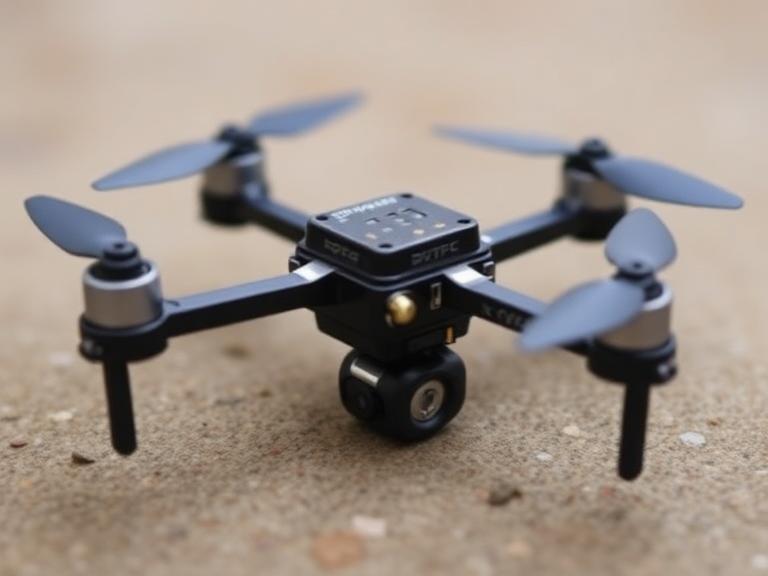
What is a MEMS IMU?
How a MEMS IMU Works
Role in Drone Navigation
Comparison with Other Technologies
Pros and Cons
Buying Guide
FAQ
If you are involved in the drone industry, whether as a manufacturer, operator, or systems integrator, you have likely heard the term “MEMS IMU” and know it is important. But what exactly does it do, and why is it so critical for drone navigation? In this guide, we will break down the function of a MEMS IMU, explaining its core components, how it works, and its indispensable role in enabling modern drone flight.
What is a MEMS IMU?
A MEMS IMU is a device that measures a drone’s velocity, orientation, and gravitational forces, using a combination of accelerometers and gyroscopes . It is the primary sensor that allows a drone’s flight controller to understand its movement and position in three-dimensional space.
Core Components
A typical MEMS IMU consists of:
- Three-axis gyroscope: Measures the rate of rotation (angular velocity) around the drone’s pitch, roll, and yaw axes .
- Three-axis accelerometer: Measures linear acceleration along the drone’s x, y, and z axes .
- Temperature sensors: Compensate for environmental changes that can affect sensor accuracy .
Advanced IMUs may also integrate magnetometers, barometers, and even GNSS receivers to provide a more comprehensive navigation solution .
How It Works
The gyroscope detects angular velocity, while the accelerometer detects linear acceleration. By continuously measuring these parameters, the IMU provides the raw data that the flight controller uses to calculate the drone’s attitude (pitch, roll, and yaw), velocity, and position through a process called dead reckoning .

ChinaMoneypro UAV offers a range of MEMS IMUs designed for various UAV applications. For instance, the MP-IMU0301D is a highly reliable six-axis MEMS IMU providing high-speed sampling at 1 kHz for precise angular velocity and linear acceleration measurements .
How a MEMS IMU Works
The core function of a MEMS IMU is to provide real-time inertial data. Here is a breakdown of how it achieves this:
Gyroscope: Measuring Rotation
The gyroscope measures the drone’s angular velocity. This data is essential for determining how the drone is rotating in space, which is the foundation for attitude control . Key specifications for a gyroscope include measurement range and bias stability, which indicates how much the measurement drifts over time.
Accelerometer: Measuring Acceleration
The accelerometer measures linear acceleration, including the constant acceleration of gravity. This data helps the drone determine its tilt relative to the Earth’s surface and is crucial for calculating velocity and position .
Sensor Fusion: Combining the Data
Raw IMU data is noisy and drifts over time. To overcome this, the data from the gyroscope and accelerometer are fused together using complex algorithms. This process, often called sensor fusion, combines the high-frequency, dynamic response of the gyroscope with the stable, low-frequency reference of the accelerometer to produce a reliable, drift-free estimate of the drone’s attitude.
Pro Tip: When evaluating a MEMS IMU, pay close attention to the gyroscope’s bias instability and the accelerometer’s bias stability. Lower numbers indicate higher accuracy and less drift over time. The ChinaMoneypro MP-IMU0301D, for example, offers a gyroscope bias instability of ≤ 0.3°/h and an accelerometer bias stability of ≤ 0.15 mg .
For applications requiring even higher precision, ChinaMoneypro offers the MP-GI0521 MEMS Integrated Navigation System, which fuses MEMS gyroscopes and accelerometers with GNSS data .
Role in Drone Navigation
In drone navigation, the MEMS IMU plays several critical roles:
1. Attitude Control and Stabilization
This is the most fundamental role of the IMU. By providing real-time data on the drone’s orientation, the flight controller can make instantaneous adjustments to the motors to maintain a stable, level flight. This is what allows a drone to hover in place, even when buffeted by wind or turbulence . The IMU enables the drone to “know” its orientation and correct for any deviations.
2. Navigation and Path Planning
By integrating the acceleration data over time, the IMU can calculate the drone’s velocity and, with further integration, its position. This process, known as dead reckoning, allows the drone to navigate and follow a pre-programmed flight path, even in the absence of GPS signals .
3. GNSS Signal Augmentation
In most modern drones, the IMU works in tandem with a GNSS receiver (like GPS). The GNSS provides absolute position data, while the high-frequency IMU data fills in the gaps between GNSS updates. This sensor fusion results in a much more precise and responsive navigation system .
4. GNSS-Denied Navigation
In environments where GPS signals are jammed, spoofed, or simply unavailable (e.g., indoors, in deep canyons, or under dense tree cover), the IMU becomes the drone’s primary navigation sensor . The quality of the IMU directly determines how long the drone can maintain an accurate position without external references .
Critical: The accuracy of a MEMS IMU is paramount for autonomous drone operations. A high-quality IMU with low drift is essential for maintaining precise positioning, especially in GNSS-denied environments. The ChinaMoneypro MP-GI0521, for instance, can maintain a horizontal position error of ≤ 200m for up to 3 minutes without GNSS .
ChinaMoneypro UAV offers a range of products specifically designed for these critical navigation roles. The MP-GI0521 provides a complete GNSS/INS navigation solution, while the MP-IM003 is an ultra-compact tactical-grade IMU weighing only 55g .
Comparison Table: MEMS IMU vs. Other Technologies
| Technology | Accuracy | Cost | Size/Weight | Typical Use in Drones |
|---|---|---|---|---|
| MEMS IMU | Moderate to High | Low to Moderate | Very Small, Lightweight | Primary sensor for all consumer and most commercial drones |
| Fiber Optic Gyro (FOG) IMU | Very High | High | Larger, Heavier | High-end special and surveying drones requiring extreme precision |
| Ring Laser Gyro (RLG) IMU | Extremely High | Very High | Large, Heavy | Strategic-grade applications, large UAVs, and aerospace |
| GNSS Only (GPS) | Position: Moderate to High | Low | Small | Provides absolute position, but vulnerable to jamming and signal loss |
Pros and Cons of MEMS IMU for Drone Navigation
- Small size and light weight, ideal for compact drones
- Low power consumption, extending flight times
- Cost-effective, enabling mass adoption
- High reliability and ruggedness, suitable for harsh environments
- Can be integrated with GNSS for superior navigation performance
- Susceptible to drift over time, requiring periodic calibration or fusion with other sensors
- Lower accuracy compared to FOG or RLG systems for strategic-grade applications
- Performance can be affected by temperature changes without proper compensation
- Individual sensor errors (bias, scale factor) need to be modelled and corrected
Buying Guide: How to Choose a MEMS IMU for Your Drone
From our experience, selecting the right MEMS IMU is critical for your drone’s performance. Here is a decision framework for different applications.
Expert Recommendation: For most commercial drone applications, a MEMS-based integrated navigation system that combines a high-performance IMU with GNSS provides the best balance of cost, size, and performance. The ChinaMoneypro MP-GI0521 is a prime example of this approach, offering a complete navigation solution in a compact, lightweight package .
Explore more of ChinaMoneypro UAV’s inertial navigation solutions for a variety of UAV applications.
Common Mistakes When Choosing a MEMS IMU
- Choosing a low-cost IMU without considering its long-term stability and drift characteristics, leading to poor navigation performance over time.
- Not accounting for temperature compensation. An IMU that is not properly compensated will give inaccurate readings as the temperature changes .
- Forgetting about the integration effort. Some IMUs require complex calibration and sensor fusion algorithms, adding development time.
- Overlooking the physical specifications. Ensure the IMU’s size, weight, and power consumption are suitable for your drone’s payload capacity and flight time requirements .
- Not testing the IMU in the intended operational environment. Performance in a lab setting may not reflect real-world conditions with vibrations and temperature fluctuations.
About ChinaMoneypro UAV – ChinaMoneypro UAV is a national-level high-tech enterprise, transformed from a prestigious state-owned research institute. With deep roots in defense-grade engineering, we specialize in the R&D and manufacturing of advanced unmanned platforms and integrated sensing-communication solutions. Headquartered in one of China’s premier innovation hubs, Moneypro is among the few full-stack providers offering complete UAV systems, engines, gimbals, radar, data links, and communication technologies.
Frequently Asked Questions
Can a drone fly without a MEMS IMU?
Technically, no. A drone cannot stabilize itself or navigate without an IMU or an equivalent sensor. It is the core sensory component for flight control .
What is the difference between a MEMS IMU and a GNSS receiver?
A GNSS receiver (like GPS) provides absolute position data, but it is slow and can be lost. A MEMS IMU provides high-frequency data on movement and orientation, but it drifts over time. They are complementary systems; together, they form a robust navigation solution .
How often should a MEMS IMU be calibrated?
It depends on the quality of the IMU and the application. High-end IMUs with advanced compensation algorithms may not require frequent user calibration. However, for critical applications, it is good practice to perform a calibration before each flight or after significant temperature changes.
What is “tactical-grade” in the context of an IMU?
It refers to an IMU with very high accuracy and low drift, suitable for applications like missile guidance and high-end UAVs that require precise navigation even without GNSS . The ChinaMoneypro MP-IM003 is a tactical-grade IMU .
References and Trusted Sources
- 1. ChinaMoneypro UAV – Product Specifications and Application Notes (2026).
- 2. Ericco Technology – IMU How to Improve Drone Stability and Navigation
- 3. IEEE Xplore – Hybrid Domain Error Suppression for MEMS-IMU Array
Explore more: hybrid VTOL drone |
heavy lift VTOL drone |
VTOL cargo drone |
fixed wing drones |
long range drone with camera