Elevating Satellite Communications with a High-Performance 4400–4950MHz Low-Noise Amplifier
n
In the demanding world of satellite communications (satcom), signal integrity is paramount. Whether you’re managing ground stations or space-based equipment, every decibel of gain and every fraction of a noise figure matters. The 4400–4950MHz low-noise amplifier (LNA) module is engineered to meet these rigorous requirements, acting as a cornerstone for reliable signal processing in the satellite communication chain.
n
This RF low noise amplifier is specifically designed for the C-band satellite communication spectrum, addressing the critical need for boosting weak signals without introducing excessive noise. From its exceptional noise performance to its robust power handling, this LNA module ensures that your satellite communication links remain clear, stable, and resistant to interference.
n
Core Performance Metrics of This RF Low Noise Amplifier
n
At the heart of this module lies a suite of performance characteristics that distinguish it from standard amplifiers. The device operates within a passband of 4400 to 4950 MHz, a frequency range crucial for satellite uplinks and downlinks. Within this band, it delivers a consistent passband gain of 22.0 to 25.0 dB (including ripple), with peak-to-peak ripple held to just 1 dB over any 10 MHz bandwidth. This flat response ensures that data signals are amplified uniformly, preserving the integrity of the transmitted information.
n
The noise figure, a key indicator of signal purity, is an impressively low 2.2 dB. This low noise figure is essential for satellite communications, where signals arriving from space are often extremely weak. By minimizing the noise added during amplification, this amplifier enables receivers to capture clearer data from distant satellites. Furthermore, the input third-order intercept point (IIP3) of -7.5 dBm demonstrates excellent linearity, allowing the module to handle strong adjacent interference signals without generating spurious products.
n
Frequency Rejection and Interference Management
n
Effective satellite communication requires more than just amplification; it demands precise filtering to block out-of-band interferers. This LNA module excels in this area, providing strong antenna-to-receiver rejection across various frequency bands. This selective suppression enhances the overall signal-to-noise ratio and protects downstream components from overload.
n
The robust rejection characteristics are designed to filter out common interference sources, ensuring that only the desired 4400–4950 MHz signal passes through with minimal degradation.
n
Complete Technical Specifications in Structured Format
n
The following table provides a comprehensive overview of the module’s technical parameters, including mechanical and environmental data.
n
| Parameter | Specification |
|---|---|
| Passband | 4400 ≤ F ≤ 4950 MHz |
| Passband Gain (including ripple) | 22.0 ≤ Gain ≤ 25.0 dB |
| Passband Ripple | 1 dB peak-to-peak over 10 MHz bandwidth |
| Noise Figure | 2.2 dB |
| Input Third-Order Intercept Point (IIP3) | -7.5 dBm |
| Antenna to Rx Rejection | 1225 ≤ F ≤ 1575 MHz: -40 dBc 5250 ≤ F ≤ 5850 MHz: -48 dBc 7100 ≤ F ≤ 7650 MHz: -75 dBc |
| RF Power Capability (Rx Output) | 15 dBm |
| RF Power Capability (Antenna Input) | 10 dBm |
| Port VSWR (Rx Output) | 1.8:1 (50 ohm) |
| Port VSWR (Antenna) | 1.5:1 (50 ohm) |
| DC Input Voltage | 11 to 13 VDC |
| DC Input Current | < 60 mA |
| DC Power Connector | Coaxial (DC V+ and return on coax cable center conductor and outer ground shield) |
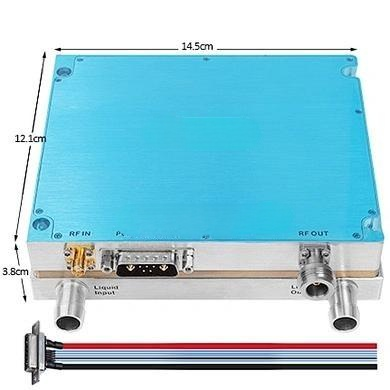
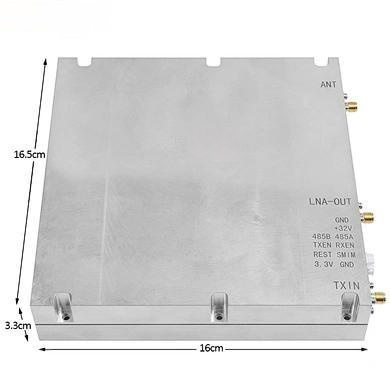
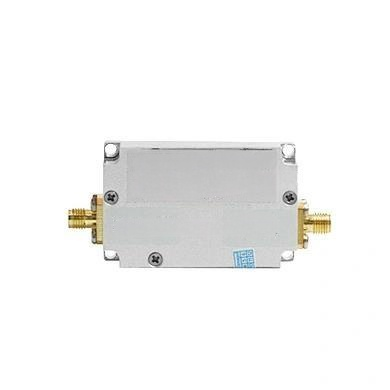
| Case Dimensions | 5.4 x 3.4 x 1.8 cm |
| Weight | 0.062 kg |
| RF Connectors | SMA Female |
| Operating Temperature Range | -20 to +70°C |
| Non-Operating Temperature Range | -40 to +85°C |
| Altitude | 0 to 70,000 ft |
| Humidity | 10 to 95%, non-condensing |
n
Practical Applications and Integration for Your Satellite System
n
The design of this RF low noise amplifier prioritizes integration ease and operational reliability. With a DC input voltage range of 11 to 13 VDC and low current consumption of less than 60 mA, it can be powered by standard satellite receiver power supplies. Its compact mechanical size of 5.4 x 3.4 x 1.8 cm and lightweight design (0.062 kg) make it suitable for space-constrained environments, whether in antenna feed-horns or alongside receivers.
n
The specification ensures stable operation across a wide ambient temperature range from -20°C to +70°C, crucial for the fluctuating conditions found in satellite communication installations. The use of SMA female connectors provides a standardized, reliable interface for high-frequency RF connections. This module is engineered to deliver consistent performance, whether deployed in a fixed ground station, a mobile satcom terminal, or as part of a satellite payload.
n
Conclusion: A Reliable Foundation for Clear Satellite Links
n
The 4400–4950MHz low-noise amplifier module represents a sophisticated solution for modern satellite communications. Its balanced performance between low noise figure, flat gain, and strong linearity addresses the core challenges of maintaining signal fidelity. By systematically detailing every parameter—from RF performance to mechanical dimensions—this RF low noise amplifier provides engineers and system designers with the confidence to integrate it into mission-critical applications. With this LNA module in the signal chain, achieving robust and clear satellite communication links becomes a consistent reality.