Introduction
nnIn the rapidly evolving landscape of wireless communication, the demand for robust, high-performance signal amplification has never been greater. Whether powering critical data links in unmanned systems, enhancing radar capabilities, or ensuring stable connections in industrial IoT networks, the quality of your RF chain often depends on one component: the amplifier module. The 5100 – 5900MHz High Power Amplifier Module stands out as a versatile and potent solution for engineers and integrators who require clean, reliable power across the crucial 5.1 to 5.9 GHz band. This module doesn’t just boost signals; it provides the backbone for reliable, long-range, and high-throughput wireless systems. By understanding its capabilities, specifications, and integration requirements, you can unlock the full potential of your communication platform.nn
Core Specifications and Performance of the High Power Amplifier Module
nnTo appreciate what this module can achieve in a real-world system, we need to examine its core performance metrics. The heart of this device lies in its ability to deliver a saturated power output of 45±1dBm, coupled with a significant gain of 45±2dBm. This means the module can effectively amplify low-level input signals to a powerful output capable of overcoming path loss and ensuring strong signal reception at the receiving end. The wide bandwidth of 5.1 – 5.9 GHz ensures it can cover multiple channels and applications, from Wi-Fi 6E extended bands to specific license-free ISM and fixed wireless access services.nn| Parameter | Technical Specification |n| :— | :— |n| Working Frequency | 5.1 – 5.9 GHz |n| Saturated Power Output | 45±1 dBm |n| Gain | 45±2 dBm |n| In-band Flatness | (Specified in data sheet, typically ≤ ±1.5 dB) |n| Working Current | ≤ 3 A |n| Input & Output VSWR | ≤ 1.5 |n| Out-of-band Spurs (9kHz-1GHz) | ≤ -36 dBm / 30 kHz |n| Out-of-band Spurs (1-12.75GHz) | ≤ -30 dBm / 30 kHz |n| Maximum Lossless Input | +10 dBm |nnThe table above clarifies the critical operational boundaries. The VSWR (Voltage Standing Wave Ratio) of less than or equal to 1.5 indicates excellent impedance matching, which is crucial for minimizing signal reflections and maximizing power transfer to the antenna. The low spurious emissions ensure compliance with regulatory standards and prevent interference with adjacent channels. The maximum lossless input of +10 dBm provides a clear guideline for safe input drive levels without risk of damage or degradation.nn
Mechanical and Environmental Design
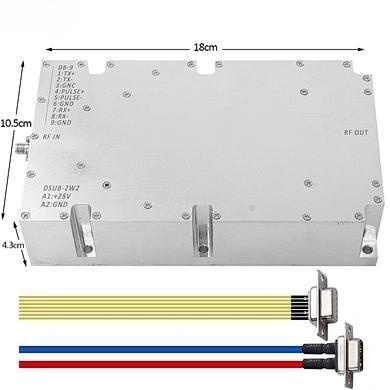
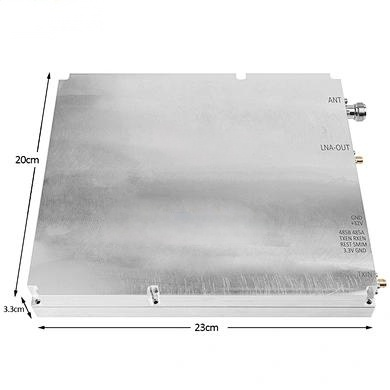
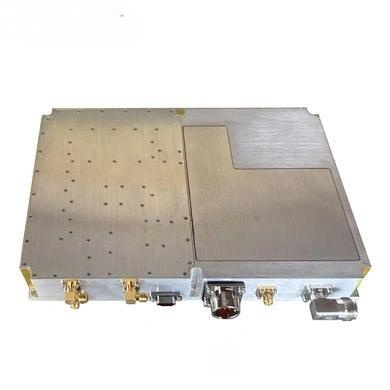
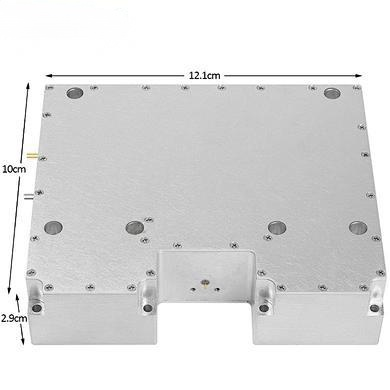
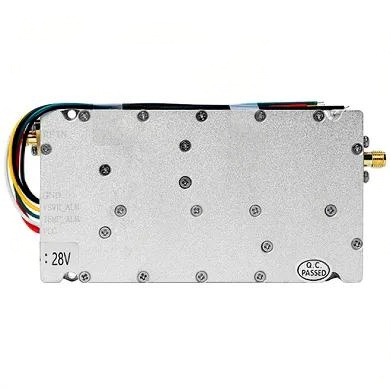
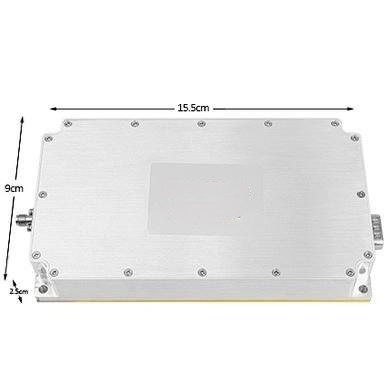
nnThe physical architecture of the high power amplifier module is engineered for practical deployment. The use of an SMA-KFD RF port is standard for high-frequency connections, offering reliability and ease of use. The power and monitoring interface employs a feed-through capacitor, which is a brilliant choice for filtering out high-frequency noise entering or leaving the module via the DC lines. This design detail directly contributes to the module’s spectral purity and stability.nnThe compact footprint of 125 x 65 x 20 mm belies its substantial power-handling capability. This size is ideal for integration into equipment racks, drone payloads, or custom test benches where space is at a premium. The module is designed to operate reliably in harsh environments, with specifications for temperature and humidity that cover a wide range of operational scenarios.nn| Parameter | Specification |n| :— | :— |n| Amplifier Size | 125 x 65 x 20 mm |n| RF Port | SMA-KFD |n| Power Supply Interface | Feed-through capacitor |n| Operating Temperature | -10 ~ +55 °C |n| Relative Humidity (Operating) | 5% ~ 95% (Non-condensing) |n| Storage Temperature | -25 ~ +65 °C |n| Monitoring Interface | Feed-through capacitor |nn
Integrated Monitoring and Control Features
nnOne of the most advanced aspects of this module is its built-in reporting functionality, which transforms it from a simple amplifier into a smart subsystem. This is where the high power amplifier module truly differentiates itself from simpler alternatives. It provides real-time telemetry for two critical parameters: current and temperature.nn
Current Report Function
nnThe module monitors the current draw and converts it to a voltage signal. The chips within the module read the current value and output a voltage proportional to the current. Typically, the relationship is linear, allowing a microcontroller or analog-to-digital converter (ADC) to easily interpret the system’s load. For example, a voltage of 0-5V might correspond to a specific current range, enabling engineers to detect faults, impedance mismatches, or thermal runaway conditions before they cause damage.nn
Temperature Report Function
nnTemperature monitoring is even more straightforward, thanks to a voltage reference output. The chip provides a temperature reading based on a simple formula: VO = 10 mV / °C * T °C + 500 mV (with 25°C as the basic reference point). This means that at 25°C, the output voltage is 500 mV. For every degree Celsius increase, the voltage rises by 10 mV. This linear output makes it exceptionally easy to use a standard microcontroller ADC for precise thermal management. You can set thresholds for under-temperature, over-temperature, or trigger a thermal shutdown sequence to protect the module and your overall system.nn
Practical Applications and Integration
nnWith its powerful output, wide bandwidth, and intelligent monitoring, this module is ideally suited for demanding applications. It serves as an excellent high power amplifier module for Wi-Fi 6/6E infrastructure, point-to-point backhaul links, radar systems, and test equipment. The 10-pin interface simplifies the connection to the host system’s power supply and monitoring circuits. The feed-through capacitors on the power and monitoring lines are crucial for maintaining signal integrity and preventing interference from the power supply. When integrating, ensure that the cooling solution is adequate for the thermal load (≤3A at +28V), as the amplifier will generate significant heat during continuous high-output operation. The temperature and current report voltages can be connected directly to ADC inputs on your microcontroller or embedded system for real-time status updates.nn
Conclusion
nnThe 5100 – 5900MHz High Power Amplifier Module is a high-performance, feature-rich solution for demanding RF applications. Its combination of 45dBm saturated output power, wide bandwidth, and intelligent monitoring capabilities makes it an outstanding choice for system integrators. The high power amplifier module not only amplifies your signal but also empowers you with the telemetry needed to build a smarter, more reliable system. By leveraging its specifications and integrated monitoring functions, you can ensure optimal performance, longevity, and operational safety across a wide range of environmental conditions. This module represents a significant step forward in creating efficient and robust wireless communication links.