5.6-5.8G TDD Linear Amplifier: The Core RF Module for High-Frequency Signal Amplification
nn
In the demanding world of high-frequency communications, signal integrity and power efficiency are paramount. The 5.6-5.8G TDD linear amplifier stands as a professional-grade RF module engineered to meet the rigorous requirements of the 5600-5800 MHz band. This advanced component is not just an amplifier; it is a comprehensive solution for building robust RF links in TDD (Time Division Duplex) systems. By integrating a high-performance linear amplifier with intelligent control and protection features, this RF module ensures that your high-frequency signals are amplified with exceptional clarity, minimal noise, and unwavering stability. Whether you are involved in wireless infrastructure, point-to-point communication, or specialized test equipment, this amplifier provides the power and precision needed for mission-critical applications.
nn
Precision Engineering for the 5.6-5.8G Band
nn
The amplifier is meticulously designed to operate within the 5.6-5.8 GHz high-frequency band, offering a precise and reliable solution for signal amplification. Unlike wideband alternatives, this focused design ensures optimal performance within its designated spectrum, minimizing out-of-band interference and maximizing efficiency. The core of this RF module is its TDD architecture, which facilitates rapid switching between transmit (downlink) and receive (uplink) modes, a critical requirement for modern wireless communication protocols. With a switching delay of ≤4.8 microseconds, the amplifier ensures seamless data flow without latency issues, making it ideal for real-time applications.
nn
Key Performance Indicators of the RF Module
nn
To fully appreciate the capabilities of this 5.6-5.8G TDD linear amplifier, it is essential to examine its detailed specifications. The following table outlines the critical parameters that define its performance, demonstrating its superiority in gain, noise figure, and linearity.
nn
| Test Item | Downlink Indicator | Uplink Indicator | Unit | Remark |
|---|---|---|---|---|
| Frequency Range | 5600–5800 | 5600–5800 | MHz | |
| Maximum Output Power | 40 ± 0.5 | 15 | dBm | |
| Gain | 45 ± 1.5 | 25 ± 1.0 | dB | |
| Noise Figure | ≤ 15 | ≤ 3 | / | |
| Flatness | ≤ 3 | ≤ 2 | dB | |
| PA Voltage | 32 | 32 | V | |
| Power Conversion Efficiency | >15% | / | % | @40dBm |
| Gain Adjustment Step Size | 1.0 | Not supported | dB | |
| Numerical Control Regulation Error | 1–16dB ≤ 1.0 | Not supported | dB | |
| Spurious Emission (In-Band) | ≤ -36 | / | dBm | Tested with CW signal at center frequency and max output power |
| Spurious Emission (Out-of-Band 9KHz–1GHz) | No clutter above normal noise floor | / | dBm | |
| Spurious Emission (Out-of-Band 1G–12.75GHz) | No clutter above normal noise floor | / | dBm | |
| EVM | ≤ 10% | ≤ 1.2% | % | Dynamic testing @40dBm |
| ACLR | ≤ -35 | dBC | / | |
| Maximum Allowable Input Power | ≤ +10 | ≤ -10 | dBm | No damage for 1 min continuous operation |
| Input VSWR | ≤ 1.50 | ≤ 1.50 | ||
| Output VSWR | ≤ 1.50 | ≤ 1.50 | ||
| Switching Delay | ≤ 2 | ≤ 4.8 | us | |
| High and Low Temperature Test Ambient Temperature | -10 to +55 | -10 to +55 | °C | Starts normally at low temps, monitoring works normally |
| EVM (High/Low Temp) | ≤ 15% | ≤ 1.2% | % | @40dBm |
| Gain Stability | ± 2 | / | dB | @-10°C to +55°C |
| Power Stability | ± 1.5 | / | dB | @-10°C to +55°C |
| Current | ≤ 2.5A @32V | / | A | |
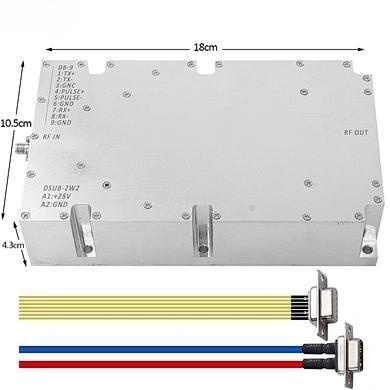
| Power Interface | KF2EDG5.08-4P Male Connector | |||
| Monitoring Interface | XH2.54-8P Male Connector | |||
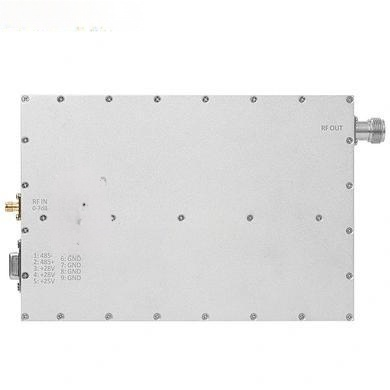
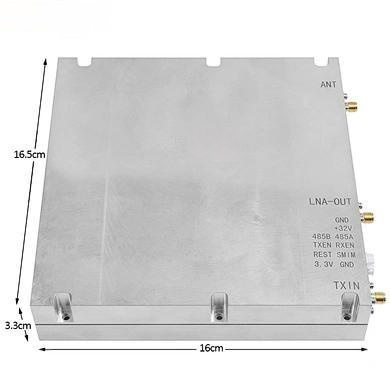
| RF Input/Output Connectors | RF-IN/LAN OUT/ANT: SMA-K/MCX-K | |||
| Uplink/Downlink Switching Methods | TX_EN and RX_EN signal: 10 = transmit, 01 = receive, 00 = both off. Simultaneous setting to 11 is prohibited. | |||
nn
Advanced Features of the RF Module
nn
Beyond raw performance, this 5.6-5.8G TDD linear amplifier is packed with intelligent features that simplify integration and enhance reliability. The built-in 0-16 dB digital control attenuation adjustment allows for precise gain management, ensuring that signal levels are optimized for varying conditions. Multi-level protection mechanisms, including over-temperature, over-power, and VSWR protection, safeguard the amplifier and downstream components from damage, extending operational lifespan. The RS-485 interface provides real-time parameter configuration and status monitoring, enabling remote management and diagnostics—a crucial advantage in deployed networks. This combination of performance and intelligence makes this RF module a standout choice for engineers seeking a reliable, high-quality solution for the 5.6-5.8G band.
nn
Environmental and Mechanical Robustness
nn
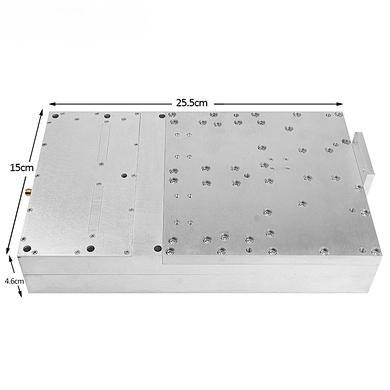
The amplifier is built to withstand challenging environments. Operating reliably over a temperature range of -10°C to +55°C, it maintains excellent gain and power stability, as evidenced by the ±2 dB and ±1.5 dB stability figures, respectively. The industrial-grade structural design, coupled with rich interfaces like SMA-K and MCX-K connectors, ensures easy installation and integration into existing systems. Input and output VSWR of ≤1.5 minimize signal reflections, preserving signal integrity and maximizing power transfer. This RF module is not just a component; it is a durable, high-performance building block for your RF infrastructure.
nn
Conclusion: The Ultimate RF Module for 5.6-5.8G Applications
nn
In summary, this 5.6-5.8G TDD linear amplifier represents the pinnacle of RF module design for the high-frequency band. It delivers the power, linearity, and reliability required for demanding applications, from wireless backhaul to advanced communication systems. Its precise frequency coverage, low noise, and intelligent control features set it apart as a true professional-grade solution. When you need a high-performance RF module for your 5.6-5.8 GHz projects, this amplifier offers the confidence of proven engineering and the flexibility to adapt to your specific needs. Choose this RF module to ensure your signal amplification is both powerful and pristine, every time.