Understanding the 4×4 Hybrid Combiner: A Critical Component for Modern RF Systems
nnIn the ever-evolving landscape of wireless communications, signal integrity and power management are paramount. The 4×4 Hybrid Combiner stands as a cornerstone technology for network operators and system integrators seeking to combine multiple RF signals with minimal loss and maximum isolation. This device is far more than a simple connector; it is a precision-engineered solution designed to meet the rigorous demands of 4G, 5G, and multi-band networks. By efficiently merging four input signals into a single output, this combiner ensures that your infrastructure remains robust, scalable, and interference-free. Whether you are upgrading an existing system or designing a new deployment, understanding the capabilities and specifications of the 4×4 Hybrid Combiner is essential for optimizing performance and reliability.nn
Key Specifications of the 4×4 Hybrid Combiner
nnTo fully appreciate the engineering behind this component, it is vital to examine its technical parameters. The following table details the critical specifications that define its performance, including frequency range, insertion loss, and power handling capabilities.nn
| Parameter | Value |
|---|---|
| Frequency Range (MHz) | 698 – 2700 |
| Insertion Loss (dB) | 6 ± 1.2 |
| Isolation (dB) | ≥ 25 |
| Return Loss (dB) | ≥ 18 |
| VSWR (dB) | Not specified |
| Intermodulation Products (dBm) | ≤ -160 dBc (with 2 x 43 dBm) |
| Maximum Input Power (W) | 300 or 500 |
| Operating Temperature (°C) | -25 to +70 |
| Relative Humidity (%) | 0 ~ 95 |
| Impedance (Ω) | 50 |
nn
Dimensions and Physical Characteristics
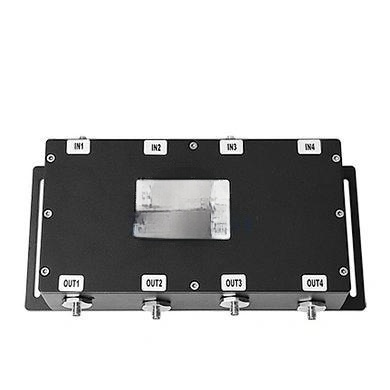
nnBeyond electrical performance, the physical build of the 4×4 Hybrid Combiner ensures durability and ease of integration. The device is designed to withstand harsh environmental conditions while maintaining a compact form factor.nn
| Physical Parameter | Measurement |
|---|---|
| Size (mm) | 194 x 138 x 49 |
| Weight (g) | 2300 |
| Connector Type | 4.3-10 Female, N Female, 7-16 Female |
| Ingress Protection | IP65 |
| Color | Black |
nn
Benefits of Using a 4×4 Hybrid Combiner
nn
Enhanced Signal Isolation and Low Intermodulation
nnOne of the standout features of this 4×4 Hybrid Combiner is its exceptional isolation of ≥ 25 dB, which prevents signal leakage between ports and minimizes cross-talk. This is critical in dense network environments where multiple carriers operate simultaneously. Additionally, the intermodulation products are suppressed to ≤ -160 dBc, ensuring that even with high-power inputs of 2 x 43 dBm, the combiner introduces negligible distortion. This level of performance directly supports cleaner signal propagation and reduces the risk of interference, which is vital for maintaining high data throughput in 5G and LTE networks.nn
Broadband Frequency Coverage for Multi-Band Operations
nnCovering a frequency range from 698 MHz to 2700 MHz, this combiner is engineered to support a wide array of wireless standards, including GSM, UMTS, LTE, and 5G NR. This broadband capability allows network operators to deploy a single device across multiple bands, simplifying inventory management and reducing deployment complexity. The insertion loss of 6 ± 1.2 dB is carefully balanced to ensure efficient power combining without degrading the signal strength excessively, making it a practical choice for tower-mounted or indoor applications.nn
Robust Construction with IP65 Rating
nnDurability is a key consideration for outdoor installations, and the 4×4 Hybrid Combiner delivers with an IP65 ingress protection rating. This means it is fully protected against dust and low-pressure water jets from any direction, making it suitable for rooftops, towers, or enclosures exposed to the elements. The lightweight weight of 2300 g and compact dimensions ensure easy handling and mounting, while the choice of connectors—4.3-10 Female, N Female, and 7-16 Female—provides flexibility to match existing cabling infrastructure. The black color also aids in thermal management and aesthetic consistency with other network components.nn
Practical Applications and Integration Tips
nnWhen integrating the 4×4 Hybrid Combiner into your RF system, consider the maximum input power limits of either 300 W or 500 W, depending on the specific model. This ensures that the device can handle the combined power from multiple transmitters without overheating or sustaining damage. The 50 Ω impedance matches standard coaxial cables and connectors, simplifying connection. For optimal performance, always verify that the VSWR (voltage standing wave ratio) is maintained at a low level—while the exact value is not listed, the return loss of ≥ 18 dB indicates good impedance matching, which minimizes signal reflections. Use high-quality cables and ensure proper grounding to further enhance reliability.nn
Conclusion: Why the 4×4 Hybrid Combiner is Essential for Your Network
nnIn conclusion, the 4×4 Hybrid Combiner is a highly capable and versatile component that addresses the most demanding requirements of modern RF systems. With its wide frequency coverage, low intermodulation distortion, robust isolation, and durable IP65 construction, it provides a reliable foundation for combining signals in multi-band, high-power environments. By incorporating this combiner into your network design, you can achieve superior signal integrity, reduce interference, and ensure long-term operational stability. Whether for a small cell deployment or a large macro cell tower, this device offers the performance and flexibility needed to keep your infrastructure future-proof. When you choose the 4×4 Hybrid Combiner, you are investing in a solution that balances precision engineering with practical durability, making it an indispensable tool for any serious telecommunications professional.