


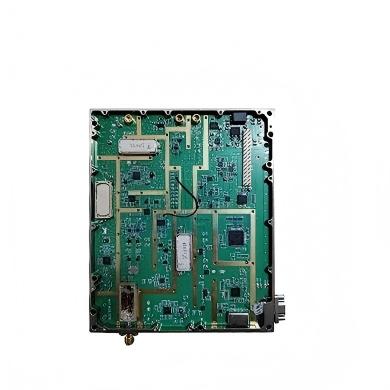
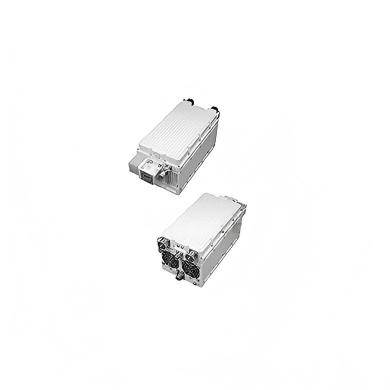
L-band Transceiver Module: A High-Performance Communication Powerhouse
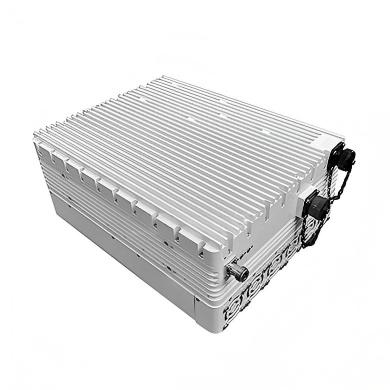
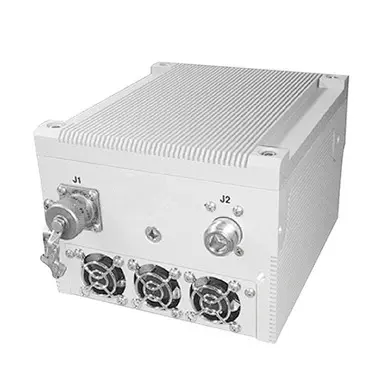
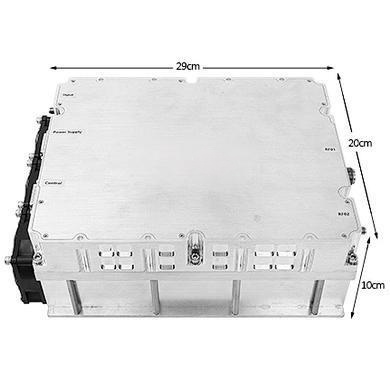
nnThe L-band Transceiver Module stands as a critical component in modern communication systems, offering exceptional performance and reliability. This sophisticated module is designed as a dual-transmit, four-receive configuration, with a meticulously engineered layout that integrates multiple functions into a compact form factor. On the receiving side, the module features Σ, Δ, and Ω channels, enabling precise reception and down-conversion of various mode response signals, including M1 through M6. Additionally, an ADS-B IN channel effortlessly handles ADS-B signals for enhanced situational awareness. Each receiving channel comes equipped with a built-in self-test function and supports amplitude and phase correction for the Σ, Δ, Ω, and ADS-B IN channels, ensuring signal accuracy and stability. The module also offers intermediate frequency (IF) and video output capabilities, making it versatile for diverse applications.nn
Transmission Capabilities and Reliability Features
nnIn terms of transmission, the L-band Transceiver Module boasts two dedicated channels—Σ and Ω—that perform up-conversion and power amplification for interrogation signals across M1-M6 modes. These features enable robust long-distance signal transmission. Advanced functions such as transmission detection, transceiver isolation, and standing wave detection further enhance the module’s reliability and safety, minimizing risks in demanding operational environments.nn
Key Performance Parameters and Specifications
nnTo ensure peak performance, the L-band Transceiver Module adheres to stringent performance parameters. The transmitting frequency is stable at 1030 MHz ± 0.05 MHz, with a power output of ≥ 57 dBm. On the receiving end, the center frequency is 1090 MHz ± 0.5 MHz, with sensitivity levels of ≤ -86 dBm for the Σ, Δ, and Ω channels and ≤ -90 dBm for the ADS-B channel. These specifications make the module ideal for aviation communications, radar monitoring, and other fields requiring stable and efficient signal handling. Below is a comprehensive breakdown of the module’s performance indices across transmitter, receiver, and RF power amplifier units.nn
| Parameter | Requirement |
|---|---|
| Transmitter Unit | |
| Transmitting frequency | 1030 MHz ± 0.05 MHz |
| Transmitting power | ≥ 57 dBm (transmitting module port power) |
| Modulation frame signal | AM should be at least 200ns ahead of ASK signal and 300ns behind ASK signal |
| Duty ratio | ≤ 2% |
| Reflection detection | Output 3.3V (tentative) when load standing wave ≥ 2.5, simulate pulse signal alarm |
| Pulse Envelope Characteristics | |
| Pulse Width M1, M2, M3/A, MC | 0.8 μs ± 0.05 μs |
| M5 symbol width | 1.0625 μs–1.375 μs |
| M6 (similar to M4) | 0.5 μs ± 0.05 μs |
| Pulse rising edge | ≤ 0.1 μs |
| Pulse falling edge | ≤ 0.2 μs |
| Pulse top unevenness | ≤ 0.75 dB |
| Pulse sequence unevenness | ≤ 1.0 dB |
| Harmonic Requirements | |
| Second harmonic | ≤ -80 dB or -50+10log10(P) (P = peak transmission power in W) |
| Third harmonic | ≤ -80 dB or -50+10log10(P) |
| Other harmonics | ≤ -80 dB; unexpected power output: (-30 dBm) |
| IF Interrogation Signal Input Requirements | |
| IF frequency | 130 MHz ± 0.05 MHz |
| IF amplitude | 0 dBm ± 2 dB |
| Modulation method | ASK, MSK, DPSK |
| Quantity of channels | 2 channels (Σ and Ω) |
| Detection output | ≥ +3V |
nn
Receiver Unit: Main Performance of Σ, Δ, Ω Receiving Channels
nn
| Parameter | Requirement |
|---|---|
| Receiving center frequency | 1090 MHz ± 0.5 MHz |
| Receive tangent sensitivity | ≤ -86 dBm |
| Receive dynamic range | ≥ 60 dB |
| Image rejection | ≥ 60 dB |
| Σ, Δ channel consistency (uncalibrated) | ±1 dB (amplitude); ≤ 10° (phase) |
| Anti-burning | With 1000W (or maximum transmission power) anti-burning capability |
| Out-of-band rejection | 1090 MHz ± 25 MHz (OOB), 60 dB |
| IF Response Signal Output Requirements | |
| Center frequency | 70 MHz ± 0.05 MHz (local oscillator frequency accuracy error ≤ 0.05 MHz) |
| Amplitude range | -50 dBm to +10 dBm |
| 3 dB bandwidth | 19 MHz ± 1 MHz |
| Input port standing wave ratio | ≤ 1.4 (design guarantee) |
| Noise figure | ≤ 3 dB |
| Video output | 0V–2V |
nn
Receiver Unit: Main Performance of ADS-B Channels
nn
| Parameter | Requirement |
|---|---|
| Receiving center frequency | 1090 MHz ± 0.5 MHz |
| Receive tangent sensitivity | ≤ -90 dBm |
| Receive dynamic range | ≥ 60 dB |
| Image rejection | ≥ 60 dB |
| Anti-burning | With 1000W (or maximum transmission power) anti-burning capability |
| Out-of-band rejection | 1090 MHz ± 25 MHz (OOB), 60 dB |
| IF Signal Output Requirements | |
| Center frequency | 70 MHz ± 0.05 MHz (local oscillator frequency accuracy error ≤ 0.05 MHz) |
| Amplitude range | -50 dBm to +10 dBm |
| 3 dB bandwidth | 4 MHz–6 MHz |
| Input port standing wave ratio | ≤ 1.4 (design guarantee) |
| Video output | 0V–2V |
nn
Broadband RF Power Amplifier Performance
nn
| Type | Requirement Name | No. | Requirement Value | Remark |
|---|---|---|---|---|
| Overall Working Mode | ||||
| Overall working mode | RF_001 | 1 | TDD | |
| Quantity of RF transceiver channels | RF_002 | 2 | 1T/2R | |
| RF transmit and receive channel isolation | RF_003 | 3 | ≥ 40 dB | |
| Channel-to-channel isolation (receive and receive) | RF_004 | 4 | ≥ 60 dB | |
| Transmit/receive switching time | RF_006 | 5 | ≤ 5 μs | |
| Transceiver switching requirement | RF_007 | 6 | No switching shock | |
| RF frequency | RF_008 | 7 | 1350–1550 MHz | |
| IF frequency | RF_009 | 8 | 350 MHz | |
| Signal bandwidth | RF_010 | 9 | 36 MHz | |
| Power supply | RF_011 | 10 | +28V/3A, +5.2V/2A | |
| Weight | RF_012 | 11 | ≤ 1000 g | |
| Power consumption (50% duty ratio) | RF_013 | 12 | ≤ 48W | |
| RF Port | ||||
| Characteristic impedance | RF_014 | 13 | 50 Ω | |
| Standing wave coefficient | RF_015 | 14 | ≤ 1.5 | |
| TX | ||||
| Maximum average output power (antenna port) | RF_016 | 15 | ≥ 43 dBm | When input modulation signal power is -10 dBm |
| Output power flatness | RF_017 | 16 | ≤ 2.0 dB @ 1350–1550 MHz | Within working frequency band |
| Output power flatness | RF_018 | 17 | ≤ 1.0 dB @ 36 MHz | Within RF signal bandwidth |
| Output power consistency (different modules) | RF_019 | 18 | ≤ 1 dB | |
| Peak-to-average ratio | RF_020 | 19 | 7.5 dB | |
| ACPR (OFDM) | RF_021 | 20 | ≥ 35 dBc | |
| EVM (64QAM) | RF_022 | 21 | ≤ 5% | |
| Spurious level | RF_023 | 22 | ≤ -80 dBm @ (≤1280 MHz, ≥1640 MHz) | |
| Out-of-band rejection | RF_024 | 23 | ≤ -40 dBc @ (≤1280 MHz, ≥1640 MHz) | |
| RX | ||||
| RX channel gain | RF_025 | 24 | 15 dB ± 2 dB | |
| Output power range | RF_026 | 25 | -90~0 dBm | |
| Noise figure | RF_027 | 26 | ≤ 3 dB</td
Related products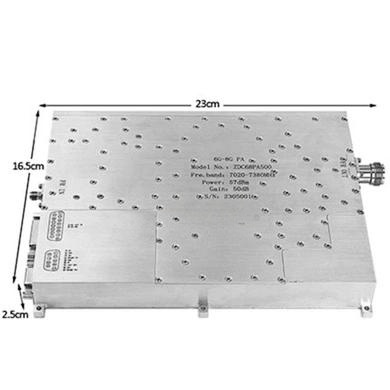
China Moneypro C Band 6-8GHz Pulse Adjustable RS422 Communication 500W Power Amplifier
Get ready for unmatched power and precision with our C Band 6-8GHz 500W pulse amplifier. It delivers a stunning ≥50dB gain and ≥57dBm output, making it a beast for demanding radar systems. You can easily tweak the pulse format via RS422, while built-in protection circuits keep everything running smoothly. Designed to thrive in tough conditions from -10°C to 50°C, it's your go-to for reliable, high-performance RF amplification.
China Moneypro 14-14.5GHz Ku band 400W Integrated Amplifier BUC
Tired of weak signals and unreliable satellite connections? Meet the game-changing 400W Ku-band GaN SSPA/BUC from MOP Tech, built to deliver rock-solid performance in even the toughest conditions. With 200W linear and 400W saturated power, it ensures clear, stable transmission for long-range and complex environments—plus, it sips just 1450W at full linear output for impressive energy savings. Compact and lightweight at only 58 pounds, it’s a breeze to install in fixed sites or mobile setups, and it operates flawlessly from -40°C to +60°C, meeting MIL-STD-810 standards. Flexible frequency bands and OpenBMIP Ethernet make remote management a snap. Step up your satellite system today
China Moneypro 40W X-Band GaN Satcom Block Upconverter for VSAT and Ground Stations
Need to bridge the gap between your ground station and satellite? Our 40W X-Band GaN Block Upconverter turns IF signals into powerful X-band transmissions for reliable uplinks. It’s built tough, operating flawlessly from -40°C to +60°C, and sips just 120W at 20W linear power to keep things cool. Plus, remote monitoring via Ethernet or RS-232 ensures you stay in control no matter where it’s deployed. Ready to upgrade your VSAT or ground station setup?
China Moneypro 8-12GHz Power Amplifier 100W RF Module Radar and Satcom
Finally, a power amplifier designed to keep pace with your most demanding RF systems. This 100W X-band module delivers rock-solid performance from 8 to 12 GHz, so you can count on clean, powerful signals for everything from radar to satellite links. Its rugged design handles extreme temperatures and fast switching with ease, making it a reliable choice for critical missions. Experience the power and precision your next-generation system deserves.
China Moneypro Low VSWR Ka band 32W GaN SATCOM Block Upconverter
Experience unmatched performance with MOP Tech's 32W Ka-band GaN SATCOM Block Upconverter—the most compact and rugged module on the market. It delivers 16W linear power and 45 dBm saturated power, ensuring crystal-clear signals even in extreme conditions from -40°C to +60°C. With low VSWR, stellar phase noise, and flexible Ethernet/RS-232 interfaces, integrating into your system is effortless. Best of all, it weighs just 5.6 pounds, making it ideal for ground stations, vehicles, or airborne platforms. Trust this powerhouse for reliable, high-quality satellite communications.
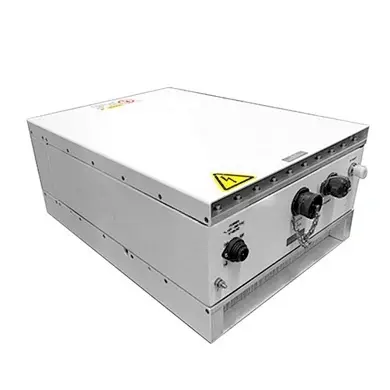
China Moneypro Ultra-High Power 400W X-Band GaN BUC Saturated Output 150W Linear
Meet the 400W X-Band GaN BUC—a powerhouse that delivers a stunning 400W saturated output while maintaining 200W of clean linear power. Built with advanced gallium nitride technology, this upconverter turns your IF signals into rock-solid X-band transmissions for satellite comms. It thrives in extreme conditions, from -40°C to +60°C, and offers smart remote monitoring via Ethernet or SNMP. Whether for military, government, or commercial use, this device ensures reliable, high-performance uplinks every time.
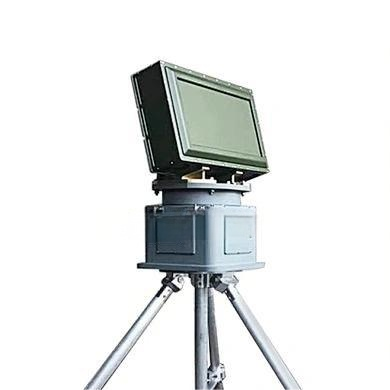
China Moneypro High Protection Level 2D Phased Array Radar for Drone Defense System
Imagine detecting and tracking over 60 tiny drones at once, even in tough weather—that's exactly what this 2D phased array radar does. It combines quick electronic scanning with a 360° mechanical rotation, so no blind spots exist. With pinpoint accuracy of under a degree, it gives you trusted intel to act fast. Plus, you can link it seamlessly with jammers or lasers for full drone defense. It’s durable, flexible, and ready for any high-stakes airspace.
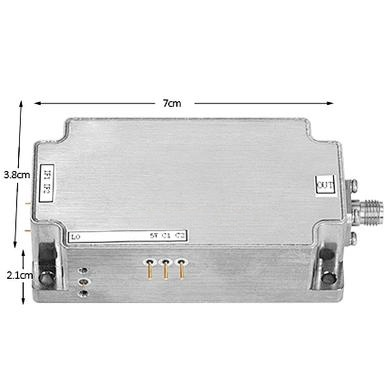
China Moneypro High-performance X/Ku Dual Band RF Upconverter Filter for Phased Array Radar Application
Simplify your phased array radar design with the MOPFC-7.7-9.5G-4342, a high-performance dual band upconverter filter that packs two independent X/Ku band channels into one compact module. It delivers crisp signal clarity, effectively blocking adjacent-channel interference with ≥65dBc out-of-band suppression and ≤2dB passband flatness. Enjoy flexible spectrum planning with configurable LO frequencies, plus lightning-fast channel switching in under 10μs. Housed in rugged nickel-plated aluminum and MIL-STD-810G compliant, this drop-in solution reduces system size by 30% while maintaining top performance in demanding environments.
| |
