Understanding the Essential Electrical Specifications for Optimal Performance
When selecting a reliable RF component, grasping the core electrical specifications is paramount. The device is engineered to handle a wide frequency range across three dedicated ports, ensuring seamless integration into modern communication systems. Port 1 operates efficiently within the 698-960 MHz range, covering critical cellular and LTE bands. Port 2 extends from 1710 to 2700 MHz, making it suitable for advanced 4G and early 5G networks. Port 3 spans the high-frequency 3300-3800 MHz range, targeting mid-band 5G deployments. These electrical specifications guarantee minimal signal loss and robust isolation, exceeding 50 dB, which prevents interference between channels. The insertion loss and return loss values are meticulously calibrated to maintain signal integrity, while the VSWR is optimized for low reflection. With a standard 50-ohm impedance and high input power handling, the component supports demanding environments. The passive intermodulation (PIM) performance, particularly IM3, is rigorously controlled to avoid distortion, and the DC/AISG bypass feature allows up to 3000 mA of current pass-through for antenna control systems.
Electrical Specifications at a Glance
| Parameter | Port 1 | Port 2 | Port 3 |
|---|---|---|---|
| Frequency Range (MHz) | 698-960 | 1710-2700 | 3300-3800 |
| Insertion Loss | Optimized for minimal loss | ||
| Return Loss / VSWR | Engineered for low reflection | ||
| Isolation | >50 dB | ||
| Impedance | 50 Ω | ||
| Input Power | High power handling capacity | ||
| PIM (IM3) | Low intermodulation distortion | ||
| DC/AISG By-pass | Max 3000 mA | ||
Environmental Specifications Built for Durability
The device is designed to withstand harsh environmental conditions, making it ideal for both indoor and outdoor installations. It features advanced lightning protection rated at 10 KA with a 10/350 microsecond pulse, safeguarding against sudden surges. The operating temperature ranges from -20 °C to +65 °C, while storage tolerance extends from -40 °C to +85 °C, ensuring reliability in extreme climates. With an environment humidity range of 5% to 95%, the component resists moisture and corrosion. Its IP67 rating guarantees protection against dust and temporary water immersion, so you can deploy it in exposed locations without worry. These specifications collectively ensure long-term performance and minimal maintenance, even in challenging outdoor settings.
Key Environmental Parameters
| Parameter | Value |
|---|---|
| Lightning Protection | 10 KA; 10/350 µs pulse |
| Operating Temperature | -20 °C to +65 °C |
| Storage Temperature | -40 °C to +85 °C |
| Environment Humidity | 5% to 95% |
| Application | Indoor or outdoor, IP67 |
Mechanical Specifications for Easy Integration
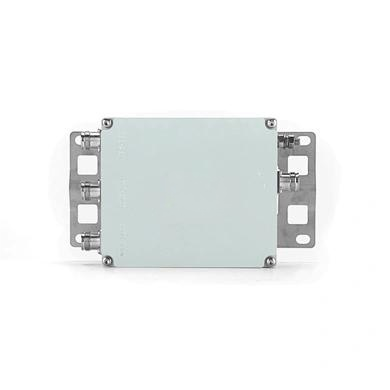
The mechanical design focuses on simplicity and robustness. It comes equipped with 4 pieces of 4.3-10 female connectors, a popular choice for high-power and low-PIM applications. The compact dimensions, measuring 170 x 145 x 50 mm (excluding connectors), allow for flexible mounting in tight spaces. The unit is finished in a neutral grey color, blending well with standard equipment racks and outdoor enclosures. These mechanical specifications ensure straightforward installation and reliable connectivity, whether you are upgrading an existing network or building a new one.
Mechanical Details Table
| Parameter | Value |
|---|---|
| Connectors | 4 pcs 4.3-10 Female |
| Dimensions (Without Connectors) | 170 x 145 x 50 mm |
| Color | Grey |
Why These Electrical Specifications Matter for Your Network
Understanding the electrical specifications outlined above is crucial for network engineers and installers. The wide frequency coverage across three ports enables multi-band operation, reducing the need for multiple components. High isolation and low PIM ensure clean signal transmission, which is vital for high-data-rate applications like 5G. The DC/AISG bypass simplifies remote antenna tilt and monitoring, while the robust environmental and mechanical specs guarantee longevity. By focusing on these electrical specifications, you can select a component that delivers consistent performance, minimizes signal degradation, and supports future network expansions. Whether you are deploying in a data center or on a tower, these engineered parameters provide the reliability and efficiency modern communications demand. In conclusion, the electrical specifications, environmental resilience, and mechanical design work together to offer a complete solution for demanding RF environments, ensuring your infrastructure remains robust and future-ready.