Understanding the Core Electrical Specifications for Optimal RF Performance
n
When selecting an antenna for critical communication systems like base stations, indoor coverage, or multi-standard networks (GSM/CDMA/PCS/3G/WLAN), the electrical specifications form the foundation of performance. This antenna delivers outstanding versatility by operating across two essential frequency bands: a lower band spanning 698-960 MHz and an upper band covering 1710-2690 MHz. This broad range ensures compatibility with virtually all modern cellular and wireless standards, from legacy 2G networks to the latest LTE and 5G deployments.
n
The voltage standing wave ratio (VSWR) is a critical measure of how efficiently RF power is transmitted from the source to the antenna. Here, the VSWR is ≤1.5, indicating excellent impedance matching and minimal signal reflection. This low VSWR translates to higher efficiency, reduced heat generation in the transmitter, and stronger overall signal integrity. Gain is specified at 10 dBi, offering a significant boost to signal strength that extends coverage range and improves penetration through obstacles like walls and foliage. The vertical beamwidth is 55° in the lower band and 45° in the upper band, creating a focused, directional coverage pattern that maximizes energy where it is needed most.
n
Polarization is vertical, which is the industry standard for most mobile and base station applications, ensuring seamless integration with existing infrastructure. The impedance is a standard 50 Ω, matching the characteristic impedance of most coaxial cables and RF components. Maximum input power is rated at 100 watts, making it suitable for both low-power indoor systems and higher-power outdoor deployments. For reliability in exposed environments, the antenna includes DC grounding for lightning protection, safeguarding against voltage surges caused by electrical storms.
n
| Parameter | Specification |
|---|---|
| Frequency Range (MHz) | 698-960 / 1710-2690 |
| VSWR | ≤1.5 |
| Gain (dBi) | 10 |
| Vertical Beamwidth (°) | 55 / 45 |
| Polarization | Vertical |
| Impedance (Ω) | 50 |
| Max Power (W) | 100 |
| Lightning Protection | DC Grounded |
nn
Mechanical and Environmental Specifications for Reliable Deployment
n
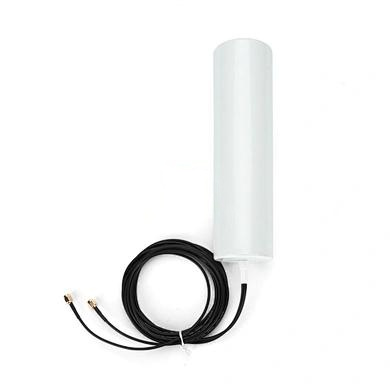
Beyond electrical performance, the physical construction and environmental resilience of this antenna ensure dependable operation in diverse conditions. The connector is a durable SMA-male type, with the option for customization to meet specific installation requirements. This flexibility allows integration with a wide range of cables and connectors without the need for adapters, reducing signal loss and potential points of failure.
n
Weighing just 470 grams, this antenna is lightweight yet robust, minimizing structural load on mounting poles and brackets. Its compact dimensions of 62 mm diameter and 230 mm length make it unobtrusive and easy to install in tight spaces such as ceilings, small enclosures, or outdoor pole mounts. The recommended installation pole diameter is 40-50 mm, ensuring a secure and stable fit for both indoor and outdoor environments.
n
Temperature tolerance spans from -40°C to +60°C, covering extreme climates from freezing winters to scorching summers. This wide operating range guarantees consistent performance and longevity whether the antenna is deployed on a rooftop in a cold climate or inside a hot factory floor. The mechanical design also prioritizes durability, with materials selected to resist corrosion, UV exposure, and mechanical stress.
n
| Parameter | Specification |
|---|---|
| Connector Type | SMA-male (Customizable) |
| Net Weight (g) | 470 |
| Dimensions (mm) | 62 × 230 |
| Installation Pole Dia. (mm) | 40-50 |
| Operating Temperature (°C) | -40 to +60 |
nn
Versatile Applications and Reliable Coverage
n
This antenna is engineered for a broad spectrum of applications, making it a versatile choice for network operators, system integrators, and installers. It is ideally suited for base station installations, where reliable coverage and high gain are paramount for connecting end users over long distances. In indoor coverage systems, its compact size and omnidirectional-like pattern (due to vertical polarization and beamwidth) help eliminate dead zones in offices, shopping malls, hospitals, and stadiums.
n
Compatibility with GSM, CDMA, PCS (Personal Communications Service), 3G (UMTS/HSPA), and WLAN (Wi-Fi) networks means this single antenna can replace multiple antennas in multi-technology environments. This reduces installation complexity, lowers costs, and simplifies inventory management. For example, in a modern 5G-ready small cell, it can handle both legacy 4G LTE traffic and newer 5G NR signals within its frequency range.
n
The antenna also excels in distributed antenna systems (DAS) and repeater systems, where consistent performance across all supported bands is critical. With its robust lightning protection and wide temperature range, it is equally at home on a building rooftop as it is inside an underground parking garage. The low VSWR ensures that even in systems with multiple antennas (MIMO configurations), interference and signal loss are minimized, maintaining high data throughput and call quality.
nn
Installation and Operational Flexibility
n
Installing this antenna is straightforward thanks to its lightweight design and standard mounting requirements. The SMA-male connector can be directly attached to compatible cables like LMR-195 or RG-58 types, although custom connectors are available to match specific cable interfaces. The recommended pole diameter of 40-50 mm is common for standard antenna mounts, brackets, and mast arms, so you won’t need specialized hardware.
n
For indoor installations, the antenna can be mounted on ceilings or walls using simple L-brackets, with the compact shape allowing it to blend into the environment. Outdoor installations benefit from the weather-resistant construction, though for marine or extreme environments additional sealing may be recommended. The DC-grounded lightning protection provides a safety path that can be bonded to your building’s grounding system, meeting most electrical code requirements.
n
When optimizing specifications for your specific network, the antenna’s ability to operate across such a wide frequency range without tuning adjustments is a major advantage. You can deploy it in multiple locations knowing each unit will perform to the same high standard. This consistency simplifies network planning and ensures uniform coverage quality.
nn
Conclusion: A Reliable Solution for Modern Connectivity
n
In summary, this antenna delivers exceptional value through its comprehensive range of electrical and mechanical specifications. With dual-band coverage spanning 698-960 MHz and 1710-2690 MHz, 10 dBi gain, low VSWR, and robust construction, it is optimized for base stations, indoor coverage systems, and multi-standard networks. The compact size and lightweight design simplify installation, while the wide temperature range and lightning protection ensure long-term reliability in any environment. Whether you are upgrading an existing network or building new coverage zones, this antenna provides the performance, flexibility, and durability required to keep users connected. Its versatile design and clear specifications make it an excellent choice for any professional seeking a high-quality, all-purpose antenna solution.