Introducing the 50W Power Amplifier: Unlocking Reliable Signal Boosting
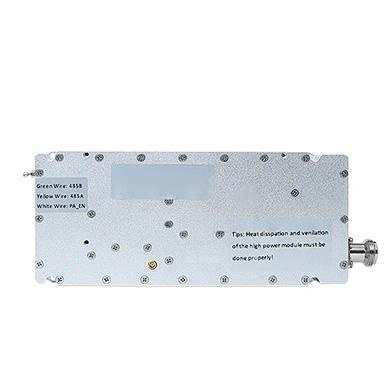
nnIn the world of wireless communications, ensuring a strong and stable signal is paramount. The 50W Power Amplifier Model MOP-PA-5/6G-50W stands as a robust solution for applications demanding high output within the 5.7 to 5.85 GHz frequency band. Whether you are extending network range or compensating for cable losses, this amplifier delivers consistent, high-gain performance. Understanding its capabilities is essential for engineers and integrators seeking to optimize their systems. This article explores how the 50W power amplifier serves as a critical component in modern RF setups, focusing on its technical specifications, operational reliability, and practical deployment.nn
Core Specifications of the 50W Power Amplifier
nnThe heart of any amplifier lies in its technical parameters. The MOP-PA-5/6G-50W is engineered for precision and efficiency within the 5725-5850 MHz range, commonly used for ISM and Wi-Fi applications. Below is a comprehensive breakdown of its key specifications.nn
Key Performance Parameters
nn
| Parameter | Value |
|---|---|
| Working Frequency | 5725 – 5850 MHz |
| Saturated Power Output | 47 ± 1 dBm |
| Gain | 47 ± 2 dB |
| In-Band Flatness | ≤ 1 dB |
| Working Current | ≤ 6 A |
| Input/Output VSWR | ≤ 1.5 |
| Maximum Lossless Input | +10 dBm |
nn
Spurious Emissions and Operating Conditions
nnThe amplifier is designed to minimize out-of-band spurs, ensuring compliance with regulatory standards. The following table details the spurious emission limits and environmental operating ranges.nn
| Parameter | Specification |
|---|---|
| Out-of-Band Spurs (9 kHz – 1 GHz) | ≤ -36 dBm / 30 kHz |
| Out-of-Band Spurs (1 GHz – 12.75 GHz) | ≤ -30 dBm / 30 kHz |
| Operating Voltage | DC +32 V |
| Power Supply Interface | 2W2 |
| RF Port | SMA-KFD |
| Monitoring Interface | DB9: Pin 1 (TEMP), Pin 3 (VSWR) |
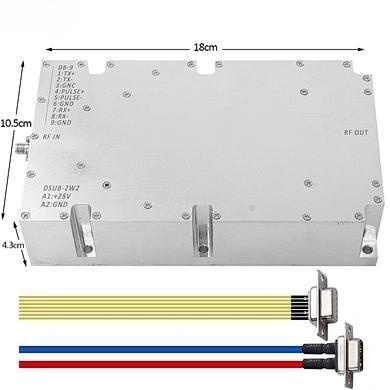
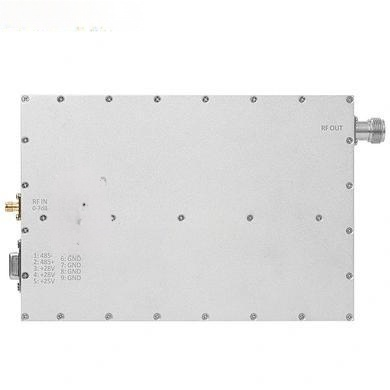
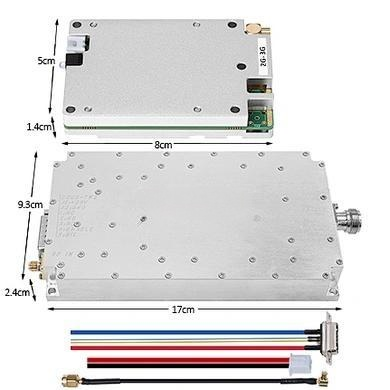
| Amplifier Dimensions | 186 x 94 x 26 mm |
| Operating Temperature | -10°C to +55°C |
| Relative Humidity | 5% to 95% (Non-condensing) |
| Storage Temperature | -25°C to +65°C |
nn
Why the 50W Power Amplifier Excels in Real-World Deployments
nn
Robust Signal Integrity and Low Distortion
nnWith a saturated power output of 47 dBm (approximately 50 watts) and a gain of 47 dB, this 50W power amplifier provides substantial signal uplift without sacrificing linearity. The in-band flatness of ≤1 dB ensures that the amplified signal maintains its original modulation characteristics, crucial for data-heavy protocols like Wi-Fi 5 and 6. This performance directly contributes to better throughput and reduced error rates in point-to-point and point-to-multipoint links.nn
Built for Harsh Environments
nnDeploying RF equipment often means exposure to challenging conditions. The amplifier’s operating temperature range of -10°C to +55°C, combined with tolerance for humidity levels up to 95%, guarantees reliability in outdoor or industrial settings. The compact dimensions of 186 x 94 x 26 mm make it easy to integrate into existing enclosures or cabinet setups, while the SMA-KFD RF port ensures a secure, low-loss connection.nn
Integrated Monitoring for System Intelligence
nnThe DB9 monitoring interface (with pins dedicated to temperature and VSWR) allows for real-time system health checks. This feature enables engineers to remotely monitor the 50W power amplifier’s condition, preventing damage from excessive heat or antenna mismatch. Such intelligent feedback loops are invaluable for maintaining long-term operational stability.nn
Conclusion: The Essential Role of the 50W Power Amplifier
nnThe 50W Power Amplifier Model MOP-PA-5/6G-50W emerges as a dependable workhorse for the 5.8 GHz band. Its combination of high gain, low spurious emissions, and rugged design makes it suitable for telecommunications, broadcasting, and industrial wireless networks. By integrating this amplifier, you ensure not only strong signal coverage but also system longevity. When selecting your next RF component, the 50W power amplifier offers the perfect balance between power, precision, and protection, meeting the rigorous demands of modern wireless infrastructure.