Understanding the Precision and Performance of RF Attenuators
nn
In the world of radio frequency (RF) engineering, ensuring signal integrity is paramount. One of the most crucial components for managing signal levels is the RF attenuator. This device is not just a simple resistor; it is a precision instrument designed to reduce the power of a signal without significantly distorting its waveform. Whether you are testing a new antenna system, balancing signal levels in a cellular network, or protecting sensitive measurement equipment, the attenuator you choose directly impacts your system’s performance. This article dives deep into the specifications of a high-quality unit, covering its frequency range, power handling, and environmental resilience.
nn
Critical RF Performance Specifications
nn
At the heart of any attenuator’s capability is its ability to maintain consistent performance across a wide frequency spectrum. The device under discussion operates from DC up to 3000 MHz (3 GHz), making it suitable for everything from baseband applications to advanced 4G LTE and Wi-Fi systems. Its attenuation value, which can be selected from 3 dB to 40 dB, provides the flexibility needed for fine-tuning signal levels. The high return loss and low VSWR values indicate excellent impedance matching, which minimizes signal reflections and ensures maximum power transfer.
nn
Attenuation Accuracy and Linearity
nn
Precision is key in RF design. This attenuator boasts a tolerance of ±0.75 to 1.2 dB, ensuring that the attenuation value you select is the value you get. Such accuracy is critical for creating repeatable test setups and reliable system calibrations. Furthermore, the device’s intermodulation distortion products are exceptionally low, measuring ≤ –120 dBc (with 2 x 43 dBm tones). This linearity ensures that even under high-power conditions, the attenuator does not introduce unwanted harmonics or spurious signals, preserving the purity of the transmission path.
nn
Mechanical and Environmental Durability
nn
An RF attenuator is often deployed in challenging environments, from outdoor cellular base stations to industrial test labs. Therefore, its mechanical and environmental specifications are just as important as its electrical performance. This model is built to withstand extreme conditions while providing reliable connectivity. Below is the complete technical data for this high-performance RF attenuator.
nn
| Parameter | Specification |
|---|---|
| Frequency Range | DC – 3000 MHz |
| Attenuation Value | 3 – 40 dB |
| Attenuation Tolerance | ±0.75 – 1.2 dB |
| Return Loss | ≥ 19 dB |
| VSWR | ≤ 1.25 |
| Intermodulation Products | ≤ –120 dBc (with 2 x 43 dBm) |
| Maximum Input Power | 10 W |
| Operating Temperature | –20°C to +75°C |
| Relative Humidity | 5% – 95% |
| Impedance | 50 Ω |
| Dimensions | 64.65 x 35 x 35 mm |
| Weight | 180 g |
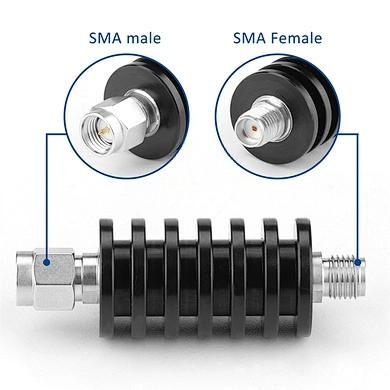
| Connector Type | SMA Male / SMA Female |
| Ingress Protection | IP65 |
nn
Built for Real-World Applications
nn
The combination of rugged construction and precise electrical characteristics makes this RF attenuator an ideal choice for a variety of applications. Its IP65 rating means it is fully protected against dust ingress and low-pressure water jets from any direction, making it suitable for outdoor deployment. The SMA connector interface ensures compatibility with standard test cables and equipment, while the compact design allows for easy integration into tight spaces.
nn
Whether you are managing signal levels in a distributed antenna system (DAS), performing amplifier testing, or troubleshooting interference, the reliability of your attenuator is non-negotiable. The table above demonstrates that this component does not compromise on any front—it offers high power handling, exceptional linearity, and broad frequency coverage. By choosing a device with verified specifications, you ensure the accuracy of your measurements and the longevity of your system.
nn
In conclusion, a high-quality RF attenuator is more than a simple power reducer; it is a gateway to signal clarity and system stability. From its DC-3 GHz bandwidth and precise 3-40 dB attenuation range to its robust IP65 housing, this unit exemplifies the standards required for professional RF work. Always refer to the full specifications to match the attenuator to your specific needs, and invest in quality components to protect your network’s performance.