Understanding Antenna Performance: Key Parameters in Focus
nn
When evaluating antenna specifications, the interplay of various parameters determines overall performance. The focus keyword here is the balance between coverage and signal quality. This article explores the critical specifications that define antenna behavior across different operational conditions. By breaking down each parameter, you will gain a clearer understanding of how to select the right antenna for your specific application.
nn
Modern wireless communication systems demand antennas that can handle wide frequency ranges while maintaining low signal loss and high isolation. The specifications provided reflect a versatile design suitable for both indoor and outdoor installations. Let’s delve into the details.
nn
Interface and Frequency Range
n
The antenna supports a frequency range of 617 to 6000 MHz, covering sub-6 GHz bands. This wide bandwidth enables deployment in 4G LTE, 5G NR, and Wi-Fi systems. The interface offers both vertical and horizontal polarization options, allowing flexibility in mounting orientation.
nn
Gain and Beamwidth Balance
n
With a gain of 2 to 6 dBi, the antenna provides moderate amplification suitable for short to medium range coverage. The half-power beamwidth differs by orientation: horizontal beamwidth is 360 degrees, while vertical beamwidth varies between 90 and 60 degrees depending on configuration. This creates an omni-directional pattern in the horizontal plane with controlled vertical spread.
nn
Electrical Specifications Focus
nn
Electrical parameters directly impact signal integrity and system reliability. The focus keyword applies to voltage standing wave ratio (VSWR), which influences how much power is reflected from the antenna. Lower VSWR values indicate better impedance matching.
nn
VSWR and Impedance
n
The antenna achieves a VSWR of ≤1.8 for vertical polarization and ≤1.5 for horizontal polarization. This low reflection ensures efficient power transfer. Input impedance is standard 50 ohms, compatible with most RF systems. Maximum input power is 50 watts, sufficient for base stations and access points.
nn
Intermodulation and Isolation
n
Third-order intercept point (TOI) is ≤-153 dBm, indicating good linearity and minimal intermodulation distortion. Isolation between ports exceeds 25 dB, reducing interference in multi-port configurations. Cross-polar ratio is ≥15 dB at 0 degrees and ≥10 dB at ±60 degrees, ensuring polarization purity across the beam.
nn
Mechanical and Environmental Specifications Focus
nn
The focus keyword extends to physical durability. The antenna is designed for outdoor use with robust materials and compact dimensions.
nn
Dimensions and Weight
n
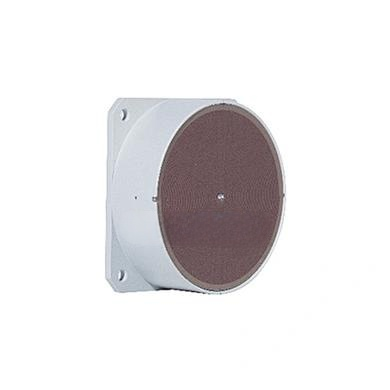
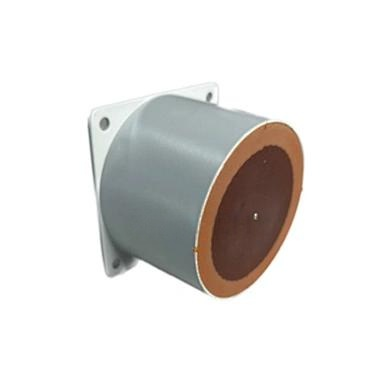
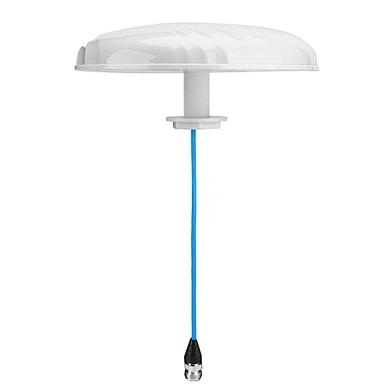
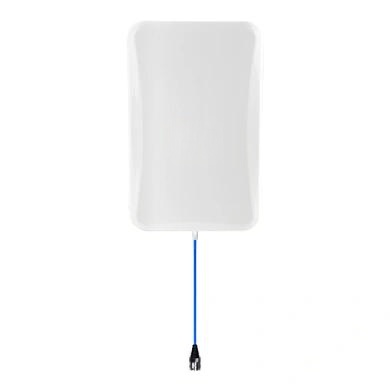
The antenna measures 220 mm in diameter and 18 mm in thickness. Weight is only 0.3 kg, simplifying installation on poles or walls. Operating temperature range is -55 to 60 degrees Celsius, suitable for extreme climates.
nn
Material and Mounting
n
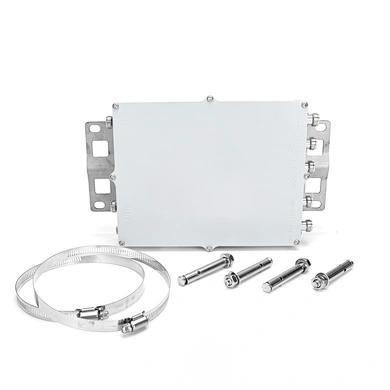
The radome is made of ABS plastic in white color, providing UV resistance and weather protection. Lightning protection is DC ground, offering basic surge immunity. Input connector type is N-Female for reliable RF connections. Mounting is accomplished by fastened screw nuts, compatible with standard poles.
nn
| Parameter | Specification |
|---|---|
| Interface | Vertical / Horizontal |
| Frequency Range (MHz) | 617 – 6000 |
| Gain (dBi) | 2 – 6 |
| Half-power Beamwidth (°) | H: 360 / V: 90 or 60 |
| VSWR (Vertical) | ≤1.8 |
| VSWR (Horizontal) | ≤1.5 |
| Third-order Intercept Point (dBm) | ≤-153 |
| Isolation between Ports (dB) | ≥25 |
| Cross-polar Ratio (dB) | ≥15 at 0° / ≥10 at ±60° |
| Input Impedance (Ω) | 50 |
| Polarization | Linear |
| Maximum Input Power (W) | 50 |
| Lightning Protection | DC Ground |
| Input Connector Type | N-Female |
| Dimensions (mm) | Φ220 × 18 |
| Antenna Weight (kg) | 0.3 |
| Operating Temperature (°C) | -55 to 60 |
| Radome Material | ABS |
| Radome Color | White |
| Mounting Method | Fastened with screw nuts |
nn
Conclusion
n
This antenna strikes an effective balance between coverage, gain, and electrical performance. The focus keyword throughout this article emphasizes the importance of matching electrical and mechanical specifications to real-world installation needs. Whether for 5G small cells, LTE repeaters, or indoor coverage, the parameters provided offer a solid foundation for reliable wireless connectivity. Always cross-reference these specifications with your system requirements to ensure optimal performance in your environment.