Understanding Radio Frequency Cable Specifications
nn
When selecting a high-performance coaxial cable for demanding RF applications, understanding the technical specifications is crucial. This article breaks down the key parameters of a premium corrugated copper cable designed for superior signal transmission. Whether you are designing a telecommunications network or upgrading a broadcast system, these specifications will guide your choice. Let’s explore the detailed characteristics that define this industry-standard radio frequency cable.
nn
Mechanical and Physical Structure
nn
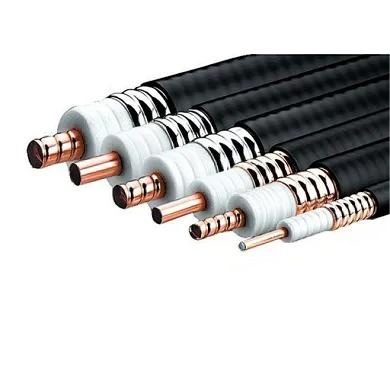
The physical construction of this RF cable is engineered for durability and signal integrity. The use of high-grade materials ensures minimal signal loss and long service life. Below are the structural parameters that form the backbone of this transmission line.
nn
| Component | Material | Diameter (mm) |
|---|---|---|
| 1. Inner Conductor | Smooth Copper Tube | 9.4 |
| 2. Dielectric | Physical Foam Polyethylene | 22.8 |
| 3. Outer Conductor | Corrugated Copper Tube | 24.8 |
| 4. Jacket | Black PE | 27.5 |
nn
Key Electrical Properties for RF Performance
nn
Electrical characteristics determine how efficiently your radio frequency cable transmits power and signals. These parameters directly impact system performance, from impedance matching to power handling. The following table outlines the critical electrical specifications you need to consider.
nn
| Parameter | Value |
|---|---|
| Capacitance (pF/M) | 76 |
| Impedance (Ohm) | 50 |
| Velocity of Propagation (%) | 88 |
| Peak Power Rating (KW) | 60 |
| RF Peak Voltage (KV) | 3.1 |
| Insulation Resistance (MΩ.km) | >5000 |
| Cut-off Frequency (GHz) | 4.9 |
| Insulation Voltage (KV) | 10 |
| Inner Conductor DC Resistance (Ω/km) | 1.00 |
| Outer Conductor DC Resistance (Ω/km) | 1.20 |
| Jacket Spark (KV) | 8.0 |
| Shielding Effectiveness (dB) | >120 |
nn
VSWR Specifications Across Frequency Bands
nn
Voltage Standing Wave Ratio (VSWR) is a critical measure of signal reflection. Low VSWR levels across the operating frequency range ensure efficient power transfer and minimal interference. The radio frequency cable achieves excellent VSWR values as detailed below.
nn
| Frequency Range (GHz) | VSWR ≤ | Return Loss ≥ (dB) |
|---|---|---|
| 0.005 – 3.0 | 1.15 | 23.1 |
| 0.8 – 1.0 | 1.10 | 26.4 |
| 1.7 – 2.0 | 1.13 | 24.6 |
| 2.0 – 2.4 | 1.15 | 23.1 |
nn
Mechanical and Environmental Durability
nn
Installing a radio frequency cable in challenging environments requires robust mechanical properties. These parameters define how the cable handles bending, pulling, and temperature extremes. Understanding these values helps ensure long-term reliability in the field.
nn
| Parameter | Value |
|---|---|
| Min. Single Bending Radius (mm) | 90 |
| Min. Repeated Bending Radius (mm) | 250 |
| No. of Bends | 15 |
| Mobile Apply (mm) | 500 |
| Bending Moment (N.m) | 16.3 |
| Tensile Strength (kg) | 147 |
| Storage Temp (°C) | -55 to +85 |
| Installation Temp (°C) | -40 to +60 |
| Operating Temp (°C) | -55 to +85 |
nn
Attenuation and Average Power Ratings
nn
Signal loss as a function of frequency is a defining characteristic of any radio frequency cable. These attenuation and power handling values (measured at VSWR 1.0, cable temp 20°C, ambient temp 40°C) are essential for predicting system performance. The data below shows how this cable performs across the spectrum.
nn
| Frequency (MHz) | Attenuation (dB/100m) | Average Power (KW) |
|---|---|---|
| 100 | 1.28 | 6.62 |
| 200 | 1.84 | 4.60 |
| 450 | 2.84 | 2.99 |
| 800 | 3.90 | 2.19 |
| 900 | 4.16 | 2.06 |
| 1000 | 4.03 | 2.50 |
| 1500 | 5.56 | 1.54 |
| 1800 | 6.18 | 1.39 |
| 2000 | 6.57 | 1.31 |
| 2200 | 6.94 | 1.24 |
| 2400 | 7.31 | 1.19 |
| 2500 | 7.49 | 1.16 |
| 3000 | 8.34 | 1.04 |
nn
Conclusion: Selecting the Right Radio Frequency Cable
nn
Choosing a radio frequency cable with the right specifications is vital for optimizing your RF system. The detailed parameters provided—from mechanical construction to electrical performance—offer a comprehensive view of this cable’s capabilities. With low attenuation across a wide frequency range, excellent VSWR characteristics, and robust mechanical design, this radio frequency cable meets the demands of modern telecommunications and broadcasting applications. Always reference these specifications to ensure compatibility with your system requirements, and remember that proper installation practices will maximize the cable’s performance and longevity.